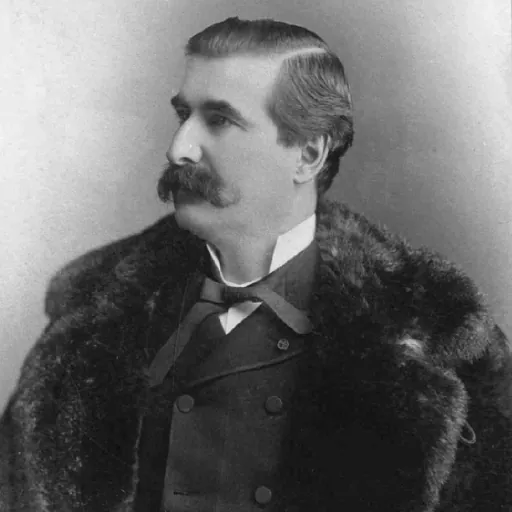
About Honoré Mercier
Lived 1840 – 1894 (aged 54). Honoré Mercier was a Canadian politician, lawyer, journalist and newspaper editor.
Honoré Mercier (October 15, 1840 – October 30, 1894) was a Canadian lawyer, journalist and politician in Quebec. He was the ninth premier of Quebec from January 27, 1887, to December 21, 1891, as leader of the Parti National or Quebec Liberal Party (PLQ). He rose to power by mobilizing the Francophone opposition to the execution of Louis Riel, denouncing it as a betrayal by John A. Macdonald's Conservative government.
Early background
Mercier was born in Saint-Athanase, Lower Canada to farmer Jean-Baptiste Mercier and Marie Kimener. Mercier is descended from Julien Mercier (1621-1676) who arrived from Tourouvre, France in 1647. Mercier studied at the Jesuit College Sainte-Marie in Montreal, and was called to the Bar of Quebec in April 1865. As the age of 22, Mercier became the editor of Le Courrier de St-Hyacinthe newspaper. He opposed the Confederation project as early as 1864, believing that it would be detrimental to French Canadians.
Member of Parliament
In 1871, he was instrumental in creating the short-lived Parti National. Mercier successfully ran as a Liberal candidate in the 1872 election. He became Member of the House of Commons for the district of Rouville. He did not run for re-election in the 1874 election. In the 1878 election, Mercier was candidate in the district of St. Hyacinthe. He was defeated by the Louis Tellier, his Conservative opponent.
Provincial politics
In 1879, Mercier was appointed Solicitor General of Quebec in the Cabinet of Premier Henri-Gustave Joly de Lotbinière and served in that position for less than a year. He won a by-election and became Member of the Legislative Assembly for the district of Saint-Hyacinthe. He was re-elected in the 1881 and 1886 elections and won another by-election in 1887.
With his strong nationalist stance, Mercier was very much a precursor of later nationalist premiers in future decades who confronted the federal government and tried to win more power for Quebec. He promoted contacts with Francophones in other parts of North America outside of Quebec including Western Canada and New England. Those francophones had not yet been assimilated into the English-Canadian or American culture to the extent they would be in the future. Mercier promoted reform, economic development, Catholicism, and the French language. He won popularity but also made enemies. He was returned to the legislature as the Member for the district of Bonaventure and his party won the 1890 election with an increased majority. In 1891, he was created a count by the Pope.
Political downfall On December 16, 1891, he was dismissed by Lieutenant Governor Auguste-Réal Angers after a report concluded that his government had diverted public funds. He lost the 1892 election, and gave up the party leadership to Félix-Gabriel Marchand. He was brought to trial later that year and found not guilty when a second report concluded differently on the matter. However, his health had greatly deteriorated and his political career was over. He died in 1894 at the age of 54, and was interred in the Notre Dame des Neiges Cemetery in Montreal, Quebec.
Legacy The following landmarks were named to honour Honoré Mercier:
The Mercier Bridge that links the western part of the Island of Montreal with the South Shore; The town of Mercier, Quebec; Avenue Mercier, located in downtown Shawinigan, Quebec, Canada; The provincial electoral district of Mercier; An elementary school named Honoré-Mercier in Montreal; A high school named Honoré-Mercier in Montreal; A hospital in Saint-Hyacinthe, Québec named Hôpital Honoré-Mercier; Avenue Honoré-Mercier, located in the Quebec City centre; The borough of Mercier–Hochelaga-Maisonneuve and its contained district of Mercier in Montreal.
Family His son Honoré Mercier fils was a multi-term member of the Legislative Assembly of Quebec and a Cabinet Minister; his grandson Honoré Mercier III served one term in the Legislative Assembly.
Mercier was Lomer Gouin's father-in-law and is a great-great-grandfather of NDP retired leader Thomas Mulcair.
Electoral record
Don’t just read it —
keep it.
Full-length biographies made to live with: read them, listen on the way to work, watch them tonight.
- E-book
- Audio
- Video
Instant download · yours to keep · every purchase keeps this site free
Important facts
People in Honoré Mercier's life
Named in this biography and alive at the same time




Related people
Same field, nearest in time





Contemporaries
People whose lives overlapped Honoré Mercier's

Frequently asked questions
Who was Honoré Mercier?
Canadian politician (1840-1894)
When was Honoré Mercier born?
Honoré Mercier was born on 15 October 1840 in Saint-Jean-sur-Richelieu.
When did Honoré Mercier die?
Honoré Mercier died on 30 October 1894 in Montreal.
What was Honoré Mercier's occupation?
Honoré Mercier was a politician, lawyer, journalist and newspaper editor.
What nationality was Honoré Mercier?
Honoré Mercier was Canadian.
Sources & further reading
Cite this page
APA: Biography.guide. (2026). Honoré Mercier. https://biography.guide/honore-mercier/
MLA: "Honoré Mercier." Biography.guide, https://biography.guide/honore-mercier/.
Chicago: "Honoré Mercier." Biography.guide. https://biography.guide/honore-mercier/.
Data last updated: 2026-09-20 · Spot an error? Report a correction.
Page generated 2026-09-27 05:10 UTC