
About Hong Chengchou
Lived 1593 – 1665 (aged 71–72). Hong Chengchou was a Chinese politician.
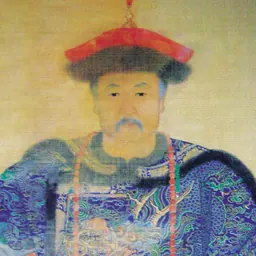
Hong Chengchou (; 1593–1665), courtesy name Yanyan and art name Hengjiu, was a Chinese official who served under the Ming and Qing dynasties. He was born in present-day Liangshan Village, Yingdu Town, Fujian Province, China. After obtaining the position of a jinshi (進士; successful candidate) in the imperial examination in 1616 during the reign of the Wanli Emperor, he joined the civil service of the Ming Empire and served as an official in Shaanxi. During the reign of the Chongzhen Emperor (r. 1627–1644), he was promoted to Supreme Commander of Shaanxi, Shanxi, Henan, Huguang, and Sichuan; Minister of War, and later on, Governor-General of Jiliao (薊遼; an area which included parts of present-day Shandong, Hebei and Tianjin).
In 1642, Hong surrendered and defected to the Manchu-led Qing Empire after his defeat at the Battle of Song-Jin. He became one of the Qing Empire's leading Han Chinese scholar-politicians, and one of the architects of the Manchu conquest of China. While he was in office, he encouraged the Manchu rulers to adopt Han Chinese culture and provided advice to the Qing government on how to consolidate its control over the former territories of the fallen Ming Empire, as well as having an active role in the conquest of South China. Apart from Dorgon and Fan Wencheng , Hong was regarded as one of the most influential politicians in the early Qing dynasty, but his legacy became controversial for his defection to the Qing Empire and for his suppression of the Southern Ming dynasty (a short-lived state formed by remnants of the fallen Ming Empire).
Early life and service under the Ming Dynasty Early service under the Ming Dynasty against the peasant rebellions
When he was young and preparing for his future career as an official, he was strictly tutored by a man called Zhang Xianmo, who likely introduced him to the study of military classics, something that would become important later in his career. When he received the jinshi degree in 1616, he was made an official of the Ministry of Justice in the capital, where he remained for six years. In summer of 1638 Hong renewed the pressure on Li, and hotly pursued him. Guessing that he was trying to flee through Tong Pass, Hong contacted Sun Chuanting, who established a three-pronged ambush. Li's army was trapped and destroyed, and he escaped with just 17 followers, remaining mostly inactive and hiding in the mountains of Shaanxi for the rest of 1638.
After conducting a vigorous defense of Songshan for six months, with various failed attempts at relief from Shanhaiguan and at breaking out from the siege, he was captured the 18 of March of 1642 as a turncoat called Xia Chengde, the garrison commander of Songshan, opened the gates to the Manchus. Finally, in 1652 they made their move. Li Dingguo attacked the prince Kong Youde in Guangxi and, after defeating his army in a series of engagements, took Guilin. Kong Youde, trapped inside the city, committed suicide. The Southern Ming forces then recaptured much of Guangxi and started making inroads into Huguang. The Manchu court sent the prince Nikan in August 1652 with 100.000 men to counterattack, but Li Dingguo destroyed this army in an elaborate ambush in January of 1653 and Nikan was killed in the fighting.
When Hong reached the capital of Beijing, his patron Shunzi had died shortly before on February 5, 1661. Hong was granted definitive retirement in early 1662 and died on April 3, 1665. In spite of former promises of the court and for unclear reasons, he was not granted a very high-ranking nobiliary title, and it was extraordinarily low given his position and merits. That he did not surrender voluntarily back in 1642, that the regents for Kangxi looked down on him as part of the victorious army at Song-Jin, and that their ideological stance and his previous popularity with Shunzhi had a role have been proposed as causes, but there is no conclusive evidence either way.
Don’t just read it —
keep it.
Full-length biographies made to live with: read them, listen on the way to work, watch them tonight.
- E-book
- Audio
- Video
Instant download · yours to keep · every purchase keeps this site free
Important facts
People in Hong Chengchou's life
Named in this biography and alive at the same time






Related people
Same field, nearest in time


Contemporaries
People whose lives overlapped Hong Chengchou's




Frequently asked questions
Who was Hong Chengchou?
Chinese general
When was Hong Chengchou born?
Hong Chengchou was born in 1593 in Nan'an.
When did Hong Chengchou die?
Hong Chengchou died in 1665 in Nan'an.
What was Hong Chengchou's occupation?
Hong Chengchou was a politician.
What nationality was Hong Chengchou?
Hong Chengchou was Chinese.
Sources & further reading
Cite this page
APA: Biography.guide. (2026). Hong Chengchou. https://biography.guide/hong-chengchou/
MLA: "Hong Chengchou." Biography.guide, https://biography.guide/hong-chengchou/.
Chicago: "Hong Chengchou." Biography.guide. https://biography.guide/hong-chengchou/.
Data last updated: 2026-09-22 · Spot an error? Report a correction.
Page generated 2026-09-27 05:23 UTC