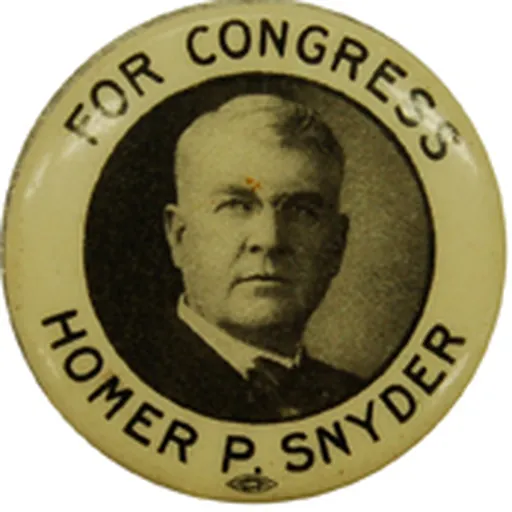
About Homer P. Snyder
Lived 1863 – 1937 (aged 74). Homer P. Snyder was an American politician.
Homer Peter Snyder (December 6, 1863 – December 30, 1937) (aka H.P. Snyder) was an American politician and businessman from New York. Snyder began his business career in the knitting industry, and moved to bicycle manufacturing. He left the company to began a political career, entering congress in 1915 and holding office until 1925. He became known for his advocacy on behalf of Native Americans, chairing the Committee on Indian Affairs and introducing the Indian Citizenship Act in 1924.
Biography
Born in Amsterdam, Montgomery County, New York, he attended the common schools and was employed in various capacities in knitting mills until 1887. He moved to Little Falls in 1887 and continued employment in knitting mills; he engaged in the manufacture of knitting machinery in 1890 and, later, of bicycles and other wheeled vehicles.
He was an unsuccessful candidate for election in 1912 to the Sixty-third Congress, and was elected as a Republican to the Sixty-fourth and to the four succeeding Congresses, holding office from March 4, 1915, to March 3, 1925. He was chairman of the Committee on Indian Affairs (Sixty-sixth through Sixty-eighth Congresses) and a member of the Committee on World War Veterans' Legislation (Sixty-eighth Congress). On the former committee, his most significant achievement was sponsoring the landmark Indian Citizenship Act of 1924 (also called the Snyder Act), which granted citizenship to all of the United States' Indian population.
Snyder was a delegate to the Republican National Conventions in 1916 and 1920 and was not a candidate for reelection in 1924. He resumed his former manufacturing pursuits and in 1937 died at his home in Little Falls; interment was in the Church Street Cemetery. In the mid-to-late 1890s, Snyder manufactured Laclede brand bicycles for E.C. Simmons, supplementing Simmons' other Laclede bicycle manufacturing being done in St. Louis, MO.
The D.P. Harris Hardware and Manufacturing Company originated the "Rollfast" bicycle name in the 1890s. In the early 1900s, Harris teamed up with Snyder, Snyder being the primary manufacturer of the bicycles, with Harris providing some parts and doing the marketing. Shortly after WWI, the two companies decided that Harris would stop making complete bikes and Snyder would buy all their hardware (cranks, stems, etc.) from Harris. Snyder/Harris then started buying up struggling bike companies, including Peerless, Great Western, Pioneer, Overland and possibly others.
Mohawk bicycles were built by Snyder between 1925 and 1972. H.P. Snyder was chairman of the Indian Affairs Committee which sponsored the Indian Citizenship Act of 1924 (aka the Snyder Act). This legislation granted U.S. citizenship to all Native Americans. To recognize the legislation, H.P. ordered the construction of the Mohawk Bicycle. He chose the Mohawk name because the Mohawk people were originally based in the valley of the Mohawk River which runs on the south side of Little Falls, NY, the home of Snyder's main plant.
A 1927 Snyder Boy's Bicycle, designed to look like a contemporary motorcycle, is displayed at the Smithsonian National Museum of American History.
During the Great Depression, Snyder began manufacturing bikes for other retailers including Montgomery Ward, who sold them under the Hawthorne name.
In 1938, Snyder acquired the Excelsior Mfg Co cycling company located in Michigan City, Indiana (not to be confused with the Chicago-based Excelsior cycling company, owned by Schwinn) and used it as an assembly plant and Midwest shipping hub for bicycles they made for D.P. Harris (Rollfast), Montgomery Ward, and others. Among others, Rollfast Hopalong Cassidy bicycles were assembled there.
In early 1973, Mossberg purchased the stock of the HP Snyder company. At that time, Snyder mostly made bikes for DP Harris under the "Rollfast" name, as well as contracts for Montgomery Ward. Shortly thereafter, Mossberg started selling bikes to Western Auto, Sears, and other distributors that Mossberg had contracts with for firearms and other products. Around 1976, Mossberg lost their contracts with DP Harris and Ward, and terminated Snyder's bicycle production on May 7, 1976 after 81 continuous years in business.
Don’t just read it —
keep it.
Full-length biographies made to live with: read them, listen on the way to work, watch them tonight.
- E-book
- Audio
- Video
Instant download · yours to keep · every purchase keeps this site free
Important facts
Related people
Same field, nearest in time





Contemporaries
People whose lives overlapped Homer P. Snyder's



Frequently asked questions
Who was Homer P. Snyder?
American politician
When was Homer P. Snyder born?
Homer P. Snyder was born on 6 December 1863 in Amsterdam.
When did Homer P. Snyder die?
Homer P. Snyder died on 30 December 1937 in Little Falls.
What was Homer P. Snyder's occupation?
Homer P. Snyder was a politician.
What nationality was Homer P. Snyder?
Homer P. Snyder was American.
Sources & further reading
Cite this page
APA: Biography.guide. (2026). Homer P. Snyder. https://biography.guide/homer-p-snyder/
MLA: "Homer P. Snyder." Biography.guide, https://biography.guide/homer-p-snyder/.
Chicago: "Homer P. Snyder." Biography.guide. https://biography.guide/homer-p-snyder/.
Data last updated: 2026-09-21 · Spot an error? Report a correction.
Portrait: Wikimedia Commons · author & licence
Page generated 2026-09-27 05:00 UTC