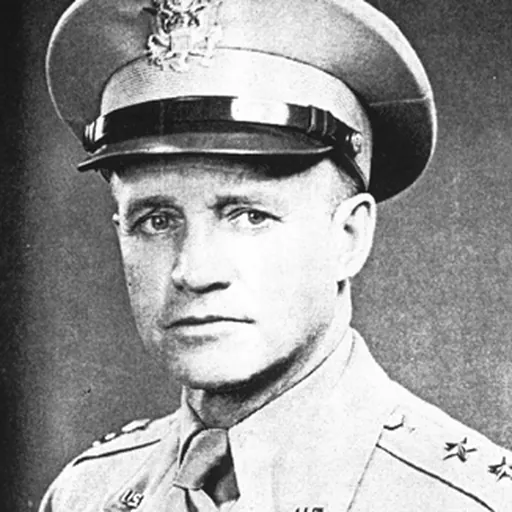
Hobart R. Gay
United States Army general
About Hobart R. Gay
Lived 1894 – 1983 (aged 89). Hobart R. Gay was an American military personnel and new Mexico Military Institute.
Lieutenant General Hobart Raymond Gay (May 16, 1894 – August 19, 1983), nicknamed "Hap", was a United States Army officer who served in numerous conflicts, including World War II, where he worked closely alongside General George S. Patton, and later in the Korean War, where he commanded the 1st Cavalry Division.
Early military career He was first commissioned into the Army Reserve as a 2nd lieutenant following his graduation from Knox College in 1917. He played as a halfback on the Knox College football team and earned a Bachelor of Science degree.
On October 26, 1917, over six months after the American entry into World War I, Gay was commissioned into the Regular Army as a cavalry officer. He was promoted to 1st lieutenant on October 26, 1917, and captain in July 1920. In his early career, he was a cavalry officer. As a captain, he tutored author Robert A. Heinlein in equitation and musketry.
He transferred to the Quartermaster Corps June 11, 1934, and was promoted to major on August 1, 1935. He was promoted to lieutenant colonel on August 18, 1940, and then to colonel in the Army of the United States (AUS) on December 24, 1941, shortly after the United States entered World War II.
World War II General George S. Patton and members of his Third Army staff, 1945. Sat to Patton's right is his chief of staff, Brigadier General Hobart R. Gay.
Gay was awarded the Silver Star in December 1942 for gallantry in action on November 8, 1942, in Casablanca. He was chief of staff of the I Armored Corps, commanded by General George S. Patton, in North Africa at the time. Gay would continue to serve as Patton's chief of staff until Patton's death in December 1945.
Gay was promoted to brigadier general (AUS) on June 24, 1943. In this capacity, Gay was a key member of Patton's command staff during the Third Army's drive into Germany following the Normandy landings. In November 1944 he was awarded the Distinguished Service Cross (DSC), the citation for which reads:
He was promoted to major general (AUS) on March 20, 1945, shortly before the end of World War II in Europe.
Korean War In September 1949, Gay took command of the 1st Cavalry Division in Osaka, Japan. He brought the 1st Cavalry to Korea, where it was in action on July 19, 1950, joining in the general South Korean-U.S. retreat before the North Korean invasion force. It was during this period that earned Gay an oak leaf cluster to his DSC.
The President of the United States of America, under the provisions of the Act of Congress approved July 9, 1918, takes pleasure in presenting a Bronze Oak Leaf Cluster in lieu of a Second Award of the Distinguished Service Cross to Major General Hobart Raymond Gay (ASN: 0-7323), United States Army, for extraordinary heroism in connection with military operations against an armed enemy of the United Nations while as Commanding General of the 1st Cavalry Division. Major General Gay distinguished himself by extraordinary heroism in action against enemy aggressor forces in the Republic of Korea during the period from 18 July to 1 October 1950. During this period, although faced by overwhelming numerical superiority, General Gay so skillfully led his Division that the enemy's advance was slowed and ultimately halted along the Naktong River Line. His continuous presence at the front under enemy artillery, mortar, and small-arms fire with total disregard for his own personal safety was an inspiration to his men during the critical period of the United Nations buildup. On 25 September 1950, the Division made a break-through at Tabu-dong. General Gay joined the task force formed to exploit the success, placing his quarter-ton vehicle behind the two leading tanks, taking part in numerous firefights. In one instance the lead tank was hit by enemy antitank fire, halting the column. Realizing the seriousness of the situation and the necessity for pushing forward, General Gay made his way under enemy fire to the lead tank and personally directed accurate fire at the enemy antitank guns, which eliminated them. His aggressive leadership, courage under fire, and personal heroism, enable the task force to continue its rapid advance and prevented the enemy from organizing a defensive position which would have nullified the breakthrough. Despite this, he was awarded the Army Distinguished Service Medal for his service in Korea. The medal's citation reads as follows:
The President of the United States of America, authorized by Act of Congress July 9, 1918, takes pleasure in presenting a Bronze Oak Leaf Cluster in lieu of a Second Award of the Army Distinguished Service Medal to Major General Hobart Raymond Gay (ASN: 0-7323), United States Army, for exceptionally meritorious and distinguished services to the Government of the United States, in a duty of great responsibility as Commanding General, 1st Cavalry Division, in Korea, from 8 July 1950 to 15 February 1951. and later acknowledged in a U.S. Army investigation. The South Korean government in 2005 certified the names of 163 No Gun Ri dead and missing and 55 wounded, and said many more likely were killed. On July 26, the day the No Gun Ri killings began, Gay told rear-echelon reporters he was sure most refugees fleeing south were North Korean infiltrators. Two days earlier, word had been sent from his operations staff to fire on all refugees trying to cross U.S. lines. Gay later described refugees as "fair game," and the U.S. ambassador in South Korea said such a policy had been adopted theater-wide.
Later service, retirement, and death
In September 1954 General Gay was made commander of U.S. Fifth Army in Chicago, Illinois. He was nominated by President Dwight D. Eisenhower in October 1954 for promotion to Lieutenant General (temporary).
Hobart R. Gay's career in the U.S. Army ended in 1955 as the Commanding General, Anti-aircraft and Guided Missile Center, Fort Bliss, Texas.
Awards and decorations Lieutenant General Hobert G. Gay's awards and decorations include: Decorations Distinguished Service Cross with bronze oak leaf clusterArmy Distinguished Service Medal with bronze oak leaf clusterSilver Star with two bronze oak leaf clustersLegion of Merit with bronze oak leaf clusterBronze Star with bronze oak leaf clusterAir Medal with bronze oak leaf clusterArmy Commendation Medal Unit Award Army Meritorious Unit Commendation Service Medals World War I Victory MedalAmerican Defense Service MedalAmerican Campaign MedalEuropean-African-Middle Eastern Campaign Medal with Arrowhead device and silver campaign starWorld War II Victory MedalArmy of Occupation MedalNational Defense Service MedalKorean Service Medal with three bronze campaign stars Foreign Awards Distinguished Service Order (United Kingdom)Legion of Honour (Chevalier)Legion of Honour (Officier)French Croix de guerre (device(s) unknown)Order of the Patriotic War First Class (Union of Soviet Socialist Republics) Order of the White Lion Class II (Czechoslovakia)Czechoslovak War CrossRepublic of Korea Presidential Unit CitationUnited Nations Korea MedalKorean War Service Medal
Media portrayal In the film Patton (1970), the character of Brigadier General Hobart Carver, played by Michael Strong, was based on Gay. In the 1986 telefilm The Last Days of Patton, Gay was portrayed by Murray Hamilton.
Don’t just read it —
keep it.
Full-length biographies made to live with: read them, listen on the way to work, watch them tonight.
- E-book
- Audio
- Video
Instant download · yours to keep · every purchase keeps this site free
Important facts
People in Hobart R. Gay's life
Named in this biography and alive at the same time

Related people
Same field, nearest in time




Contemporaries
People whose lives overlapped Hobart R. Gay's

Frequently asked questions
Who was Hobart R. Gay?
United States Army general (1894-1983)
When was Hobart R. Gay born?
Hobart R. Gay was born on 16 May 1894 in Rockport.
When did Hobart R. Gay die?
Hobart R. Gay died on 19 August 1983 in El Paso.
What was Hobart R. Gay's occupation?
Hobart R. Gay was a military personnel and new Mexico Military Institute.
What nationality was Hobart R. Gay?
Hobart R. Gay was American.
Sources & further reading
Cite this page
APA: Biography.guide. (2026). Hobart R. Gay. https://biography.guide/hobart-r-gay/
MLA: "Hobart R. Gay." Biography.guide, https://biography.guide/hobart-r-gay/.
Chicago: "Hobart R. Gay." Biography.guide. https://biography.guide/hobart-r-gay/.
Data last updated: 2026-09-23 · Spot an error? Report a correction.
Portrait: Wikimedia Commons · author & licence
Page generated 2026-09-27 05:06 UTC