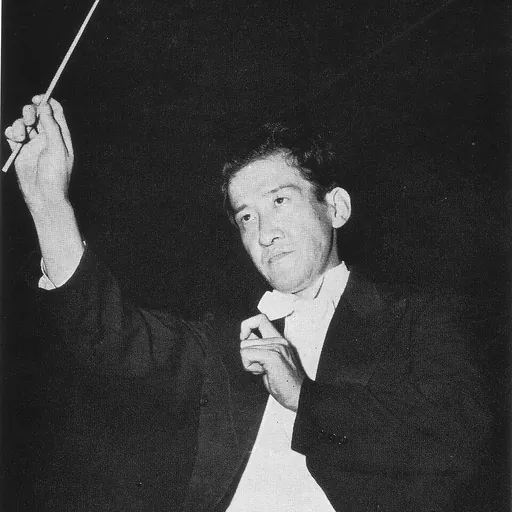
About Hisatada Otaka
Lived 1911 – 1951 (aged 39). Hisatada Otaka was a Japanese composer and conductor.
Besides conducting, Otaka also composed prolifically, and had taught Hikaru Hayashi, Kan Ishii, Among Otaka's compositions are his first symphony ("Society for the Construction of the Bell Tower of Peace"), Cello Concerto, Flute Concerto, and Rhapsody for Piano and Orchestra (1943).
Death and legacy On 16 February 1951, Hisatada Otaka died at the age of 39, from what Andrzej Panufnik says was overwork. After his death, the orchestra's name changed to the NHK Symphony Orchestra because of funding received from NHK (Japanese Broadcasting Corporation).
Hisatada Otaka's youngest son, Tadaaki Otaka, conducts his father's work regularly, along with the works of Andrzej Panufnik.
Personal life Hisatada Otaka married Misao Otaka sometime before 1940. According to Panufnik, they were already married when they would invite Panufnik to their house in Vienna, and they left Vienna for Japan in 1940.
When the couple moved to Japan, they had a daughter and two sons. Michiko Otaki (in or after 1940), the daughter, is a pianist. Atsutada Otaka (1944), the elder son, is a musicologist and a composer. Tadaaki Otaka, (1947), the younger son, is a popular Japanese conductor, a permanent conductor of the NHK Symphony Orchestra since 2010, the first Japanese person to win the Elgar Medal, and musical director of the Osaka Philharmonic Orchestra.
When Hisatada Otaka died in 1951, the couple's children were still very young (Tadaaki being only 4 years old), and therefore Misao was left as a widowed mother.
Selected compositions Japanische Suite No. 1 (Nihon Kumikyoku) Sinfonietta for Strings (1937) Midare Capriccio for 2 pianos (Op. 11 1939; rev. 1947?) (Premiered 2 December 1939) Piano Trio (1941) Rhapsody for Piano and Orchestra (1943) Symphony No. 1 "Society for the Construction of the Bell Tower of Peace" (Op. 35; 1948 Maestoso – Allegro appassionato Adagio assai sostenuto, molto espressivo ‒ Andante con moto, ma sempre sostenuto ‒ Adagio sostenuto Flute Concerto (Op. 30a 1948; 30b 1951) (1=The flute concerto was originally completed in 1948 for chamber orchestra as Op.) 30a, when it was finished it was the first Japanese flute concerto. In 1951, Hisatada Otaka started a rewrite for a bigger orchestra, but was left incomplete since Otaka's death that year, however his student, Hikaru Hayashi, completed the work in 1951 as Op. 30b.
The most popular of Otaka's work is his flute concerto, which is played and recorded commonly, and was supported among his peers.
Style Otaka's style reflects much of his teachers in the 1930s, showing Viennese and German styles.
Flute concerto However, the flute concerto Op. 30 is written in a specific French romantic style, although with distinct sections Japanese themes, it is written differently than many other concert works by Otaka, seemingly independent from the style of his teachers from Germany and Vienna, The Guardian said the piece had a "jazzy inflection" during the slower movement of the concerto, due to the French style and structure many French flautists performed the piece such as Jean-Pierre Rampal and Emmanuel Pahud and was popular in France.
Don’t just read it —
keep it.
Full-length biographies made to live with: read them, listen on the way to work, watch them tonight.
- E-book
- Audio
- Video
Instant download · yours to keep · every purchase keeps this site free
Important facts
People in Hisatada Otaka's life
Named in this biography and alive at the same time





Related people
Same field, nearest in time




Contemporaries
People whose lives overlapped Hisatada Otaka's





Frequently asked questions
Who was Hisatada Otaka?
Japanese composer and conductor (1911-1951)
When was Hisatada Otaka born?
Hisatada Otaka was born on 26 September 1911 in Tokyo.
When did Hisatada Otaka die?
Hisatada Otaka died on 16 February 1951.
What was Hisatada Otaka's occupation?
Hisatada Otaka was a composer and conductor.
What nationality was Hisatada Otaka?
Hisatada Otaka was Japanese.
Sources & further reading
Cite this page
APA: Biography.guide. (2026). Hisatada Otaka. https://biography.guide/hisatada-otaka/
MLA: "Hisatada Otaka." Biography.guide, https://biography.guide/hisatada-otaka/.
Chicago: "Hisatada Otaka." Biography.guide. https://biography.guide/hisatada-otaka/.
Data last updated: 2026-09-21 · Spot an error? Report a correction.
Portrait: Wikimedia Commons · author & licence
Page generated 2026-09-27 04:59 UTC