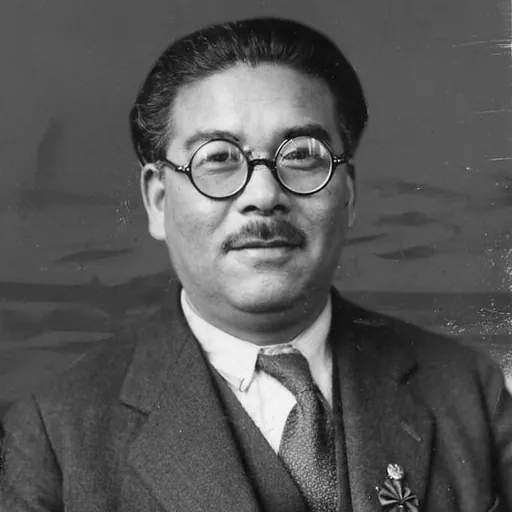
About Hisashi Asō
Lived 1891 – 1940 (aged 49). Hisashi Asō was a Japanese politician.
was a Japanese socialist politician and trade unionist active in the Taishō and early Shōwa periods. A graduate of Tokyo Imperial University, he rose in the labour movement through the Yūaikai and as founder of the All Japan Miners' Federation, leading major strikes before helping establish successive centrist proletarian parties. He served as secretary-general and later chairman of the Social Mass Party (Shakai Taishūtō), was elected to the House of Representatives for Tokyo's 5th district in 1936 and 1937, and subsequently advocated collaboration with right-wing renovationist elements and the military, dissolving the party in July 1940 to support Fumimaro Konoe's New Order movement. He was a mentor to Inejirō Asanuma, the future chairman of the Japan Socialist Party.
Biography
Hisashi Asō was born on 24 May 1891, in Higashi-Iida Village, Kusu District, Ōita Prefecture (present-day Kokonoe, Ōita). He attended the old-system Oita Middle School (now Oita Prefectural Oita Uenogaoka High School), graduated from the Third Higher School in 1913, and entered the French Law Department of Tokyo Imperial University that year, graduating in 1917. During his student days, he immersed himself in Russian literature, particularly Tolstoy and Turgenev, which sparked his interest in the Russian Revolution. He was also known for his flamboyant relationships with women.
After graduation, Asō joined the Tokyo Nichinichi Shimbun (now Mainichi Shimbun) as a journalist in 1917 but soon left. In 1918, he serialized "From Peter to Lenin" in the paper, openly supporting the Russian Revolution. That same year, with Sakuzō Yoshino and others, he helped found the Renmeikai (Dawn Society), an enlightenment organization for Taishō democracy, involving prominent intellectuals such as Inazō Nitobe, Ikuo Ōyama, Shinzo Koizumi, and Akiko Yosano. He participated in the Thursday Society and, as a senior, in the Shinjinkai at Tokyo Imperial University.
In 1919, Asō joined the Yūaikai (Friendly Society) and, with contemporary Kotora Tanahashi, pushed the organization, originally inclined toward labour-management harmony, toward more radical and militant positions. On 2 December 1919, he and 14 other union leaders were arrested during a speech event organized by the Hitachi branch, leading to its collapse. In 1920, he founded the All Japan Miners' Federation and led disputes at Ashio Copper Mine, Hitachi Copper Mine, Yubari Coal Mine, and others, resulting in repeated imprisonments. His eldest son, Yoshikata, was born in 1923; that year he published Swimming in the Muddy Stream.
In 1925, Asō became political section chief of the Japan General Federation of Labour (successor to Yūaikai). He participated in proletarian party movements and became a central executive committee member of the Labour-Farmer Party upon its formation in 1926. After internal left-right splits dissolved the party, he co-founded the Japan Labour-Farmer Party in December 1926 with Toshio Miwa, Shoichi Miyake, Yamana Yoshitsuru, and others, serving in leadership roles (secretary-general or chairman) in subsequent centrist proletarian parties: Japan Mass Party, National Mass Party, and National Labour-Farmer Mass Party.
Around the late 1920s Asō also acted as defence counsel in a disturbance case involving sugar-cane farmers and a Japanese sugar company in a tropical colony (almost certainly Taiwan). In a 1929 essay he described the company’s practice of arbitrarily harvesting mature cane without prior agreement on quantity or price, the subsequent police escalation of the commercial dispute into mass arrests and prolonged pre-trial detention, and the colonial courtroom’s inability to answer a defendant’s pointed comparison with ordinary commercial practice in Japan proper. In the same piece he recounted witnessing a Japanese official (later revealed as a police chief) strike a local boy after colliding with him on a bicycle, and the subsequent intervention by a military policeman that exposed inter-service rivalry between the police and the kenpeitai. Asō presented these episodes as revealing fragments of colonial life and power relations.
In 1932, the National Labour-Farmer Mass Party merged with the Social People's Party to form the Social Mass Party, where Asō became secretary-general (chairman: Isoo Abe). From this period, he sought to expand socialist influence by aligning with the military's "renovationist" elements. Although condemning the Manchurian Incident as capitalistic and imperialist, he claimed it pushed the army in an anti-capitalist direction and became involved in the 1931 March incident. He praised the 1934 Army pamphlet The Basic Principles of National Defense and Proposal for Strengthening It as expressing socialist tendencies in the military and became one of its strongest advocates alongside Kan'ichirō Kamei. With Kamei, he advanced the party's shift toward totalitarianism.
Asō was elected to the House of Representatives for Tokyo's 5th district in the 1936 general election and reelected in 1937. With the outbreak of the Second Sino-Japanese War in 1937, he supported the government on condition of localized resolution and non-escalation, approving military budgets. In 1938, he and Kamei worked with Akiyama Teisuke to draft plans for a new reformist, totalitarian party led by themselves and Fumimaro Konoe. In 1939, he attempted a merger with Tōhōkai under Seigō Nakano to explore right-wing ties, though it failed at the last minute despite pushing against Abe's reservations.
In 1940, amid the controversy over Saitō Takao's anti-military speech, Asō supported Saitō's expulsion from the House. He purged right-wing party members opposing it, including Abe Isoo, Bunji Suzuki, Tetsu Katayama, Suehiro Nishio, Chōzaburō Mizutani, and Jiichirō Matsumoto, and succeeded Abe as party president. Cooperating actively with Konoe's New Order movement, he dissolved the Social Mass Party on 6 July 1940, ahead of others, anticipating a leading role in the Imperial Rule Assistance Association. He joined the preparatory committee for the new system under the Second Konoe Cabinet. However, he died of heart paralysis (heart attack) on 6 September 1940, at age 49. He is buried at Tama Cemetery. His sudden death deprived Inejirō Asanuma, who deeply admired Asō's character and followed his national-socialist line of social reform through cooperation with the military, of a key mentor and spiritual pillar.
Evaluation
Hisashi Asō believed Japan's revolution could only succeed through collaboration among military forces, proletarian forces, the Emperor, and popular forces. However, as military dictatorship intensified, he supported the military, the Sino-Japanese War, and the Imperial Rule Assistance Association while suppressing opposition, leading some to view his stance as war-affirming.
Family Eldest son: Yoshikata Asō (secretary to Inejirō Asanuma, former House of Representatives member) Grandson (Yoshikata's son): Teruhisa Asō (Shinjuku Ward assembly member)
Asō was a mentor to Inejirō Asanuma; his son Yoshikata later served as Asanuma's secretary.
Selected works A Labour Activist's Soliloquy (Kinsei Shakai Shisō Sōsho), Ōtōkaku, 1921 The Crowd Striving to Live, Shinkōsha, 1923 Swimming in the Muddy Stream, Shinkōsha, 1923 (reissued by Kaizōsha, 1930) Dawn, Shinkōsha, 1924 Theory and Practice of Proletarian Parties, Kagaku Shisō Fukyūkai, 1924 Those Crossing Life, Shinkōsha, 1925 What Is a Proletarian Party? The Newly Born Labour-Farmer Party, Shichōsha, 1926 An Incident That Occurred in a Certain Colony (某殖民地發生的事變), 1929 (Chinese translation by Xie Liuyi; included in the collection Fan Mou de Fanzui / 范某的犯罪) Talks on Socialism, Seibundō Jūsen Bunko, 1930 Life Exists in Struggle, Ōtōkaku, 1930 Father, Do Not Grieve: A Full-Length Novel, Senshinsha, 1930 The Approaching Crisis of World War: Positively Recognize the Current Situation (National Policy Studies No. 3), Kokusaku Kenkyūsha, 1938 The Meaning of Modern War, Shakai Taishūtō Shuppanbu, 1938 Selected Works of Hisashi Asō Vol. 2 (Dawn), Kaikō Shoten, 1947
Translation James Welsh, Heroes from the Bottom: The Story of Coal Miner Robert Sinclair, co-translated with Yasuo Watanabe, Shinkōsha, 1924
Biographies Biography of Hisashi Asō, compiled by Hisashi Asō Biography Publication Committee, 1958 Shōichi Miyake, History of Japanese Social Movements in a Turbulent Period: The Trajectories of Toyohiko Kagawa, Hisashi Asō, and Inejiro Asanuma, Gendai Hyōronsha, 1973
Don’t just read it —
keep it.
Full-length biographies made to live with: read them, listen on the way to work, watch them tonight.
- E-book
- Audio
- Video
Instant download · yours to keep · every purchase keeps this site free
Important facts
People in Hisashi Asō's life
Named in this biography and alive at the same time




Related people
Same field, nearest in time




Contemporaries
People whose lives overlapped Hisashi Asō's


Frequently asked questions
Who was Hisashi Asō?
Japanese politician (1891–1940)
When was Hisashi Asō born?
Hisashi Asō was born on 24 May 1891.
When did Hisashi Asō die?
Hisashi Asō died on 6 September 1940.
What was Hisashi Asō's occupation?
Hisashi Asō was a politician.
What nationality was Hisashi Asō?
Hisashi Asō was Japanese.
Sources & further reading
Cite this page
APA: Biography.guide. (2026). Hisashi Asō. https://biography.guide/hisashi-aso/
MLA: "Hisashi Asō." Biography.guide, https://biography.guide/hisashi-aso/.
Chicago: "Hisashi Asō." Biography.guide. https://biography.guide/hisashi-aso/.
Data last updated: 2026-09-20 · Spot an error? Report a correction.
Portrait: Wikimedia Commons · author & licence
Page generated 2026-09-27 04:58 UTC