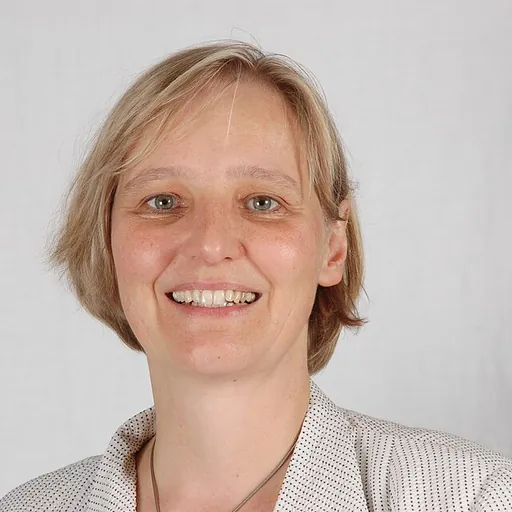
About Hildigund Neubert
Born 1960. Hildigund Neubert is a German politician, singer and thuringia.
Hildigund Neubert (born Hildigund Falcke) is a German politician. At the time of East Germany's "peaceful revolution" she was a member of Demokratischer Aufbruch (DA, "Democratic Awakening"), one of the political organisations that advocated for democracy and helped bring about the 1990 East German general election.
After reunification she remained active on the centre-right of German politics.
Life and works Early life and education
Hildigund Falcke was born in Quedlinburg. Her father is the Evangelical theologian Heino Falcke. She grew up in Gnadau, a village to the north of Quedlinburg.
She studied at the academy between 1979 and 1984 and met Ehrhart Neubert, who was working at the academy as part-time student chaplain. He was also employed at the time as a parish priest and was emerging as a leading figure in the East German peace movement. Hildigund and Ehrhart Neubert married in 1987 and moved to Berlin the same year.
Berlin
In Berlin they lived in a relatively small first-floor apartment by a busy road junction with its own set of traffic lights. Hildigund Neubert's first impression of Berlin was that it was, after Weimar, noisy, cold and dirty. (She and her husband already had two small children two care for.) The "Democracy Now" citizens' movement was also a more obvious reality in Berlin than in Weimar. Two weeks after the young family moved into their little apartment the so-called "Environment Library" at the nearby Church of Zion ("Zionskirche") was stormed by the security services. The Church of Zion was a well-known meeting centre for people engaged with the pro-democracy church-based political reform movement ("Kirche von Unten") and the raid was accompanied by arrests. Neubert hurried over with the babies' pram filled with thermos flasks of hot tea to try and help. A few months later Schnur would be unmasked as a long-standing Stasi spy. Kasner became better known to commentators after his daughter became Germany's chancellor (head of government) in 2005.
The night the wall was breached
9 November 1989 was an important day because it marked the day after the first birthday of Wilhelm, the Neuberts' third (and at the time youngest) child. They remembered the anniversary only the day after it fell, and they hastily improvised an ad hoc ceremony involving a candle, a quick blessing, a hymn and a not quite random present that had been acquired some months earlier. That evening news came through on the radio in the kitchen (tuned to a West German news report) that in East Berlin protesters had breached the wall. There had been no serious attempt by the uniformed border guards and other security service personnel present to prevent the development, and Soviet soldiers looking on made no move. As usual, that evening the Neuberts were entertaining visitors to a meal: on this occasion guests included some "reform communists" from France. Their foreign visitors were convinced that the grapevine reports picked up by the western radio station could not possibly be true. While their German guests slipped off to make their way to the wall and investigate further, the Frenchmen stayed on, determined to pursue the serious discussion they were having at table about the possibility of a future communism with a human face. The Neuberts were therefore not present that evening as the gap in the Berlin Wall was breached and then enlarged so that incredulous East Berliners could pour through, most of them at this stage simply curious to find out how things looked on the other side. It was several days later, having accepted an invitation to give an interview to Radio Glasnost, that Hildigund Neubert undertook her own first visit to West Berlin.
At this stage Neubert was in no hurry to follow former DA colleagues into the CDU. Formed, it seemed to her, primarily by "West German lawyers" she found the party "culturally alien": "I looked different, I was different" ("Ich sah anders aus, ich war anders"). On the domestic front, for a number of months the Neuberts accommodated a young Lithuanian deserter from the Soviet army in their Berlin home. Initially on a voluntary basis, and later, till 2003, as a part-time employee, Hildigund Neubert became involved in the work of the office. In the process she became an expert on the many stages of the relevant laws on rehabilitation, the ground rules for press work and the mechanisms and responsibilities of the (West) German Bundestag. One important project on which she worked in depth was a witness survey, complemented by archival research, for a publication on forced labour in East German detention institutions. For a number of years after 1996 Hildigund Neubert served as a member of the CDU Regional Party Executive for Berlin.
State Commissioner for Stasi records
In 2003 her appointment as State Commissioner for Stasi records in Thuringia marked something of a new beginning. Ehrhart Neubert was by now 63 and nearing retirement, but Hildigund was still only 43, and keen to take on a new public role when Thuringia's new Minister-president, Dieter Althaus, proposed her for the Erfurt-based job in succession to Jürgen Haschke. The appointment was confirmed by a vote in the state parliament ("Landtag") on 23 October 2003. The term of her appointment was initially of five years, but in 2008 she was re-elected for a second five-year term, thereby staying in the post for ten years, just as her predecessor had done.
In some ways Neubert's responsibilities were not so different from those she had undertaken at the Bürgerbüro, but as only the second Thuringia State Commissioner for Stasi records she had the chance to set her own priorities according to her own assessments of what was needed. In a frantic evidence destroying exercise, back in 1989/90 as democracy activists stormed the main administrative offices of the Stasi, Stasi officers set about burning the files, but due both to the vast number of files and the speed with which democracy activists stormed the buildings and prevented the destruction of documents, many records survived. Roughly 50% of the surviving Stasi files on individual citizens were centrally archived at the Stasi Records Agency in Berlin. The other half were archived locally by the Stasi record agencies in each of the five new Federal States (former East Germany). People who believe that the East German security Services might have been maintaining files on them have a legal entitlement to search in the records agencies to find out what information on them had been collected and filed. As commissioner for Stasi records, Neubert provided advice on how to locate and search the files that concerned them. She also prioritized helping former victims of state persecution with rehabilitation and restitution procedures. Advising employers who wished to use surviving Stasi records to find out if any of their current or potential employees had been registered as one of several hundred thousand Stasi informers during the dictatorship years was another important part of her responsibilities. There was also a large amount of work in supporting the work of journalists, historians and other researchers, young and old, many of them involved in education provision. Not infrequently she found herself in controversial situations involving the lives of individuals. Skills in conflict resolution were an important job requirement. One reason that she loved the job, as she herself recalled, was that during her ten-year term of office she never stopped learning.
Under the laws which had established the regional Commissioners for Stasi records, a third five-year term in office was not possible. When Neubert retired from the job in 2013, Landtag President Birgit Diezel, paid tribute to the great passion and unstinting commitment which she had applied to the job. Thanks to Hildigund Neubert, Thüringia had been the first German state to implement pensions for victims of particularly harsh treatment and/or imprisonment under the one-party dictatorship. Diezel also singled out for special mention the compensation fund that Neubert, through sheer persistence, had managed to establish for victims of the East German system of residential homes for orphaned children and young people. Responding to Diezel, Neubert commended the political establishment for never having attempted to apply pressure or influence to the commission. She explained that more than twenty years after the ending of the dictatorship, further examination of Stasi files to check out whether new applicants for jobs in the public and private sectors were in most cases superfluous, since younger job applicants were too young to have been involved with the Stasi, while the necessary checks had in most cases already been performed in respect of older applicants. But the educational role of the commission was undiminished. There were still plenty of people with curious questions about the history of the one-party dictatorship. And in the case of politicians, she firmly believed that on-going Stasi checks were necessary: "If someone has worked for the Stasi, that says something important about that person's respect for the personal rights and liberties of other people".
Recognition In 2006 Hildigund Neubert was awarded the Order of Merit ("Bundesverdienstkreuz").
Don’t just read it —
keep it.
Full-length biographies made to live with: read them, listen on the way to work, watch them tonight.
- E-book
- Audio
- Video
Instant download · yours to keep · every purchase keeps this site free
Important facts
Family & relationships
People in Hildigund Neubert's life
Named in this biography and alive at the same time

Related people
Same field, nearest in time





Contemporaries
People whose lives overlapped Hildigund Neubert's


Frequently asked questions
Who is Hildigund Neubert?
German politician
When was Hildigund Neubert born?
Hildigund Neubert was born in 1960 in Quedlinburg.
What is Hildigund Neubert's occupation?
Hildigund Neubert is a politician, singer and thuringia.
What nationality is Hildigund Neubert?
Hildigund Neubert is German.
Sources & further reading
· Wikipedia: Hildigund Neubert
Cite this page
APA: Biography.guide. (2026). Hildigund Neubert. https://biography.guide/hildigund-neubert/
MLA: "Hildigund Neubert." Biography.guide, https://biography.guide/hildigund-neubert/.
Chicago: "Hildigund Neubert." Biography.guide. https://biography.guide/hildigund-neubert/.
Data last updated: 2026-09-22 · Spot an error? Report a correction.
Portrait: Wikimedia Commons · author & licence
Page generated 2026-09-27 05:02 UTC