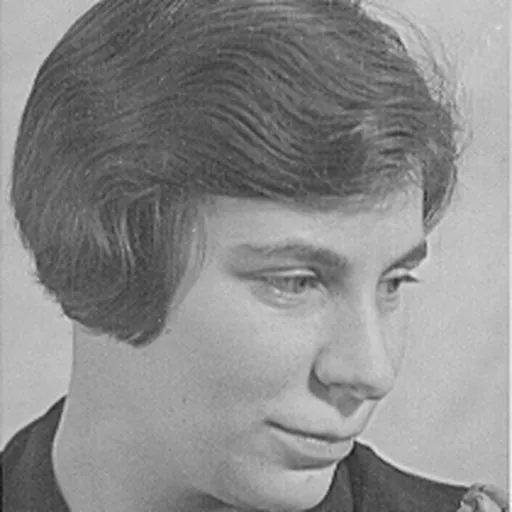
About Hilde Levi
Lived 1909 – 2003 (aged 94). Hilde Levi was a German and Danish physicist, university teacher and chemist, known for Autoradiography and Radiocarbon dating.
Hilde Levi (9 May 1909 – 26 July 2003) was a German-Danish physicist. She was a pioneer of the use of radioactive isotopes in biology and medicine, notably the techniques of radiocarbon dating and autoradiography. In later life she became a scientific historian, and published a biography of George de Hevesy.
Born into a non-religious Jewish family in Frankfurt, Germany, Levi entered the Ludwig-Maximilians-Universität München in 1929. She carried out her doctoral studies at the Kaiser Wilhelm Institute for Physical Chemistry and Electrochemistry at Berlin-Dahlem, writing her thesis on the spectra of alkali metal halides under the supervision of and Fritz Haber. By the time she completed it in 1934, the Nazi Party had been elected to office in Germany, and Jews were no longer allowed to be hired for academic positions. She went to Denmark where she found a position at the Niels Bohr Institute of Theoretical Physics at the University of Copenhagen. Working with James Franck and George de Hevesy, she published a number of papers on the use of radioactive substances in biology.
When the Nazis began rounding up Danish Jews in September 1943, Levi fled to Sweden, where she worked for the biologist John Runnström at the Wenner-Gren Institute for Experimental Biology in Stockholm. After the war ended, she returned to Denmark to work at the Zoophysiological Laboratory in Copenhagen. She spent the 1947–48 academic year in the United States learning about the recently discovered techniques of radiocarbon dating and autoradiography, which she introduced to Europe. She retired from the Zoophysiological Laboratory in 1979, but became involved with the Niels Bohr Archive, where she collected papers of de Hevesy, eventually publishing his biography.
Early life Hilde Levi was born in Frankfurt, Germany, on 9 May 1909, the daughter of Adolf Levi, the sales director of a metal company, and his wife Clara (née Reis), the daughter of a printer. Hilde had an older brother called Edwin. She was a gifted musician who learned to play the piano at a young age. During the summers, she would listen to performances at her cousins' summer house in Bavaria by musicians including Elisabeth Schumann and Richard Strauss.
Although Jewish, Levi's family did not practise their religion, and were not part of the Jewish community, but when she was enrolled at the Victoria School (now the Bettina School) in Frankfurt, her religion was listed as Jewish. Religious instruction was compulsory, so she had to attend classes with a local rabbi. She soon rebelled against this, and told her parents that she did not wish to attend the classes. She came to reject formal religion.
While at high school, Levi decided that she would become a scientist. Her final year was devoted to a physics project on spectra and photography, which became her Oberreal Abiturium. She was the only girl in her class to major in physics that year. After her graduation in April 1928, her father sent her to England for six months to learn English. She entered the Ludwig-Maximilians-Universität München in 1929, where she listened to lectures by Arnold Sommerfeld. For her doctorate, she was accepted into the Kaiser Wilhelm Institute for Physical Chemistry and Electrochemistry at Berlin-Dahlem, where she wrote her thesis on the spectra of alkali metal halides, under the supervision of and Fritz Haber. She then became assistant to the Hungarian physical chemist George de Hevesy. The recent discovery of induced radioactivity and the consequent creation of short-lived radioactive isotopes opened up a number of new uses for radioactive substances in biology which she explored with de Hevesy, publishing a number of papers with him. The Friedrich Wilhelm University of Berlin cancelled Levi's doctorate in 1938. In April 1940, the Germans occupied Denmark. When the Nazis began rounding up Danish Jews in September 1943, Levi was one of the thousands of Jews who fled to Sweden. For the rest of the war she worked for the biologist John Runnström at the Wenner-Gren Institute for Experimental Biology in Stockholm.
On returning to Denmark, she worked with the National Museum of Denmark in Copenhagen to develop radiocarbon dating equipment. This was put to the test in 1951, dating the Grauballe Man. Autoradiography was then used by the Finsen Institute to investigate the effects of the radiocontrast agent thorotrast. Levi was a consultant at the Danish National Board of Health from 1952 to 1970. That year she organised the Niels Bohr Centennial Exhibition at the Copenhagen Town Hall. In 2001, she was honoured by the Humboldt University of Berlin (previously the Friedrich Wilhelm University of Berlin), along with other students who had been dismissed in 1933. She died in Copenhagen on 26 July 2003.
Don’t just read it —
keep it.
Full-length biographies made to live with: read them, listen on the way to work, watch them tonight.
- E-book
- Audio
- Video
Instant download · yours to keep · every purchase keeps this site free
Important facts
People in Hilde Levi's life
Named in this biography and alive at the same time





Related people
Same field, nearest in time



Contemporaries
People whose lives overlapped Hilde Levi's



Frequently asked questions
Who was Hilde Levi?
German physicist (1909–2003)
When was Hilde Levi born?
Hilde Levi was born on 9 May 1909 in Frankfurt.
When did Hilde Levi die?
Hilde Levi died on 26 July 2003 in Copenhagen.
What was Hilde Levi's occupation?
Hilde Levi was a physicist, university teacher and chemist.
What was Hilde Levi known for?
Hilde Levi was known for Autoradiography and Radiocarbon dating.
What nationality was Hilde Levi?
Hilde Levi was German and Danish.
Sources & further reading
Cite this page
APA: Biography.guide. (2026). Hilde Levi. https://biography.guide/hilde-levi/
MLA: "Hilde Levi." Biography.guide, https://biography.guide/hilde-levi/.
Chicago: "Hilde Levi." Biography.guide. https://biography.guide/hilde-levi/.
Data last updated: 2026-09-23 · Spot an error? Report a correction.
Portrait: Wikimedia Commons · author & licence
Page generated 2026-09-27 05:06 UTC