
About Hilary Teague
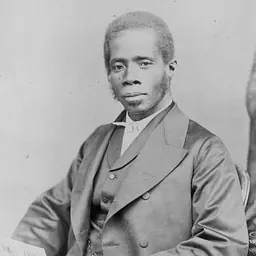
Lived 1802 – 1853 (aged 50–51). Hilary Teague was a Liberian journalist, diplomat and politician.
Hilary Teage (1805 – May 21, 1853), sometimes written as Hilary Teague, was an Americo-Liberian politician, journalist, Baptist minister and merchant who is considered a founding father of the West African nation of Liberia.
Born into an enslaved family in Virginia, Teage moved to Africa as a colonist under the auspices of the American Colonization Society (ACS) as a teenager. He became a leading citizen of Monrovia as a Baptist pastor, merchant, editor and owner of Liberia's leading newspaper, and the founder of the Liberia Lyceum. He also held several political offices in the ACS-administered colony. Teage became a leading advocate for Liberian independence from the ACS, drafting the Liberian Declaration of Independence in 1847 and serving on the convention to draft Liberia's first constitution.
After independence, Teage held several offices in the new republic, serving as a senator, the first Secretary of State and attorney general in the years that followed. After a period of ill health, he died in 1853. Due to his extensive published writing and speaking, as well as his involvement in Liberian independence, he is considered one of the most influential people in early Liberian history.
Biography Early life and education Teague was born into an enslaved family in Goochland County, Virginia, United States, in 1805. His mother was Frances Teage and his father was Colin Teage. A skilled artisan, Colin was sold around 1807 to a family in Richmond, where he was able to save enough to purchase his family's freedom by 1819 and acquire property in neighboring Henrico County. The Teages also became members of the First Baptist Church of Richmond, which included blacks and whites but was segregated. The Teages attended school through the efforts of church members and became literate.
During their early years in Liberia, the Teages bucked up against the policies of the local ACS agent, Jehudi Ashmun, who unilaterally reassigned land on which colonists had built homes and who required colonists to provide two days' worth of labor each week for the benefit of the colony, at the risk of losing food allowances for non-compliance. Colin Teage was part of the organized resistance to Ashmun, who was forced to leave his position in 1826. He remained pastor there throughout his career as a politician and journalist, preaching, performing weddings, performing baptisms and other pastoral functions. (He acquired the paper's ownership from the ACS in 1839.)
Also in 1835, he became colonial secretary, the highest-ranking official below the ACS colonial agent, a position he also took over from Russwurm.
Teage was elected a commissioner for Montserrado County in 1840 and a senator for the county in 1848. In addition to his political activities, Teage promoted independence in speeches in the Liberia Lyceum (which was the owner of the Herald and in his editorials in the Herald. in both debating and ratifying the Liberian Constitution of 1847.
Teage also wrote the Liberian Declaration of Independence, which protested against the treatment of African Americans as slaves and second-class citizens in the United States. He deliberately modeled the Liberian declaration on the United States Declaration of Independence from the point of view of a people listing its grievances against the mother country. Grievances included in Teage's declaration were that African Americans were "in some parts of that country... debarred by law from all rights and privileges of man," including participation in governance and being "taxed without our consent" and "compelled to contribute to the resources of a country which gave us no protection." Black Americans had paths of improvement closed to them while white foreign immigrants received preferences over African Americans. "We uttered our complaints, but they were unattended to, or only met by alleging the peculiar institutions of the country," Teage's declaration continued. "All hope of a favorable change in our country was thus wholly extinguished in our bosoms, and we looked with anxiety for some asylum from the deep degradation."
Teage became the republic's first Secretary of State after Liberia declared independence in 1847. He also composed Liberia's hymn of independence. He was obituarized in Frederick Douglass' Paper (the successor to The North Star, even though Frederick Douglass had been an opponent of colonization. With formerly enslaved colonists suspicious of American individualism, however, Teage promoted a republicanism based on civic virtue. Teage used his platforms in the Herald and the Lyceum to articulate a new civic identity for Liberians that would bridge their status as colonists to becoming free citizens in an independent nation. This identity was rooted in the obligation to commemorate the past hardships of the colonists and to debate actively the future of Liberia.
Robert W. July notes that Teage's draft of the declaration focused on the grievances of Americo-Liberians and gave short shrift to the indigenous Africans who had never migrated away from the region. This set the tone for future practice in which an elite class of migrants and their descendants ruled Liberia and in which native Africans did not have a guarantee of Liberian citizenship.
Teage's influence extended to the United States, where the Liberia Herald maintained a small circulation thanks in part to Teage's benefactor William Crane. His writing was also republished in the African Repository, the ACS magazine, and other outlets. He was a mentor to Edward Wilmot Blyden, who served as Teage's clerk in political offices and at the Herald and who adapted Teage's proto-black nationalism into a pan-Africanist ideology. Blyden described Teage as a "genius".
Don’t just read it —
keep it.
Full-length biographies made to live with: read them, listen on the way to work, watch them tonight.
- E-book
- Audio
- Video
Instant download · yours to keep · every purchase keeps this site free
Important facts
People in Hilary Teague's life
Named in this biography and alive at the same time



Related people
Same field, nearest in time

Contemporaries
People whose lives overlapped Hilary Teague's





Frequently asked questions
Who was Hilary Teague?
Liberian politician (1802–1853)
When was Hilary Teague born?
Hilary Teague was born in 1802 in Richmond.
When did Hilary Teague die?
Hilary Teague died on 21 May 1853 in Monrovia.
What was Hilary Teague's occupation?
Hilary Teague was a journalist, diplomat and politician.
What nationality was Hilary Teague?
Hilary Teague was Liberian.
Sources & further reading
Cite this page
APA: Biography.guide. (2026). Hilary Teague. https://biography.guide/hilary-teague/
MLA: "Hilary Teague." Biography.guide, https://biography.guide/hilary-teague/.
Chicago: "Hilary Teague." Biography.guide. https://biography.guide/hilary-teague/.
Data last updated: 2026-09-20 · Spot an error? Report a correction.
Page generated 2026-09-27 05:07 UTC