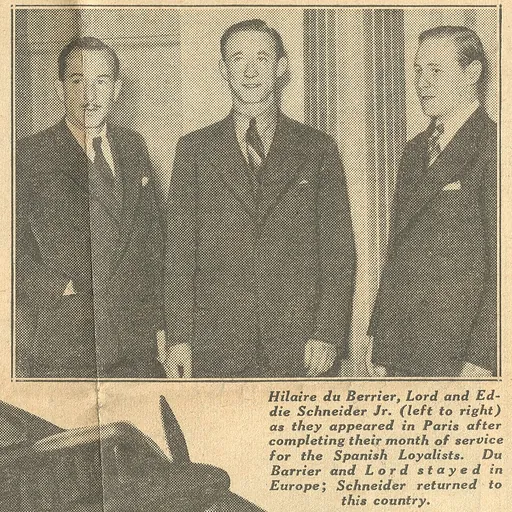
About Hilaire du Berrier
Lived 1906 – 2002 (aged 95). Hilaire du Berrier was an American and French aircraft pilot.
Hilaire du Berrier (born Harold Berrier; November 1, 1906 – October 12, 2002) was an American barnstorming pilot, mercenary adventurer, journalist, and spy. He wrote for a number of publications, mostly right-wing and far-right, including his own monthly newsletter. His father was a fur businessman; he died when Berrier was nine.
He found employment as a commercial artist in Chicago, working part time for ad agencies and department stores. He started working at the Heath School of Aviation, an early aviation manufacturer. At 20, he quit his job to become a barnstormer. He moved to Monte Carlo where he managed a nightclub, and after it closed, he worked for a perfume business. His mother died in 1935, leaving him an inheritance.
Spanish Civil War In the Spanish Civil War, du Berrier tried to join the Nationalists' air force but was prevented because he was on an Italian blacklist. He instead joined the Spanish Republican Air Force as a spy for King Alfonso XIII. According to du Berrier, he was denounced by American communist volunteers, arrested and sentenced to be executed as a spy. But, he wrote, he was pardoned by Alberto Bayo, because the Republicans felt that executing an American citizen would cost them support, especially from first lady Eleanor Roosevelt.
Living in London afterward, he caught the attention of British intelligence, which assessed that he was a "mercenary adventurer". Afterward, according to du Berrier, he traveled in Central Europe and the Balkans, representing a Dutch aircraft company, and then moved to Shanghai in China. He tried to sell aircraft in Shanghai but, according to his correspondence, the business flopped. He was awarded the French Cross of the Resistance Volunteer Combatant. briefly as an informant in Shanghai after the Japanese surrender in 1945. Also after the war he worked as a correspondent for Newsweek.
Birch publications and newsletter From 1958 until a few years before his death, du Berrier wrote articles for American Opinion magazine published by the John Birch Society and Review of the News published by Robert Welch, and its successor The New American. He was also associate editor of the John Birch newsweekly, Review of the News.
He published his monthly foreign affairs newsletter, H. du B. Reports, from June 1957 to May 2002.
He died on October 12, 2002, in Monaco. His papers covering the period 1935-1991 are stored with the State Historical Society of North Dakota.
Personal life He was married to Rosa Kadoorie of Shanghai. They had one daughter, Jeanette du Berrier Cholewa.
Works
Books Background to Betrayal: The Tragedy of Vietnam. Belmont, Mass.: Western Islands (1965). .
Pamphlets Labor's International Network. New Orleans, La.: Conservative Society of America (1962).
Recordings A Basket of Eels (1966). Los Angeles: Key Records [KLP 1060]. . Delivered at the New England Rally for God, Family and Country, Boston, 1966. Audio supervised by G. Edward Griffin.
Articles "The Ethiopian Woman." New Times and Ethiopia News (Aug. 1, 1936), p. 5. "Sad News of Ethiopian Women." New Times and Ethiopia News (Aug. 15, 1936), p. 8. "Facts—Not Fiction." New Times and Ethiopia News (Feb. 14, 1937), p. 8. "An Adventurer Retires." Esquire, vol. 10, no. 6 (Dec. 1938), pp. 52, 220, 222, 224, 226. Illustrations by William Sharp. "Outside the movies, a soldier of fortune is a military prostitute, without honor, security or friends." "Adventurers' Paradise." Esquire, vol. 12, no. 4 (Oct. 1939), pp. 42, 186–190. Illustrations by William Sharp. "Foreigners in Shanghai worked lightly, lived well, read the papers and agreed the Japs would never dare molest them." "No Wild Men in Borneo." XXth Century, vol. 1, no. 1 (Oct. 1941), pp. 45–51. Full issue. Shanghai: XXth Century Publishing Co. "We Never Noticed Carcassonne." Esquire, vol. 16, no. 6 (Dec. 1941), pp. 84–85, 223–224, 226–228. "The towers were there in the South of France, while we wished for the glory of war and never bothered to see them." "Shanghai's Morning After." XXth Century, vol. 2, no. 2 (Feb. 1942), pp. 139–144. Illustrations by Sapajou (aka George Sapojnikov, aka Georgii Avksent’ievich Sapojinikoff). Shanghai: XXth Century Publishing Co. "Coyotes Will Grow Up." XXth Century, vol. 2, no. 5 (May 1942), pp. 367–370. Illustrations by Hilaire du Berrier. Shanghai: XXth Century Publishing Co. Full volume. "Rev. Ford and Satan." XXth Century, vol. 3, no. 2/3 (Aug./Sep. 1942), pp. 192–197. Shanghai: XXth Century Publishing Co. "Tourist's Perfect Handbook." Esquire, vol. 29, no. 3 (Mar. 1948), pp. 98, 148–150. Full issue. "The traveler whose goal happens to be adventure is advised to keep in mind at all times the Golden Rule that manners make the gentleman—as well as the lady." "The Case of a Coward." Cosmopolitan (Sep. 1950). Published as Lee Clark. Ghostwritten by Hilaire du Berrier. "The Growth of Russian Influence in China." Intelligence Digest (Dec. 1950). "Americana: The Conversion of Doc Beade." American Mercury (Jul. 1952), pp. 79–86. "How We Helped Ho Chi Minh." Freeman, vol. 4, no. 15 (Apr. 19, 1954) pp. 516–518. Full issue. "The South Vietnam Americans Never Hear of." Economic Council Letter, no. 420 (Dec. 1, 1957). "About South Vietnam." American Opinion (Feb. 1958). [reprint of 1957 Economic council Letter article] "Report from Saigon." American Mercury (Sept. 1958), pp. 43–51. "FLN: Communism's Ball-Carrier in North Africa." American Mercury (Oct. 1959), pp. 140–146. "The Diem Myth." American Opinion (Oct. 1963), pp. 55–59. "Asia: Ablaze with Red Flames." American Opinion, vol. 8, no. 7 (Jul./Aug. 1965), pp. 13–46. "The Tragedy of Vietnam." Review of the News. "Asia: Consequences of a Failure of Will." American Opinion, vol. 9, no. 7 (Jul./Aug. 1966), pp. 15–46. "From Saigon." American Opinion, vol. 10, no. 1 (Jan. 1967), pp. 15–16. "Asia: We Must Win in Vietnam." American Opinion, vol. 10, no. 6 (Jul./Aug. 1967), pp. 73–104. "From the Continent." American Opinion, vol. 11, no. 1 (Jan. 1968), pp. 53–54. "From the Continent." American Opinion, vol. 11, no. 5 (May 1968), pp. 51–52. "Asia: A Nation by Nation Analysis." American Opinion, vol. 11, no. 7 (Jul./Aug. 1968), pp. 27–76. "Overseas." Review of the News (1973), pp. 49–50. "Notes on the 1974 Scoreboard." American Opinion (Jul.-Aug. 1974), pp. 105+. "The World." American Opinion, vol. 17 (Sep. 1974), pp. 107+.
Appearances Du Berrier appeared as himself in a 1982 documentary published by Western Goals Foundation titled No Place to Hide: The Strategy & Tactics of Terrorism, written, produced, and hosted by G. Edward Griffin and directed by Dick Quincer.
Don’t just read it —
keep it.
Full-length biographies made to live with: read them, listen on the way to work, watch them tonight.
- E-book
- Audio
- Video
Instant download · yours to keep · every purchase keeps this site free
Important facts
People in Hilaire du Berrier's life
Named in this biography and alive at the same time




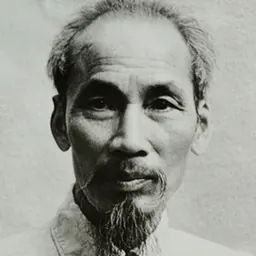



Related people
Same field, nearest in time
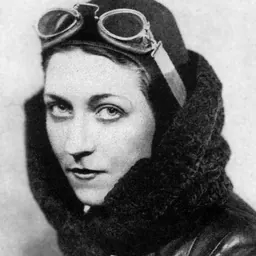

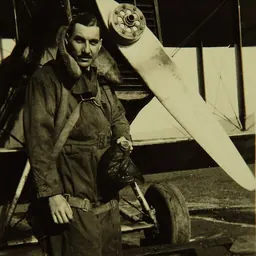
Contemporaries
People whose lives overlapped Hilaire du Berrier's



Frequently asked questions
Who was Hilaire du Berrier?
American-French aviator
When was Hilaire du Berrier born?
Hilaire du Berrier was born on 1 November 1906 in Flasher.
When did Hilaire du Berrier die?
Hilaire du Berrier died on 12 October 2002 in Monaco, Monte Carlo, Monaco.
What was Hilaire du Berrier's occupation?
Hilaire du Berrier was an aircraft pilot.
What nationality was Hilaire du Berrier?
Hilaire du Berrier was American and French.
Sources & further reading
· Wikipedia: Hilaire du Berrier
Cite this page
APA: Biography.guide. (2026). Hilaire du Berrier. https://biography.guide/hilaire-du-berrier/
MLA: "Hilaire du Berrier." Biography.guide, https://biography.guide/hilaire-du-berrier/.
Chicago: "Hilaire du Berrier." Biography.guide. https://biography.guide/hilaire-du-berrier/.
Data last updated: 2026-09-23 · Spot an error? Report a correction.
Portrait: Wikimedia Commons · author & licence
Page generated 2026-09-27 05:08 UTC