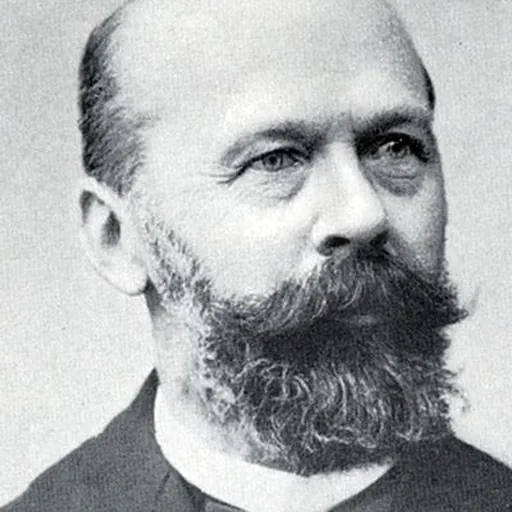
Hermann Müller
Swiss botanist, oenologist and grape breeder
About Hermann Müller
Lived 1850 – 1927 (aged 76). Hermann Müller was a Swiss botanist, mycologist, naturalist, oenologist and plant physiologist.
Bust in TägerwilenHermann Müller (; 21 October 1850 in Tägerwilen, Canton Thurgau – 18 January 1927 in Wädenswil) was a Swiss botanist, plant physiologist, oenologist and grape breeder. He called himself Müller-Thurgau, taking the name of his home canton.
Biography Hermann Müller was born to Konrad Müller, a master baker and vintner, and his wife Maria Egloff, the daughter of Karl Anton Egloff, a wine merchant of Oestrich, Hessen. He attended the Lehrerseminar Kreuzlingen (Kreuzlingen Teachers College) (1869–70). He taught in Stein am Rhein (1870–72) while studying at the Polytechnikum Zürich (1872 graduate). He then attended the University of Würzburg for graduate studies under Julius von Sachs, was awarded his PhD in 1874 and stayed some time as Sachs' assistant. During the years 1876–1890, he worked at the Prussian Institute for Horticulture and Viticulture (Königlich Preussische Lehranstalt für Obst- und Weinbau) in Geisenheim, Rheingau where he led its experimental station for plant physiology.
In 1891 he returned to Switzerland as director of the newly created Experimental Station and School for Horticulture and Viticulture (Versuchsstation und Schule für Obst-, Wein- und Gartenbau) in Wädenswil, where he stayed until his 1924 retirement. From 1902, he was also connected to Polytechnikum Zürich as professor of botany.
He worked on teams which investigated fertility of the vine, vine diseases, and malolactic fermentation in wine.
In 1890, he was made an honorary member of the German Viticultural Association and in 1920 he received an honorary doctorate from the University of Bern.
Müller researched and published on a wide range of topics in viticulture and winemaking, including the biology of vine flowering, assimilation of nutrients by the vine, vine diseases, alcoholic fermentation of wine, breeding of strains of yeast with specific properties, malolactic fermentation, development of wine faults, and methods for producing alcohol-free grape juice.
Breeding of the Müller-Thurgau grape variety
During his time in Geisenheim, Müller created the grape variety Müller-Thurgau in a breeding programme initiated in 1882, by crossing Riesling with Madeleine Royale, although for a long time, it was erroneously assumed to be Riesling x Silvaner. Müller's goal was to combine the aromatic properties of Riesling with the earlier and more reliable ripening of Silvaner. Experimental plantations continued in Geisenheim until 1890, and in 1891 150 plants were shipped to Wädenswil where trials continued under Heinrich Schellenberg (1868–1967). The most successful clone of the trials (serial no. 58) was propagated in 1897 under the designation Riesling x Silvaner 1. Vines of this variety were distributed in Switzerland and abroad from 1908, and in 1913, 100 vines of this variety were taken to Germany by August Dern (1858–1930), who had worked with Müller in Geisenheim. Dern introduced the name "Müller-Thurgau" for the variety, while Müller himself continued to call it Riesling x Silvaner 1, although he did express doubts that this was the actual parentage of the new variety, and speculated that some misidentification of vine material could have occurred in the move from Geisenheim to Wädenswil.
Many experimental plantations of Müller-Thurgau in Germany were conducted from 1920, and its breakthrough from 1938 is credited to the grape breeder Georg Scheu in Alzey. By the 1950s it had become the most cultivated of any newly created grape varieties. It was the most planted grape variety of Germany from the late 1960s to the mid-1990s, and is still the second-most planted.
Don’t just read it —
keep it.
Full-length biographies made to live with: read them, listen on the way to work, watch them tonight.
- E-book
- Audio
- Video
Instant download · yours to keep · every purchase keeps this site free
Important facts
People in Hermann Müller's life
Named in this biography and alive at the same time



Related people
Same field, nearest in time



Contemporaries
People whose lives overlapped Hermann Müller's





Frequently asked questions
Who was Hermann Müller?
Swiss botanist, oenologist and grape breeder (1850–1927)
When was Hermann Müller born?
Hermann Müller was born on 21 October 1850 in House Müller-Thurgau.
When did Hermann Müller die?
Hermann Müller died on 18 January 1927 in Wädenswil.
What was Hermann Müller's occupation?
Hermann Müller was a botanist, mycologist, naturalist, oenologist and plant physiologist.
What nationality was Hermann Müller?
Hermann Müller was Swiss.
Sources & further reading
· DBpedia: Hermann Müller (Swiss botanist)
Cite this page
APA: Biography.guide. (2026). Hermann Müller. https://biography.guide/hermann-muller-botanist-1850/
MLA: "Hermann Müller." Biography.guide, https://biography.guide/hermann-muller-botanist-1850/.
Chicago: "Hermann Müller." Biography.guide. https://biography.guide/hermann-muller-botanist-1850/.
Data last updated: 2026-09-21 · Spot an error? Report a correction.
Portrait: Wikimedia Commons · author & licence
Page generated 2026-09-27 05:00 UTC