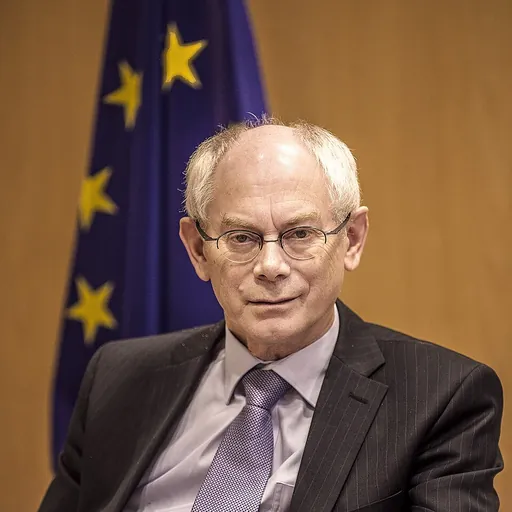
Herman Van Rompuy
Prime Minister of Belgium and President of the European Council (born 1947)
About Herman Van Rompuy
Born 1947. Herman Van Rompuy is a Belgian politician, economist and university teacher.
Herman Achille, Count Van Rompuy (; born 31 October 1947) is a Belgian politician who served as Prime Minister of Belgium from 2008 to 2009, and later as the first permanent president of the European Council from 2009 to 2014.
Van Rompuy, a politician from Belgium's Christian Democratic and Flemish party, served as the 49th prime minister of Belgium from 30 December 2008 until 25 November 2009, when he was succeeded by his predecessor, Yves Leterme. On 19 November 2009, the European Council, which consists of the heads of state or government of the EU member states, selected Van Rompuy as its first full-time President under the Treaty of Lisbon. His term officially began on 1 January 2010 and was set to run until 31 May 2012 On 1 March 2012, he was re-elected for a second and final term, serving from 1 June 2012 to 30 November 2014. In 2019, he was appointed chairman of the board of the College of Europe. and wife Germaine Geens (Begijnendijk, 1 December 1921 – Begijnendijk, 23 November 2004), he attended Sint-Jan Berchmanscollege in Brussels until 1965, where Ancient Greek and Latin were his main subjects. During his early teens, he was an avid rock and roll fan, particularly of American singer Elvis Presley.
Later, he studied at the and received a bachelor's degree in philosophy in 1968, and a master's degree in applied economics in 1971. From 1972 to 1975, he worked at the Belgian Central Bank.
Between 1980 and 1987, he was a lecturer at the Handelshogeschool Antwerpen (now Lessius University College). From 1982, he was also taught at the Vlaamse Economische Hogeschool Brussel (VLEKHO), which later became part of Hogeschool-Universiteit Brussel and is now the University of Leuven Brussels campus.
His younger brother, Eric Van Rompuy, is also a politician in the CD&V and served as a minister in the Flemish Government from 1995 to 1999. His sister, Tine Van Rompuy, is affiliated with the Workers' Party of Belgium. His another sister, Anita Van Rompuy, is not politically active and is married to Arne van der Graesen.
Belgian Minister of Budget (1993–1999) Van Rompuy was Deputy Prime Minister and Minister of Budget from September 1993 to July 1999, in the two governments led by Jean-Luc Dehaene. As budget minister, together with finance minister Philippe Maystadt, he helped drive down Belgium's debt from a peak of 135% of gross domestic product (GDP) in 1993. It fell to below 100% of GDP in 2003.
As President, Van Rompuy has avoided opposing Turkish membership of the EU. On 23 December 2010, he said "Turkish reform efforts have delivered impressive results." He continued "Turkey plays an ever more active role in its neighbourhood. Turkey is also a full-standing member of the G-20, just like five EU countries and the EU itself. In my view, even before an outcome of the negotiations, the European Union should develop a close partnership with the Turkish Republic."
President of the Belgian Chamber of Representatives (2007–2008)
After eight years in opposition, CD&V (formerly known as CVP) returned to government. On 12 July 2007, was elected as the president of the Belgian Chamber of Representatives, succeeding Herman De Croo.
Prime Minister of Belgium
On 28 December 2008, following the 2007–2008 Belgian political crisis, Van Rompuy was asked by King Albert II to form a new government after he was reluctant to take up the role of prime minister. He was sworn in as Belgian prime minister on 30 December 2008.
Taxes On 13 October 2009, Bloomberg reported that the government of Herman Van Rompuy would seek to tax banks and nuclear power to tame the deficit.
Quote on financial recovery "We are in the early stages of a recovery and at this time it is important not to weaken burgeoning confidence and to lay the foundations of a sustainable recovery" Van Rompuy said in a speech to parliament in Brussels. "Most important is to keep the direction. That will also provide stability and support."
Policy on government debt On 13 October, Bloomberg reported the following about Government Debt Policy: "Belgium will trim its budget deficit to 5.3% of gross domestic product in 2011 from almost 5.7% both this year and next, according to a slide presentation handed out by State Secretary for the Budget . told Parliament earlier today that the deficit would widen to 5.4% of GDP this year. Belgium's deficit will be little changed next year as the shortfall at the level of regional governments and municipalities will widen to 1.5% of GDP from 0.7%, offsetting efforts by the federal government to trim its deficit. Government debt will start exceeding one year's worth of national output , according to European Commission forecasts. Belgium had trimmed debt to as little as 84% of GDP in 2007, before bailouts of Fortis, Dexia SA, KBC Group NV and mutual insurer Ethias Group increased the nation's borrowing costs and inflated the debt ratio to 89.6% at the end of last year."
President of the European Council (2009–2014)
On 19 November 2009, Van Rompuy was chosen unanimously by the European Council, at an informal meeting in Brussels, to be the first full-time President of the European Council; for the period of 1 December 2009 (the entry into force of the Treaty of Lisbon) until 31 May 2012. He took up his position officially on 1 January 2010.
Gordon Brown also praised Van Rompuy as "a consensus-builder" who had "brought a period of political stability to his country after months of uncertainty". This opinion is shared by others; he has been described as the painstaking builder of impossible compromises (l'horloger des compromis impossibles) A statement made by Van Rompuy at a news conference after his selection illustrates his approach:
Given Van Rompuy's support for Europe and opposition to far right, not all parties and factions had positive words for him when he took office. British MEP and Eurosceptic Nigel Farage attacked the freshly appointed president by stating that he had "the charisma of a damp rag and the appearance of a low grade bank clerk." The remarks generated controversy and he was fined €3000 (ten days' pay) by the president (speaker) of the European Parliament for his unparliamentary comments.
In a November 2009 press conference, Van Rompuy related to global governance by stating: "2009 is also the first year of global governance with the establishment of the G20 in the middle of a financial crisis; the climate conference in Copenhagen is another step towards the global management of our planet." Van Rompuy referred to the United Nations Climate Change Conference 2009.
On 28 January 2010, Van Rompuy attended the 2010 International Conference on Afghanistan at Lancaster House in London. It was at this event that the framework for the next decade of the Islamic Republic of Afghanistan was settled by the Afghan president Hamid Karzai and his successor Ashraf Ghani and their donors. As seen at right, Gordon Brown, Hillary Clinton, Catherine Ashton and Anders Fogh Rasmussen amongst other Western leaders were in attendance.
In or just before the first months of his presidency Van Rompuy visited all EU member states, he also organised an informal meeting of the heads of state of the EU. The meeting took place on 11 February 2010, in the Solvay Library (Brussels), topics to be discussed were the future direction of the economic policies of the EU, the outcome of the Copenhagen Conference and the then recent earthquake in Haiti.
In fact, the meeting was in part taken over by the growing sovereign debt crisis (at that time, Greece), which was to become the hall mark of Van Rompuy's first two years as president. With EU member states holding divergent positions on this issue, he had to find compromises, not least between France and Germany, at subsequent European Council meetings and summits of Eurozone heads of state or government leading to the establishment of the three-year European Financial Stability Mechanism (EFSM) and the European Financial Stability Facility (EFSF) in May 2010, to provide loans to Greece (and later Ireland and Portugal) to help stabilise their borrowing costs, but subject to strict conditions. Van Rompuy with U.S. president Barack Obama and President of the European Commission José Manuel Barroso, November 2011
The European Council also gave him the assignment of chairing a task force on economic governance, composed of personal representatives (mostly ministers of finance) of the heads of government, which reported ahead of schedule to the October 2010 European Council. Its report, which proposed stronger macro-economic co-ordination within the EU in general and the Eurozone in particular and also a tightening of the Stability and Growth Pact was endorsed by the European Council. The latter also charged him with preparing, by December 2010, a proposal for a limited change to the treaty required to enable a more permanent financial stability mechanism. His draft – for an addition to Article 136 TFEU, pertaining to the Eurozone – was endorsed by the European Council at its October 2010 meeting.
His second year in office, 2011, was also marked by a deterioration of the Greek debt crisis, leading to Van Rompuy calling an extraordinary meeting of the Eurozone heads of state or government in July to adopt a first package of further measures (notably longer-term loans at lower interest rates, private sector debt-writedown, further fiscal consolidation in Greece) and again in October (in conjunction with full European Council meetings) to contain contagion from Greece to other countries (through bank recapitalisation across Europe and by leveraging the firepower of the EFSF to about €1 trillion).
His first two years were also marked by his role in co-ordinating European positions on the world stage at G8 and G20 summits and bilateral summits, such as the tense 5 October 2010, EU-China summit. He called a special European Council at short notice in early 2011, on the emerging Libya crisis, which, in agreeing conditions for military intervention, made it impossible for Germany to oppose such intervention once the conditions were fulfilled.
On 1 March 2012, Van Rompuy was re-elected unanimously as President of the European Council by the heads of state or government of the 28 EU member states. President Van Rompuy's second term lasted for two and a half years, from 1 June 2012 to 30 November 2014. After this second mandate he could not have been re-elected because the European Council President's term of office can only be extended once.
Van Rompuy was also appointed as the first president of the Euro Summit, and this for the same term of office as his Presidency of the European Council. The Euro Summit meetings are to take place at least twice a year.
In 2014, Van Rompuy was awarded the International Charlemagne Prize of Aachen for his EU role.
President's cabinet Although the European Council is, under the terms of the Lisbon treaty, a separate institution of the EU, it does not have its own administration. The administrative support for both the European Council and its president is provided by the General Secretariat of the Council of the European Union.
The president does have, however, his own private office (cabinet) of close advisers. Van Rompuy chose as his chief of staff (chef de cabinet) Baron Frans van Daele, formerly Belgian ambassador to, variously, the US, the UN, the EU and NATO and chief of staff of several Belgian foreign ministers. Also in his team were the former (and later) UK Labour MEP Richard Corbett, former Hungarian ambassador to NATO Zoltan Martinusz, former head of the EU's economic & financial committee Odile Renaud-Basso, Dutch philosopher and journalist Luuk van Middelaar, his main speech writer, and Van Rompuy's long standing press officer Dirk De Backer.
In 2013, Frans Van Daele retired both as a diplomat and as chief of staff of Van Rompuy, and was appointed chief of staff to His Majesty King Philippe. He was succeeded as chief of staff of Herman Van Rompuy by Didier Seeuws.
Later career When the EPP membership of Hungarian party Fidesz was suspended in 2019, EPP president Joseph Daul appointed van Rompuy – alongside Hans-Gert Pöttering and Wolfgang Schüssel – to a group of high-level experts who were mandated to monitor Fidesz's compliance with EPP values.
He was appointed chairman of the board of the College of Europe in 2019.
Other activities Corporate boards Dexia, board member and member of the audit committee (before 2008)
Educational institutions Centre International de Formation Européenne (CIFE), President
Non-profit organizations Club of Madrid, Member European Policy Centre (EPC), chair of the Strategic Council New Pact for Europe, chair of the Advisory Group Trilateral Commission, member of the European Group
Honours
Belgian honours Created Count van Rompuy, by Royal Decree of 8 July 2015 of King Philippe. Minister of State, by Royal Decree of 26 January 2004 of King Albert II. Order of Leopold: Commander, by Royal Decree of 22 May 2003 of King Albert II. Grand Cordon, by Royal Decree of 23 December 2009 of King Albert II.
Foreign honours Grand Cross of the National Order of Benin Grand Officier of the Legion of Honour Knight Grand Cross of the Order of Orange-Nassau (10 October 2014) Grand Cross of the Order of the Star of Romania
Honorary citizenships
Doctor honoris causa from the Ghent University (18 March 2011) Doctor honoris causa from the Catholic University of Leuven (1 June 2012) Doctor honoris causa from the Kobe University (4 March 2011) Doctor honoris causa from the Azerbaijan University of Languages (5 July 2012) Doctor honoris causa from the Vietnam National University, Hanoi (1 November 2012) Doctor honoris causa from the CEU San Pablo University (12 December 2013) Doctor honoris causa from the university of Abomey-Calavi (21 February 2014) Doctor honoris causa from the VU University Amsterdam (20 October 2015) Honorary LL.D. degree from the University of St Andrews (21 June 2016) Honorary D.C.L. degree from the University of Kent (14 July 2016) Honorary LL.D. degree from Carleton University (18 November 2017)
Awards Charlemagne Prize (29 May 2014) Nueva Economía Forum Prize (10 December 2010)
Don’t just read it —
keep it.
Full-length biographies made to live with: read them, listen on the way to work, watch them tonight.
- E-book
- Audio
- Video
Instant download · yours to keep · every purchase keeps this site free
Important facts
Family & relationships
People in Herman Van Rompuy's life
Named in this biography and alive at the same time



Related people
Same field, nearest in time





Contemporaries
People whose lives overlapped Herman Van Rompuy's


Frequently asked questions
Who is Herman Van Rompuy?
Prime Minister of Belgium and President of the European Council (born 1947)
When was Herman Van Rompuy born?
Herman Van Rompuy was born on 31 October 1947 in Etterbeek.
What is Herman Van Rompuy's occupation?
Herman Van Rompuy is a politician, economist and university teacher.
What nationality is Herman Van Rompuy?
Herman Van Rompuy is Belgian.
Sources & further reading
· Wikipedia: Herman Van Rompuy
Cite this page
APA: Biography.guide. (2026). Herman Van Rompuy. https://biography.guide/herman-van-rompuy/
MLA: "Herman Van Rompuy." Biography.guide, https://biography.guide/herman-van-rompuy/.
Chicago: "Herman Van Rompuy." Biography.guide. https://biography.guide/herman-van-rompuy/.
Data last updated: 2026-09-21 · Spot an error? Report a correction.
Portrait: Wikimedia Commons · author & licence
Page generated 2026-09-27 04:59 UTC