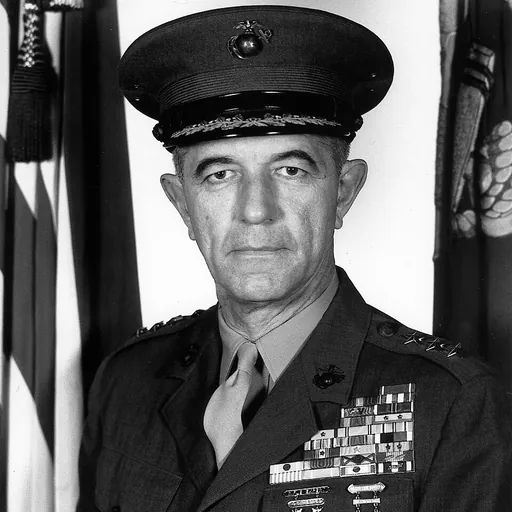
About Herman Nickerson Jr.
Lived 1913 – 2000 (aged 87). Herman Nickerson Jr. was an American military personnel.
Herman Nickerson Jr. (30 July 1913 – 26 December 2000) was a highly decorated officer of the United States Marine Corps with the rank of lieutenant general. A veteran of several wars, he distinguished himself during the Korean War as commanding officer, 7th Marine Regiment and received the Distinguished Service Cross, the second highest military award that can be given to a member of the United States Armed Forces for extreme gallantry and risk of life in actual combat with an armed enemy force.
He served two tours of duty in South Vietnam and distinguished himself as commanding general, III Marine Amphibious Force which was responsible for all marine forces in the later part of the Vietnam War. Following his retirement, Nickerson worked as chairman, National Credit Union Administration.
Early years Herman Nickerson Jr. was born on 30 July 1913 in Boston, Massachusetts, the son of Herman and Emma Nickerson. He attended the high school in Arlington, Massachusetts, and enrolled at Boston University, where he was a member of ROTC unit for four years. Nickerson graduated in June 1935 with a bachelor's degree from the business school and also was commissioned Reserve second lieutenant in June 1934.
Nickerson resigned his reserve commission in order to accept appointment as second lieutenant in the Marine Corps on July 10, 1935. He was subsequently ordered to the Basic School at Philadelphia Navy Yard for basic officer training, which he completed in February 1936. With 124 students, it was the largest Basic School class to that date. This class provided two future Marine Corps Commandants (Leonard F. Chapman Jr. and Robert E. Cushman Jr.), five lieutenant generals (Lewis J. Fields, Frederick E. Leek, Nickerson, William J. Van Ryzin, Richard G. Weede), five major generals (William R. Collins, William T. Fairbourn, Bruno Hochmuth, Raymond L. Murray, Carey A. Randall) and six brigadier generals (William W. Buchanan, Odell M. Conoley, Frederick P. Henderson, Roy L. Kline, John C. Miller Jr., Thomas F. Riley).
Nickerson then sailed for China and served two and half years with the guard duty at Shanghai International Settlement with 2nd Battalion, 4th Marine Regiment under Colonel Charles F. B. Price. He was promoted to the rank of first lieutenant in August 1938 and returned to the United States in November of that year. Nickerson then assumed command of the Marine detachment at the Naval Air Station Seattle, Washington and remained in that capacity until November 1940. He then joined 2nd Defense Battalion under Major Lewis A. Hohn at San Diego, California and later served with the same unit at Parris Island, South Carolina.
Postwar career Following the deactivation of 4th Marine Division in November 1945, Nickerson joined the staff of III Marine Amphibious Corps under Lieutenant General Keller E. Rockey. He served again as Ordnance officer and took part in the occupation of North China in Tianjin during the Chinese Civil War. After the dissolving of III Marine Amphibious Corps in June 1946, Nickerson was attached to the staff of 1st Marine Division under Major General Samuel L. Howard and served as Division Ordnance Officer and Division Legal Officer, respectively, until January 1947, when he was ordered back to the United States. For his service in China, Nickerson was decorated with the Bronze Star Medal.
Nickerson received orders to secure the high ground dominating the vital road junction near the town of Yanggu on 31 May 1951. His regiment advanced under heavy enemy mortar and after learning that two of his battalions were heavily engaged and that the enemy was grouping for a counterattack, Nickerson unhesitatingly left the comparative safety of his command post and moved forward over rugged mountainous terrain, under intense enemy mortar and artillery fire, to the most forward element of his command. Unmindful of his personal safety, he advanced to an exposed vantage point under heavy enemy fire and, guided his troops in repulsing the ferocious counterattack, taking the offensive and overwhelming the enemy to secure the high ground dominating the vital road junction of Yanggu. His regiment seized the town by nightfall and also its airfield and the hills surrounding the town.
They were ordered back to reserve on 16 September 1951 and Nickerson left the regiment four days later with the orders for new assignment. For his service with 7th Marine Regiment, he was decorated with the Legion of Merit with Combat "V" and also received Air Medal for participation in the reconnaissance flights over the enemy lines. In this capacity, Nickerson was responsible for the logistics support of the Marine Forces in the Pacific until he assumed command of Camp Lejeune in June 1965. While in this capacity, he was responsible for the training of troops designated for combat deployment to South Vietnam.
Vietnam War First tour Nickerson was ordered to South Vietnam in September 1966 and succeeded Major General Lewis J. Fields in command of the 1st Marine Division with temporary additional duty as deputy commander, III Marine Amphibious Force (III MAF) under Lieutenant General Lewis W. Walt. His tactical area was increased to 1,536 square miles and one his first orders was to move his headquarters from Chu Lai to Da Nang, which was closer to the Vietnamese Demilitarized Zone. He then established the Kit Carson program, whose members were former Viet Cong combatants, who now worked with the Marines as scouts. Nickerson receives his three-star flag during his promotion to lieutenant general by Commandant Leonard F. Chapman Jr., March 1968. His tactical area of responsibility consisted of the three southernmost provinces of I Corps: Quang Nam, Quang Tin, and Quang Ngai. This area was important for diverse reasons. It contained a large population, was a rich rice-producing basin, and was a major source of salt, which had traditionally been a medium of barter and a taxable commodity in Vietnam. Furthermore, the tree-covered foothills of the Annamite Mountains jutting into the coastal plain and the numerous rivers provided the enemy with natural access to the area.
According to the joint Vietnamese-U. S. 1967 Combined Campaign Plan in which III MAF troops were to relieve Army of the Republic of Vietnam units from outpost duty so that they could be employed more effectively elsewhere in the Revolutionary Development Program. Operation Desoto in Đức Phổ District commencing late January 1967 was the first one of these relieving operations. The Marines under Nickerson's command assumed defense of the district, but participated in the skirmishes with Viet Cong until the early April of that year and suffered 76 dead and 573 wounded. The Marines claimed 383 Viet Cong killed.
However the new policy of Vietnamization led to the reduction of US forces in South Vietnam. In mid-1969, Nickerson oversaw the redeployment of 3rd Marine Division, which was detached from his command and transferred to Okinawa within Operations Keystone Eagle and Keystone Cardinal. Throughout the rest of 1969, he oversaw the planning and execution of several search and destroy operations (including Oklahoma Hills, Pipestone Canyon) and his units inflicted severe losses on the enemy and capturing over 17,000 weapons and tons of enemy munitions, supplies, and foodstuffs. He submitted two approved supplemental applications, giving him formal recognition for a total of three documented Patriot ancestors. He oversaw the organization during a period of administrative transition that included the temporary relocation of the national headquarters from Washington, D.C., to Alexandria, Virginia, before its subsequent move to Louisville, Kentucky. They later moved to Belfast, Maine, where Nickerson was active in the Marine Corps History Program.
Nickerson was awarded a Certificate of Appreciation by then-Commandant of the Marine Corps Robert H. Barrow for his contributions to the Oral History Program. Lieutenant General Herman Nickerson Jr. died on 27 December 2000 in Belfast, Maine.
Don’t just read it —
keep it.
Full-length biographies made to live with: read them, listen on the way to work, watch them tonight.
- E-book
- Audio
- Video
Instant download · yours to keep · every purchase keeps this site free
Important facts
People in Herman Nickerson Jr.'s life
Named in this biography and alive at the same time




Related people
Same field, nearest in time


Contemporaries
People whose lives overlapped Herman Nickerson Jr.'s


Frequently asked questions
Who was Herman Nickerson Jr.?
U.S. Marine Corps Lieutenant General (1913-2000)
When was Herman Nickerson Jr. born?
Herman Nickerson Jr. was born on 30 July 1913 in Boston.
When did Herman Nickerson Jr. die?
Herman Nickerson Jr. died on 26 December 2000 in Waldo.
What was Herman Nickerson Jr.'s occupation?
Herman Nickerson Jr. was a military personnel.
What nationality was Herman Nickerson Jr.?
Herman Nickerson Jr. was American.
Sources & further reading
· Wikipedia: Herman Nickerson Jr.
· DBpedia: Herman Nickerson Jr.
Cite this page
APA: Biography.guide. (2026). Herman Nickerson Jr.. https://biography.guide/herman-nickerson-jr/
MLA: "Herman Nickerson Jr.." Biography.guide, https://biography.guide/herman-nickerson-jr/.
Chicago: "Herman Nickerson Jr.." Biography.guide. https://biography.guide/herman-nickerson-jr/.
Data last updated: 2026-09-24 · Spot an error? Report a correction.
Portrait: Wikimedia Commons · author & licence
Page generated 2026-09-27 05:09 UTC