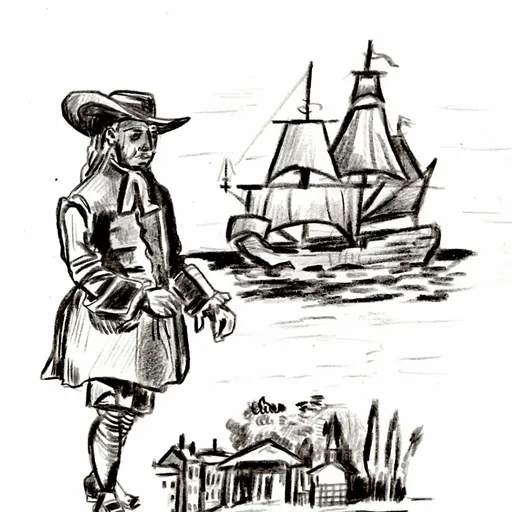
Herman Isacks op den Graeff
Original founder of Germantown, Pennsylvania, early abolitionist
About Herman Isacks op den Graeff
Lived 1642 – 1708 (aged 65–66).
Herman Isacks op den Graeff, also Herman op den Graeff, Opdengraef, Opdengraff as well as Op den Gräff (1642 in Krefeld – 1704 / 1708 in Delaware County, Philadelphia, Pennsylvania) was one of the so-called Original 13, the first closed group of German emigrants to North America and an original founder of Germantown, Pennsylvania. He was an outspoken anti slavery man and abolitionist.
Biography Krefeld Herman op den Graeff was born to Isaac Herman op den Graeff (1616–1669) and Margaret 'Grietgen' Peters Doors (around 1620–1683). Former Mennonite leader Herman op den Graeff was his grandfather. The Op den Graeff family were originally Mennonites.
Quaker missionary work in the lower and middle Rhine River valley during the 1660s resulted in the conversion of a number of Mennonites in and around Krefeld. Among these converts were Derick op den Graeff and his family. The Quakers were not as readily tolerated by the people of Krefeld. Their organized activity brought them into a dispute with the local clergy. In 1679, the Synod of Mörs (Moers) with Quakers from England and Holland as well took place in Krefeld and in the same year Herman op den Graeff and five other leading Quakers were forcibly exiled from Krefeld. In 1680, Herman and Hendrik Janez, two of that six exciled Quakers, published the pamphlet "Remonstrance" against Baron Kinski, the sheriff of the County of Moers, the Magistrate, inhabitants and the clergy of Krefeld. It was written in Dutch language and published in Rotterdam and Amsterdam. The opportunity to follow their Quaker beliefs without fear of persecution was undoubtedly a major factor in their decision to emigrate from Krefeld. Herman became one of the first 13 families, the so-called Original 13, leave, The three Op den Graeffs had another brother, Adolphus Op Den Graeff (* 1648), who did not join the emigration but settled near Koblenz before 1680. His grandson John William (Johan Wilhelm) op den Graeff (1732 - between 1800 and 1804) immigrated in 1753 to Pennsylvania as well. Their descendants joined their name into Updegrove.
Germantown Settlement Monument in Vernon Park, Philadelphia, in memory of Francis Daniel Pastorius and the first settlers.
Plan of lots in Germantown, Pennsylvania, in 1689, showing lot owners in 1689 and 1714. Derick op den Graeff owned the lot 3.
Herman op den Graeff and his family were one of the original thirteen families which founded Germantown. In 1691, Thomas Lloyd, Deputy General of Pennsylvania had granted a naturalisation to sixtytwo of the first Germantown settlers as citizens of Pennsylvania (and therefore of England) with the status of freeman including the three Op den Graeff brothers and also other important members of the settlement, Francis Daniel Pastorius and William Rittenhouse. The Krefeld Quaker advocates were Herman op den Graeff and his brother Abraham who sided Keith. Their other brother Derick op den Graeff was their opponent, who sided the conservative Quakers. He was also a co-signer of the judgment against Keith, which excluded him from the Quaker community. He was fined five pounds by a secular court. Herman on the other hand was one of a group of 69 men who wrote a letter defending Keith. After that controversy Herman and Abraham lost influence and favor and Herman didn't hold any official position.
According to the book William Penn and the Dutch Quaker Migration to Pennsylvania by Prof. William I. Hull, his heir was his brother Abraham, the only one of the three brothers Op den Graeff (beside Derick and Herman) who had descendants. (I) Margaretha Opdengraeff (1677–1748) (II) Syltge Opdengraeff (* 1685) (II) Isaac Updegrove (1693–1747)
Coat of arms
There is a reference about the Op den Graeff glass paintings of Krefeld with a description of Herman op den Graeffs coat of arms was found in the estate of W. Niepoth (op den Graeff folder) in the archives of the city of Krefeld, who noted a letter dated November 17, 1935 from Richard Wolfferts to Dr Risler: Saw the Coat of Arms glass pane in the old museum: 'Herman op den Graeff und Grietgen syn housfrau' or the like. Coat of Arms - In the sign a silver swan in blue. Helmet decoration (I think): Swan growing.
Don’t just read it —
keep it.
Full-length biographies made to live with: read them, listen on the way to work, watch them tonight.
- E-book
- Audio
- Video
Instant download · yours to keep · every purchase keeps this site free
Important facts
People in Herman Isacks op den Graeff's life
Named in this biography and alive at the same time


Contemporaries
People whose lives overlapped Herman Isacks op den Graeff's




Frequently asked questions
Who was Herman Isacks op den Graeff?
original founder of Germantown, Pennsylvania, early abolitionist
When was Herman Isacks op den Graeff born?
Herman Isacks op den Graeff was born in 1642.
When did Herman Isacks op den Graeff die?
Herman Isacks op den Graeff died in 1708.
Sources & further reading
· Wikipedia: Herman Isacks op den Graeff
· DBpedia: Herman Isacks op den Graeff
Cite this page
APA: Biography.guide. (2026). Herman Isacks op den Graeff. https://biography.guide/herman-isacks-op-den-graeff/
MLA: "Herman Isacks op den Graeff." Biography.guide, https://biography.guide/herman-isacks-op-den-graeff/.
Chicago: "Herman Isacks op den Graeff." Biography.guide. https://biography.guide/herman-isacks-op-den-graeff/.
Data last updated: 2026-09-21 · Spot an error? Report a correction.
Portrait: Wikimedia Commons · author & licence
Page generated 2026-09-27 05:01 UTC