
About Herbert Lütje
Lived 1918 – 1967 (aged 48). Herbert Lütje was a German military personnel.
Herbert Heinrich Otto Lütje (30 January 1918 – 18 January 1967) was a German military aviator, a wing commander in the Luftwaffe during World War II and an officer in the postwar German Air Force. As a fighter ace, he was credited with 50 aerial victories claimed in 247 combat missions. His 47 nocturnal claims made him the twentyfourth most successful night fighter pilot in the history of aerial warfare. All of his victories were claimed in Defense of the Reich missions, the majority at night against the Royal Air Force's (RAF) Bomber Command and three daytime claims, one over a United States Army Air Forces (USAAF) Boeing B-17 Flying Fortress bomber and two Lockheed P-38 Lightning fighter aircraft.
Born in Abbesbüttel, Lütje grew up in the Weimar Republic and Nazi Germany. Following graduation from school, he joined the military service in 1937 and was trained as a pilot. In 1939 and 1940 he served with the night-fighter squadron of Lehrgeschwader 2 (LG 2—2nd Demonstration Wing) and Jagdgeschwader 2 "Richthofen" (JG 2—2nd Fighter Wing) during the Norwegian campaign and Battle of France. Following the units reorganization, he served with III. Gruppe (3rd group) of Nachtjagdgeschwader 1 (NJG 1—1st Night Fighter Wing). Lütje claimed his first aerial victory on the night of 6/7 September 1942 and was appointed squadron leader of 8. Staffel (8th squadron) of NJG 1 in May 1943. Following his 28th aerial victory, he was awarded the Knight's Cross of the Iron Cross on 1 June 1943, shortly after he was given command IV. Gruppe of Nachtjagdgeschwader 6 (NJG 6—6th Night Fighter Wing). He was appointed Geschwaderkommodore (wing commander) of NJG 6 in October 1944. On 17 April 1945, he was awarded the Knight's Cross of the Iron Cross with Oak Leaves.
Following the rearmament of the Federal Republic of Germany, Lütje joined the German Air Force in July 1957. He died on 18 January 1967 in Cologne-Wahn.
Early life and career Lütje was born on 30 January 1918 in Abbesbüttel, at the time in the Province of Hanover, as part of the German Empire. He was the son of a farmer. After graduation from school, Lütje joined the Luftwaffe on 1 November 1937 as a Fahnenjunker (cadet) and attended the Luftkriegsschule 2 in Berlin-Gatow. Following flight training, he was promoted to Leutnant (second lieutenant) on 1 August 1939. In December 1939, he was transferred to the night fighter squadron of Lehrgeschwader 2 (LG 2—2nd Demonstration Wing).
World War II World War II in Europe began on Friday, 1 September 1939, when German forces invaded Poland. In February 1940, the night fighter squadron was absorbed by the VI. (Nacht) Gruppe (4th night fighter group) of Jagdgeschwader 2 "Richthofen" (JG 2—2nd Fighter Wing). There, Lütje was assigned to the 12. Staffel (12th squadron). Flying with this squadron, he participated in the Norwegian Campaign. On 24 April 1940, 12. Staffel was ordered to Aalborg where it stayed until May. From Aalborg, the unit flew patrol missions along the Danish coast. On 31 May, 12. Staffel was ordered back to Germany, arriving in Jever on 2 June. The Staffel then moved to Köln-Ostheim airfield, flying night-fighter missions during the Battle of France. In total, Lütje flew three missions over Norway and 19 missions during the Battle of France on the Messerschmitt Bf 109 D single engined fighter.
Night fighter career A map of part of the Kammhuber Line. The 'belt' and night fighter 'boxes' are shown. Following the 1939 aerial Battle of the Heligoland Bight, Royal Air Force (RAF) attacks shifted to the cover of darkness, initiating the Defence of the Reich campaign. By mid-1940, Generalmajor (Brigadier General) Josef Kammhuber had established a night air defense system dubbed the Kammhuber Line. It consisted of a series of control sectors equipped with radars and searchlights and an associated night fighter. Each sector named a Himmelbett (canopy bed) would direct the night fighter into visual range with target bombers. In 1941, the Luftwaffe started equipping night fighters with airborne radar such as the Lichtenstein radar. This airborne radar did not come into general use until early 1942.
Following the campaign in Norway and France, VI.(N)/JG 2 was moved to Mönchengladbach in late June. There, the unit was outfitted with the Bf 109 E, equipped with the navigational direction finder PeilG IV direction finder (PeilG - Peilgerät). The objective was to test single-engined fighter aircraft as night-fighters. During this test phase, VI.(N)/JG 2 was integrated in the newly formed Nachtjagdgeschwader 1 (NJG 1—1st Night Fighter Wing) on 26 June 1940. On 1 July, the Gruppe was officially designated III. Gruppe (3rd Group) of NJG 1 and converted to the twin-engined Messerschmitt Bf 110 heavy fighter.
At the time, Lütje was assigned to the Stab of III. Gruppe. Flying his 49th night fighter mission, he claimed his first nocturnal aerial victory on the night of 6/7 September 1941. The claim was filed over an Armstrong Whitworth Whitley bomber in the vicinity of Metelen. With five aerial victories to his credit, he was appointed Staffelkapitän (Squadron Leader) of the 8. Staffel of NJG 1 (8th Squadron of the 1st Night Fighter Wing) on 1 May 1942. On 28 September 1942, he received the Honor Goblet of the Luftwaffe and was promoted to Hauptmann (captain) on 1 October. By the end of 1942, his number of aerial victories had increased to 16.
Lütje claimed a Boeing B-17 Flying Fortress bomber shot down during a day time mission against the United States Army Air Forces (USAAF) on 4 March 1943. He achieved his 20th aerial victory on the night of 12/13 March 1943. Lütje was awarded the Knight's Cross of the Iron Cross on 1 June 1943 after he had shot down six British and Canadian bombers on the night of 13/14 May 1943. Among them was a Royal Air Force (RAF) Avro Lancaster from No. 57 Squadron piloted by Pilot Officer Jan Bernand Marinus Haye on a mission to bomb the Škoda Works at Plzeň. The bomber was set on fire and the crew bailed out safely.
He was then appointed Gruppenkommandeur (Group Commander) of the newly formed IV. Gruppe (4th Group) of Nachtjagdgeschwader 6 (NJG 6—6th Night Fighter Wing) in June 1943. IV./NJG 6 was based in Rumania and tasked with the protection of the Romanian oil fields. In September 1943 he flew a number of combat missions out of the Netherlands claiming four aerial victories.
Over Romania he again fought the USAAF during daytime sorties. Fighting the Fifteenth Air Force he shot down two P-38 Lightnings—one of them by his radio operator with the MG 81Z—on 10 June 1944. His Bf 110 G-4 (Werknummer 140018—factory number) was severely damaged. He and his wireless radio operator Oberfeldwebel (Sergeant) August Bogumil were wounded and had to make a forced landing. Over Romania, Lütje was credited with six Vickers Wellington bombers and one Soviet Ilyushin Il-4 aircraft over the Black Sea during nocturnal combat missions. At the end of August 1944 IV./NJ 6 was relocated back to Germany.
Lütje was appointed Geschwaderkommodore (Wing Commander) of NJG 6 on 13 September 1944, succeeding Major Heinrich Griese. Command of IV. Gruppe was passed on to Hauptmann Martin Becker. Lütje claimed his final eight aerial victories in 1945. On 15 March, he was nominated for the Knight's Cross of the Iron Cross with Oak Leaves . The nomination of the Oak Leaves was approved on 31 March and were awarded on 17 April 1945 after 50 aerial victories on 17 April 1945, the 836th officer or soldier of the Wehrmacht so honored. At the end of war he was taken prisoner of war and released in June 1945.
Later life Following the Wiederbewaffnung (rearmament) of the Federal Republic of Germany, Lütje joined the German Air Force in July 1957. He retired holding the rank of Oberst (colonel) and died on 18 January 1967 in Cologne-Wahn.
Summary of career
Aerial victory claims According Spick, Lütje was credited with 53 aerial victories, including two by day and 51 by night, claimed in approximately 150 combat missions. Foreman, Parry and Mathews, authors of Luftwaffe Night Fighter Claims 1939 – 1945, researched the German Federal Archives and found records for 50 victory claims. Mathews and Foreman also published Luftwaffe Aces — Biographies and Victory Claims, listing Lütje with 46 claims, plus five further unconfirmed claims and one by his air gunner Oberfeldwebel Bogumil.
Chronicle of aerial victories Claim Date Time Type Location Serial No./Squadron No. – III. Gruppe of Nachtjagdgeschwader 1 – 1 6 September 1941 23:22 Whitley Metelen 2 20 September 1941 22:18 Wellington west of Bad Bentheim 3 8 November 1941 00:04 Halifax east of Terlet Airfield Halifax L9603/No. XXXV (Madras Presidency) Squadron 4 26 March 1942 23:50 Wellington north of Vriezenveen Wellington Z1143/No. 214 (Federated Malay States) Squadron 5 4 June 1942 02:25 Wellington – 8. Staffel of Nachtjagdgeschwader 1 – 6 20 June 1942 02:32 Wellington southwest of Raalte 7 26 June 1942 00:58 Wellington northeast of Nordhorn Wellington DV951/No. 12 Operational Training Unit RAF 8 3 July 1942 01:40 Wellington north of Nordhorn 9 26 July 1942 02:01 Wellington Wielen Wellington Z1462/No. 460 Squadron RAAF 10 10 August 1942 04:18 Wellington northwest of Wierden Wellington BJ608/No. 150 Squadron RAF 11 18 August 1942 01:38 Lancaster west of Emlichheim 12 27 August 1942 23:45 Wellington southeast of Rechteren Castle Wellington Z1212/No. 460 Squadron RAAF 13 5 September 1942 02:53 Wellington northeast of Altenkeine 14 5 September 1942 03:59 Stirling northwest of Hasselt Stirling BF337/No. 214 (Federated Malay States) Squadron 15 16 September 1942 23:22 Wellington north of Ahaus Wellington Z1084/No. 22 Operational Training Unit RAF 16 17 December 1942 21:10 Lancaster northeast of Zwolle 17 2 March 1943 00:08 Halifax north of Zuidlo Halifax DT797/No. 408 Squadron 18 4 March 1943 11:31 B-17 west of Den Helder B-17 41-24512/91st Bombardment Group 19 5 March 1943 21:35 Halifax southeast of Staphorst Halifax HR687/No. 78 Squadron RAF 20 12 March 1943 21:18 Halifax east-southeast of Alstalte 21 30 March 1943 04:28 Lancaster south of Raalte Lancaster ED435/No. 49 Squadron RAF 22 3 April 1943 22:45 Lancaster west of Winterswijk 23 3 April 1943 23:37 Halifax south of Zwolle 24♠ 13 May 1943 23:52 Lancaster southeast of Almelo Lancaster ED667/No. 57 Squadron 25♠ 13 May 1943 23:42 Lancaster north of Oldenzaal Lancaster R5611/No. 106 Squadron 26♠ 13 May 1943 23:54 Lancaster south of Hörstel Lancaster W4305/No. 44 Squadron 27♠ 14 May 1943 02:25 Halifax west of Dedemsvaart Halifax JB966/No. 405 Squadron RCAF 28♠ 14 May 1943 02:45 Halifax Dalen Halifax JD113/No. 419 Squadron RCAF 29♠ 14 May 1943 02:55 Halifax east of Hoogeveen Halifax JB892/No. 77 Squadron 30 3 September 1943 23:25 Lancaster northeast of Rheine 3 September 1943 00:00 Lancaster 31 23 September 1943 22:50 Halifax 32 27 September 1943 23:40 Halifax Neustadt – IV. Gruppe of Nachtjagdgeschwader 6 – 33 6 May 1944 01:05 Wellington northwest of Ploiești 34 7 May 1944 23:59 Wellington Maroshévíz 35 8 May 1944 00:18 Wellington southwest of Blejești 36 10 June 1944 08:29 P-38 south of Bucharest 37* 10 June 1944 08:31 P-38 south of Bucharest 38 29 June 1944 02:23 Wellington north of Stockerau 39? 9 August 1944 23:00 Wellington Romania 20 August 1944 23:05 Wellington Romania 40? 20 August 1944 23:05 Wellington Romania 22 August 1944 01:05 Il-4 Romania 42 20 September 1944 23:30 Wellington northeast of Lake Neusiedl – Stab of Nachtjagdgeschwader 6 – 43 2 February 1945 23:24 Lancaster west of Karlsruhe 44 14 February 1945 20:27 Lancaster northeast of Frankfurt am Main 45 21 February 1945 20:43 Halifax southwest of Worms 46 21 February 1945 20:55 Halifax Saarbrücken 47 14 March 1945 21:24 Lancaster northwest of Nürnberg 48 16 March 1945 21:33 Lancaster south-southwest of Nürnberg 49 19 March 1945 04:45 Lancaster 50 21 March 1945 04:59 Lancaster
Awards Honour Goblet of the Luftwaffe on 28 September 1942 as Oberleutnant and Staffelkapitän German Cross in Gold on 28 January 1943 as Hauptmann in the 8./Nachtjagdgeschwader 1 Knight's Cross of the Iron Cross with Oak Leaves Knight's Cross on 1 June 1943 as Hauptmann and Staffelkapitän of the 8./Nachtjagdgeschwader 1 836th Oak Leaves on 17 April 1945 as Major and Geschwaderkommodore of Nachtjagdgeschwader 6
Don’t just read it —
keep it.
Full-length biographies made to live with: read them, listen on the way to work, watch them tonight.
- E-book
- Audio
- Video
Instant download · yours to keep · every purchase keeps this site free
Important facts
People in Herbert Lütje's life
Named in this biography and alive at the same time
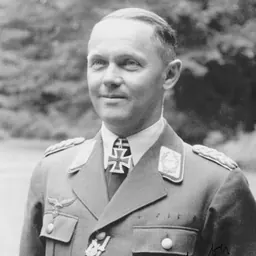



Related people
Same field, nearest in time

Contemporaries
People whose lives overlapped Herbert Lütje's




Frequently asked questions
Who was Herbert Lütje?
German flying ace
When was Herbert Lütje born?
Herbert Lütje was born on 30 January 1918 in Meine.
When did Herbert Lütje die?
Herbert Lütje died on 18 January 1967 in Cologne.
What was Herbert Lütje's occupation?
Herbert Lütje was a military personnel.
What nationality was Herbert Lütje?
Herbert Lütje was German.
Sources & further reading
Cite this page
APA: Biography.guide. (2026). Herbert Lütje. https://biography.guide/herbert-lutje/
MLA: "Herbert Lütje." Biography.guide, https://biography.guide/herbert-lutje/.
Chicago: "Herbert Lütje." Biography.guide. https://biography.guide/herbert-lutje/.
Data last updated: 2026-09-25 · Spot an error? Report a correction.
Page generated 2026-09-27 05:07 UTC