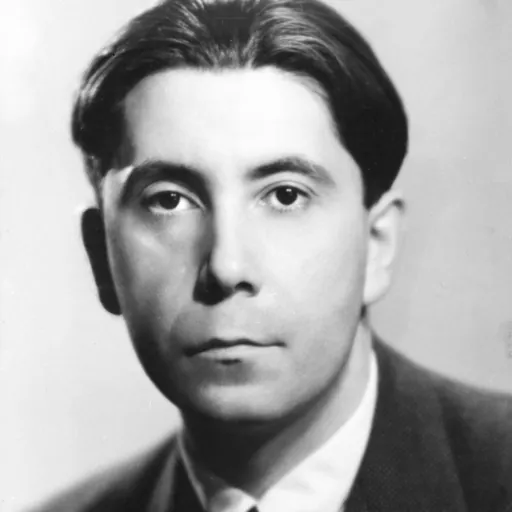
Herbert Graf
Austrian-American opera producer
About Herbert Graf
Lived 1903 – 1973 (aged 69). Herbert Graf was an American and Austrian theatrical producer, film director, opera director, director, theatre designer and theatre manager.
Herbert Graf (10 April 1903 – 5 April 1973) was an Austrian-American opera producer. Born in Vienna in 1903, he was the son of Max Graf (1873–1958), and Olga Hönig. His father was an Austrian author, critic, musicologist and member of Sigmund Freud's circle of friends. Herbert Graf was the Little Hans discussed in Freud's 1909 study Analysis of a Phobia in a Five-year-old Boy.
'Little Hans' This was one of just a few case studies which Freud published. In his introduction to the case, he had in the years before the case been encouraging his friends and associates, including Graf's parents, to collect observations on the sexual life of children in order to help him develop his theory of infantile sexuality. Thus Max Graf had been sending notes about his child's development to Freud before Herbert's fear of horses emerged. As "Little Hans", he was the subject of Freud's early but extensive study of castration anxiety and the Oedipus complex. Freud saw Herbert only once and did not analyze the child, but rather supervised the child's father, who carried out the analysis and sent extensive notes to Freud. In the published version, Herbert's father's account is abridged and punctuated by Freud's comments.
When he was four years old, Herbert was witness to a frightening event when he was at the local park in the company of the family's maid. A cart horse pulling a heavy load collapsed. Herbert became fearful of going out into the street, with his fear focused on horses and heavily loaded vehicles, which he was afraid would fall over. This fear was interpreted as a neurosis (equinophobia). Herbert's father initially attributes the neurosis to "sexual over-excitement caused by his mother's caresses"
The conclusions drawn by Freud were strongly criticized by Joseph Wolpe and Stanley Rachman in the essay "A Little Child Shall Lead Them" published first as "Psychoanalytic Evidence: A Critique Based on Freud's Case of Little Hans." in Critical Essays on Psychoanalysis, edited by Stanley Rachman, Macmillan (1963) which maintains that most of the material provided by Herbert was planted in his mind by Freud and Herbert's father.
Career in opera In 1930, in Frankfurt, Herbert Graf directed the world premiere of Arnold Schoenberg's Von heute auf morgen. In 1936, after holding operatic posts in Münster, Breslau (now Wrocław, Poland), Frankfurt (where he was director of the Opera School at the Hoch Conservatory, 1930–1933; when the Nazis came to power he was released from his duties) and Salzburg, the 33-year-old Graf emigrated to the United States, where he became a successful and popular opera producer at New York's Metropolitan Opera (1936–1960, debuting with Samson and Delilah). He staged new famous productions in the French (The Tales of Hoffmann 1937), Italian (Otello 1937, La forza del destino 1943), then German (Der Ring des Nibelungen 1947, Der Rosenkavalier 1949), repertoires. Graf had a strong sense of tradition and encouraged young operatic talent. In the late 1950s, he returned to Europe, where he produced opera at London's Royal Opera House, Covent Garden, (1958–1959). After another year in New York, Graf settled in Switzerland, working at the Zürich Opera (1960–1963), and Geneva's Grand Théâtre (1965–1973).
Graf staged several operas for the Salzburg Festival: Otello (1951, with Wilhelm Furtwängler conducting, 1952 with Mario Rossi conducting; both times with Ramón Vinay as Otello), The Marriage of Figaro (1952, with Rudolf Moralt conducting, with Erich Kunz, George London, Elisabeth Schwarzkopf, Irmgard Seefried, Hilde Gueden; 1953 revival conducted by Furtwängler and Paul Schöffler replacing London), a legendary Don Giovanni conducted by Furtwängler and designed by Clemens Holzmeister (1953, with Cesare Siepi, Elisabeth Grümmer, Anton Dermota, Schwarzkopf, Otto Edelmann, Walter Berry, Raffaele Arié, Erna Berger; revival 1954, with Dezsö Ernster replacing Arié; 1956 with Dimitri Mitropoulos conducting), Gottlob Frick replacing Ernster, Léopold Simoneau replacing Dermota, Lisa Della Casa replacing Schwarzkopf, Fernando Corena replacing Edelmann, Rita Streich replacing Berger) an equally legendary The Magic Flute conducted by Georg Solti and designed by Oskar Kokoschka (1955, cast included Gottlob Frick, Dermota, Schöffler, Kunz, Grümmer, Erika Köth, Peter Klein; revival in 1956 with Berry replacing Kunz); Elektra (1957, conducted by Mitropoulos, with Inge Borkh, Della Casa, Jean Madeira, Max Lorenz, Kurt Böhme), Simon Boccanegra (1961, with Gianandrea Gavazzeni conducting, with Tito Gobbi, Leyla Gencer, Giorgio Tozzi, Rolando Panerai), and finally La rappresentazione di anima e di corpo by Emilio de' Cavalieri (the production premiered in 1968 and was shown each year until 1973).
Graf staged Maria Callas in Les vêpres siciliennes (at the Florence May Festival and La Scala, 1951), Mefistofele (at the Verona Arena, in which Callas alternated with Magda Olivero, 1954), and Poliuto (at La Scala, 1960, also with Franco Corelli and Ettore Bastianini).
For the Arena di Verona Festival, Graf directed several productions of Aida (1954, revival in 1955; 1958; and 1966).
Publications Among the books written by Herbert Graf were The Opera and Its Future in America (New York, W. W. Norton, 1941), Opera for the People (Minneapolis, University of Minnesota Press, 1951), and Producing Opera for America (Zurich and New York, Atlantis Books, 1961).
Videography Mozart: Don Giovanni (Grümmer, della Casa, Berger, Dermota, Siepi, Edelmann; Furtwängler, 1954) [live] Deutsche Grammophon Verdi: Falstaff (Carteri, Moffo, Barbieri, Alva, Taddei, Colombo; Serafin, 1956) VAI Verdi: Aïda (Gencer, Cossotto, Bergonzi, Colzani, Giaiotti; Capuana, 1966) [live] Bel Canto Society Strauss: Elektra (Nilsson, Rysanek, M.Dunn, Nagy, McIntyre; Levine, 1980) [live] Paramount
Don’t just read it —
keep it.
Full-length biographies made to live with: read them, listen on the way to work, watch them tonight.
- E-book
- Audio
- Video
Instant download · yours to keep · every purchase keeps this site free
Important facts
People in Herbert Graf's life
Named in this biography and alive at the same time




Related people
Same field, nearest in time


Contemporaries
People whose lives overlapped Herbert Graf's

Frequently asked questions
Who was Herbert Graf?
Austrian-American opera producer (1903–1973)
When was Herbert Graf born?
Herbert Graf was born on 10 April 1903 in Vienna.
When did Herbert Graf die?
Herbert Graf died on 5 April 1973 in Geneva.
What was Herbert Graf's occupation?
Herbert Graf was a theatrical producer, film director, opera director, director, theatre designer and theatre manager.
What nationality was Herbert Graf?
Herbert Graf was American and Austrian.
Sources & further reading
Cite this page
APA: Biography.guide. (2026). Herbert Graf. https://biography.guide/herbert-graf/
MLA: "Herbert Graf." Biography.guide, https://biography.guide/herbert-graf/.
Chicago: "Herbert Graf." Biography.guide. https://biography.guide/herbert-graf/.
Data last updated: 2026-09-23 · Spot an error? Report a correction.
Portrait: Wikimedia Commons · author & licence
Page generated 2026-09-27 05:06 UTC