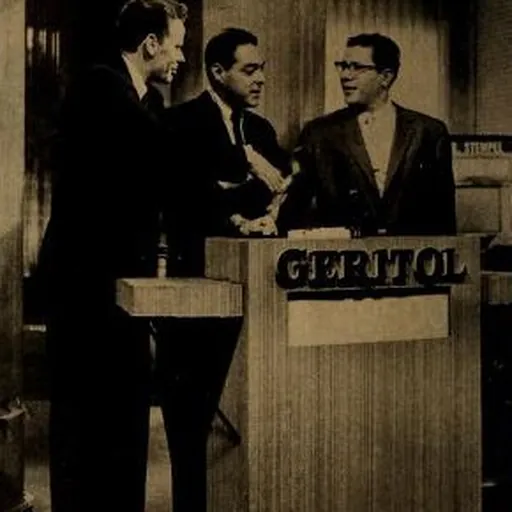
About Herb Stempel
Lived 1926 – 2020 (aged 93). Herb Stempel was an American military personnel and television, known for 1950s quiz show scandals.
Herbert Milton Stempel (December 19, 1926 – April 7, 2020) was an American television game show contestant and subsequent whistleblower on the fraudulent nature of the industry, in what became known as the 1950s quiz show scandals. His rigged six-week appearance as a winning contestant on the 1950s show Twenty-One ended in an equally rigged defeat by Columbia University teacher and literary scion Charles Van Doren.
Early life Stempel attended P.S. 89 in Queens, and was a self-described "avid reader" who was "interested in everything". He was skipped ahead several classes in school, so much so that his mother worried he was being pushed too far. When he was seven, his father died, and Stempel, his mother, and his older sister Harriet moved to what he describes as a "poorer part of the Bronx". It was in the midst of the Depression, and the struggling family was on public assistance for years.
Twenty-One was not Stempel's first quiz show. At a very young age, Stempel realized he had what he called a "retentive memory", in that he could read a page about a subject and summarize that page months later. He represented his elementary school, P.S. 6, on a radio quiz show, Americana History, where he remained undefeated for several weeks. He was one of the "Kid Wizards", a three-man team who represented The Bronx High School of Science in competitions against New York high schools, remaining undefeated throughout the year. He claimed his IQ was measured at 170.
At a time when the top five highest-rated programs on television were quiz shows, Twenty-One was a mainstay for Barry & Enright Productions and NBC, which aired the show:
Contestants on Twenty-One were given the questions and answers in advance and were coached as if they were actors, receiving instructions on which questions to answer correctly or incorrectly and how to behave during the game.
Several weeks later, Enright paid Stempel a visit while his wife was out at the theater and he was looking after their young son, and posed the fateful question: "How would you like to make $25,000?" Stempel immediately understood the implications; Enright was not going to pay him just for appearing on the show, when he could be easily defeated.
Once I said "Who wouldn't?," I became part of the game show hoax. Enright personally selected his wardrobe: an oversized, baggy double-breasted suit that had belonged to Stempel's late father-in-law, a blue shirt with a frayed collar, "terrible looking" tie, and an old "Timex watch that ticked like an alarm clock", the sound of which would be picked up by the studio microphone and thus help build suspense.
On December 5, 1956, Van Doren defeated Stempel before 15 million viewers. Van Doren went on to become the single most popular contestant in the quiz show's early history, while Stempel became the forgotten man. (In the closing minutes of his last Twenty-One appearance, asked what he would do with his winnings, a subdued Stempel said that after provisions were made for his family, he would donate a modest sum to the City College Fund “to repay the people of the city of New York for the free education they have given me”.) After his loss, Stempel overheard one backstage technician say to another: "At least, we finally have a clean-cut intellectual on this program, not a freak with a sponge memory." Enright's promise to find Stempel a panel show slot after his college graduation went unfulfilled. When Stempel, who by then had gone through his winnings, later demanded Enright follow through on his original promise, Enright demanded he first sign a statement affirming he had never been coached on Twenty-One. Again, no show materialized.
Exposure When Enright subsequently told him the promise could not be kept because he had sold his shows to NBC itself, Stempel called Jack O'Brian, a columnist who covered television for the New York City Journal-American. Although O'Brian found the story hung together, the paper's syndicate, fearing a libel suit, refused to print the allegation without further corroboration. Stempel later testified to Congress that in February 1957 he had spoken with a reporter from the New York Post, but that paper had the same reservations as the Journal-American. There were no corroborating witnesses or hard evidence to back up Stempel's accusations, and Enright dismissed them as being rooted in jealousy over Van Doren's success.
It took Ed Hilgemeier, a contestant-in-waiting who found a notebook full of answers belonging to Marie Winn, another contestant on the new quiz show Dotto, airing on CBS, to convince authorities and the Journal-American that Stempel should be taken seriously.
Manhattan Assistant District Attorney Joseph Stone, who directed two grand jury probes into the case, states that Enright described Stempel to him as "a disturbed person and a blackmailer" and denied ever giving Stempel advance questions and answers. Three days after Twenty-One contestant Richard Jackman, a writer from Oneonta, New York, told Stone that he, too, had been coached in advance of his appearance on October 3, NBC had canceled Twenty-One. The investigation of the quiz show scandal then began in earnest. Jackman only realized the game was fixed the night he appeared, when the questions he was asked were identical to the ones Enright had reviewed with him in a "practice session" that afternoon.
Enright quickly countered, denying any wrongdoing or fraud had taken place, suing the Journal-American, and mounting a campaign to discredit Stempel. At a sensational press conference, he attempted to demonstrate that Stempel was mentally unstable by playing a recording of a conversation with him that Enright had secretly taped. To further discredit him, Enright also produced the statement that Stempel had signed earlier, declaring that Twenty-One was an honest program, that Barry and Enright were beyond reproach, and that no rigging had taken place.
In 2008, Charles Van Doren broke his long silence, and in an article in The New Yorker described the overtures Robert Redford's production company made to him to cooperate with the filming of Quiz Show. He claimed that Barry & Enright Productions staffer Albert Freedman was actually responsible for scripting the entire Stempel–Van Doren competition, and rejected the image of Stempel as a penurious CCNY student:
In fact, he was a Marines [Stempel was actually in the U.S. Army] veteran married to a woman of some means who once appeared on the set wearing a Persian-lamb coat and was quickly spirited away so that she wouldn't blow his cover.
Van Doren wrote that until he viewed WGBH's American Experience documentary The Quiz Show Scandals he was ignorant of the fact that the show had once been honest—at least for one episode—and that: "Herb Stempel was the first to agree to the fix".
This latter remark is debatable. Dan Enright has stated that due to the sponsor's displeasure he began to rig the show immediately after the premiere episode debuted on September 12, 1956. Whether the contestants in the five weeks before Stempel's choreographed October 17 appearance unwittingly received the answers in "practice sessions" the way Richard Jackman described, or were openly coached the same way Stempel was, is unclear. According to Jackman, an earlier contestant than Stempel, Enright was extremely nervous before his appearance on the show and stated, to Jackman's bewilderment: "You are in a position to destroy my career." After Jackman, a struggling author, told Enright he could not continue on a rigged show, Enright tried various types of persuasion and offers of money to persuade him to change his mind. Jackman finally accepted a check for $15,000, and for continuity's sake promised to appear again so he could publicly choose to take his "winnings" and depart at the beginning of the show. Kent Anderson portrays Enright as someone who would make certain his next contestant would cooperate. Enright is described as deliberately targeting Stempel's emotions, as he did with other contestants, leaving no angle overlooked when trying to gain their full participation.
I had been a poor boy all my life, and I was sort of overjoyed, and I took it for granted that this was the way things were run on these programs ... I was stunned, I didn't know what to say ... I told him I would do it.|Herb Stempel
Don’t just read it —
keep it.
Full-length biographies made to live with: read them, listen on the way to work, watch them tonight.
- E-book
- Audio
- Video
Instant download · yours to keep · every purchase keeps this site free
Important facts
People in Herb Stempel's life
Named in this biography and alive at the same time







Related people
Same field, nearest in time




Contemporaries
People whose lives overlapped Herb Stempel's

Frequently asked questions
Who was Herb Stempel?
American game show contestant (1926-2020)
When was Herb Stempel born?
Herb Stempel was born on 19 December 1926 in The Bronx.
When did Herb Stempel die?
Herb Stempel died on 7 April 2020 in New York City.
What was Herb Stempel's occupation?
Herb Stempel was a military personnel and television.
What was Herb Stempel known for?
Herb Stempel was known for 1950s quiz show scandals.
What nationality was Herb Stempel?
Herb Stempel was American.
Sources & further reading
Cite this page
APA: Biography.guide. (2026). Herb Stempel. https://biography.guide/herb-stempel/
MLA: "Herb Stempel." Biography.guide, https://biography.guide/herb-stempel/.
Chicago: "Herb Stempel." Biography.guide. https://biography.guide/herb-stempel/.
Data last updated: 2026-09-23 · Spot an error? Report a correction.
Portrait: Wikimedia Commons · author & licence
Page generated 2026-09-27 05:08 UTC