
Heraclides Ponticus
Greek philosopher and astronomer (c.390–c.310 BC)
About Heraclides Ponticus
Lived 385 BC – 322 BC (aged 62–63). Heraclides Ponticus was a philosopher and astronomer.
Heraclides Ponticus ( Herakleides; c. 390 BC – c. 310 BC) was a Greek philosopher and astronomer who was born in Heraclea Pontica, now Karadeniz Ereğli, Turkey, and migrated to Athens. He is best remembered for proposing that the Earth rotates on its axis, from west to east, once every 24 hours. He is also hailed as the originator of the heliocentric theory, although this is disputed.
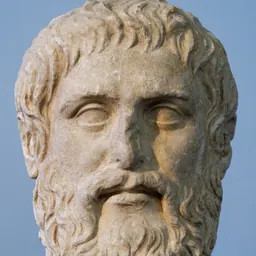
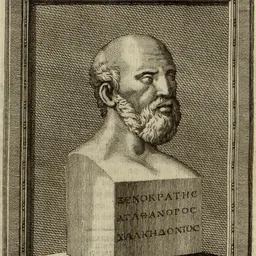
Life Heraclides' father was Euthyphron, a wealthy nobleman who sent his son to study at the Platonic Academy in Athens under its founder Plato and under his successor Speusippus. According to the Suda, Plato, on his departure for Sicily in 361/360 BC, left the Academy in the charge of Heraclides. Heraclides was nearly elected successor to Speusippus as head of the academy in 339/338 BC, but narrowly lost to Xenocrates. A punning on his name, dubbing him Heraclides "Pompicus," suggests he may have been a rather vain and pompous man and the target of much ridicule.
Works All of Heraclides' writings have been lost; only a few fragments remain. Like the Pythagoreans Hicetas and Ecphantus, Heraclides proposed that the apparent daily motion of the stars was created by the rotation of the Earth on its axis once a day. This view contradicted the accepted Aristotelian model of the universe, which said that the Earth was fixed and that the stars and planets in their respective spheres might also be fixed. Simplicius says that Heraclides proposed that the irregular movements of the planets can be explained if the Earth moves while the Sun stays still.
Although some historians have proposed that Heraclides taught that Venus and Mercury revolve around the Sun, a detailed investigation of the sources has shown that "nowhere in the ancient literature mentioning Heraclides of Pontus is there a clear reference for his support for any kind of heliocentrical planetary position."
Diogenes Laërtius, citing Aristoxenus as his source, states that Heraclides forged plays under the name of Thespis, and further states that Camaeleon claimed that Heraclides had plagiarised commentaries on Hesiod and Homer from him. Laërtius also conveys a story in which Dionysius the Deserter fooled Heraclides by forging a play, Parthenopaeus, under the name of Sophocles. Heraclides was deceived by this easily and cited it as the work of Sophocles. However, Heraclides seems to have been a versatile and prolific writer on philosophy, mathematics, music, grammar, physics, history and rhetoric, notwithstanding doubts about attribution of many of the works. It appears that he composed various works in dialogue form.
Heraclides also seems to have had an interest in the occult. In particular he focused on explaining trances, visions and prophecies in terms of the retribution of the gods, and reincarnation.
A quote of Heraclides, of particular significance to historians, is his statement that fourth century B.C. Rome was a Greek city that had been captured by Hyperboreans, typically understood as a reference to the Gallic sack of the city.
Heraclides Ponticus refers with much admiration that Pythagoras would remember having been Pirro and before Euphorbus and before some other mortal.
Don’t just read it —
keep it.
Full-length biographies made to live with: read them, listen on the way to work, watch them tonight.
- E-book
- Audio
- Video
Instant download · yours to keep · every purchase keeps this site free
Important facts
People in Heraclides Ponticus's life
Named in this biography and alive at the same time


Related people
Same field, nearest in time

Contemporaries
People whose lives overlapped Heraclides Ponticus's

Frequently asked questions
Who was Heraclides Ponticus?
Greek philosopher and astronomer (c.390–c.310 BC)
When was Heraclides Ponticus born?
Heraclides Ponticus was born in 385 BC in Heraclea Pontica.
When did Heraclides Ponticus die?
Heraclides Ponticus died in 322 BC in Athens.
What was Heraclides Ponticus's occupation?
Heraclides Ponticus was a philosopher and astronomer.
Sources & further reading
· Wikipedia: Heraclides Ponticus
· DBpedia: Heraclides Ponticus
Cite this page
APA: Biography.guide. (2026). Heraclides Ponticus. https://biography.guide/heraclides-ponticus/
MLA: "Heraclides Ponticus." Biography.guide, https://biography.guide/heraclides-ponticus/.
Chicago: "Heraclides Ponticus." Biography.guide. https://biography.guide/heraclides-ponticus/.
Data last updated: 2026-09-20 · Spot an error? Report a correction.
Page generated 2026-09-27 05:24 UTC