
Henryk Flame
Polish anti-Nazi and anti-communist resistance member
About Henryk Flame
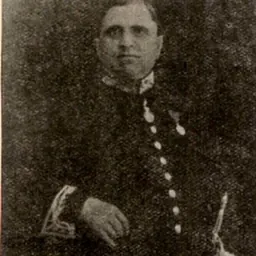
Lived 1918 – 1947 (aged 29). Henryk Flame was a Polish fighter pilot, airman, military commander, resistance fighter and soldier.
Henryk Antoni Flame (or Flamme, nom de guerre "Grot" or "Bartek"; January 19, 1918 – December 1, 1947) was a corporal and pilot in the Polish Air Force, and a captain of the anti-Nazi, and anti-Communist resistance organization NSZ.
Early life
Henryk was the son of Emeryk and Maria (née Raszyk). In 1919 the Flame family moved from Frysztat in Trans-Olza to Czechowice-Dziedzice. He finished the local gimnazjum and the Technical School in Bielsko. In 1936 he volunteered for the army and began studying at the School for Cadets of the Airforce in Bydgoszcz, which he completed in 1939 with the rank of corporal-pilot. He was allotted to the 123rd Fighter Squadron which was stationed in Kraków.
During World War II During the Nazi invasion of Poland in 1939, as a pilot of the squadron he fought the Luftwaffe at the Siege of Warsaw (1939). On September 1, 1939, the first air battle of World War II took place, during which the plane piloted by Flame was shot down. From then on he was under the direct command of the President of Warsaw, Stefan Starzyński. On the 7th of September the 123rd Squadron was withdrawn from Warsaw to Lublin. On the 17th of the same months most of the soldiers of the squadron crossed the Romanian border in order to avoid capture by the Nazis. However, Flame remained and most likely became part of the newly formed Reconnaissance Squadron operating on the Lwów – Zaleszczyki line.
Sometime after the 17th of September his plane was shot down by the Soviets who had invaded Poland in accordance with the Nazi-Soviet Molotov–Ribbentrop Pact. He organized from various groups of retreating soldiers a convoy, which at the end of September crossed into Hungary. Realizing the orders of NSZ command he put his own men in charge of the police force and hired other anti-communists into the militia. At the same time he began stockpiling weapons knowing that sooner or later a confrontation with the real communists was inevitable.
In April 1945 he was once again threatened with arrest, this time by the communists. As before he escaped to the forests, assumed the nom-de-guerre "Bartek" and created a partisan unit - the NSZ Group of the 7th Region of Silesia and Cieszyn. From May 1945 until February 1947 Flame "Bartek", led the largest anti-communist partisan group in the Trans-Olza region. This military parade lasted two hours and took place in full sight of the local communist authorities who could not do anything about it. This demonstration of power by the "King of the Beskid foothills", as Flame soon became known, Hubertus have been proposed. After this incident the initiative passed to the secret police and Flame found himself hunted and more and more of his men were caught and killed. Individuals implicated in the annihilation of the Flames'-lead NSZ units were: Henryk Wendrowski (UB agent who penetrated its ranks), Roman Romkowski (Natan Grinszpan-Kikiel) who along with Marek Fink (Mark Finkienberg) devised and supervised the conduct of the Operation "Lawina". In 1970, Fink began to use the name Witold Jozwicki. Jan Fryderyk Zielinski, Polish Secret Police functionary stated that the murdered NSZ soldiers were buried in two pits, and further elaborated that "Neither [himself], nor other functionaries knew where [they were] going. When [they] arrived there, it became apparent that [they were] in Lambinowice. At night [they] cordoned off the entire area, and began operation in the morning. Wladyslaw 'Wladzio' Osobowski [who until 1959 was an UB functionary, and later lived in the Soviet Union] finished off the 'Bartek's' unit guard with a knife. Next, through opened windows, somebody threw two grenades into two rooms. After explosions however, most of them [the NSZ soldiers] [were] still alive. They started to run. They were shocked by both the explosions and the alcohol that they drank earlier. The whole area was surrounded, and all of them were captured. After they were detained, they were ordered to take their clothes off, and then naked, they were individually lead to a 3 meter deep pit where they were murdered; everyone with a shot to the back of the head. After the shooting, either a diesel fuel, and/or gasoline was poured on bodies, and clothes, and then it was set on fire".
Because the situation became hopeless Flame decided to give himself up. The opportunity arose with the passage of the 1947 Amnesty on February 22 which promised underground soldiers that they would not be prosecuted (the promise was not kept). Henryk presented himself to the UB in Cieszyn on March 11, 1947. While this was regarded as quite a success for the communist authorities, many of them wanted revenge. However, for the time being because of the amnesty, Flame could not be legally prosecuted. A secret death sentence was supposedly issued by the President of Poland Bolesław Bierut himself, who could not forgive the humiliation associated with a 400 strong NSZ unit staging a military parade in Wisła. Neither Dadak nor anyone else involved was ever charged with his murder.
Don’t just read it —
keep it.
Full-length biographies made to live with: read them, listen on the way to work, watch them tonight.
- E-book
- Audio
- Video
Instant download · yours to keep · every purchase keeps this site free
Important facts
People in Henryk Flame's life
Named in this biography and alive at the same time

Related people
Same field, nearest in time


Contemporaries
People whose lives overlapped Henryk Flame's


Frequently asked questions
Who was Henryk Flame?
Polish anti-Nazi and anti-communist resistance member (1918–1947)
When was Henryk Flame born?
Henryk Flame was born on 19 January 1918 in Fryštát.
When did Henryk Flame die?
Henryk Flame died on 1 December 1947 in Zabrzeg.
What was Henryk Flame's occupation?
Henryk Flame was a fighter pilot, airman, military commander, resistance fighter and soldier.
What nationality was Henryk Flame?
Henryk Flame was Polish.
Sources & further reading
Cite this page
APA: Biography.guide. (2026). Henryk Flame. https://biography.guide/henryk-flame/
MLA: "Henryk Flame." Biography.guide, https://biography.guide/henryk-flame/.
Chicago: "Henryk Flame." Biography.guide. https://biography.guide/henryk-flame/.
Data last updated: 2026-09-20 · Spot an error? Report a correction.
Page generated 2026-09-27 05:28 UTC