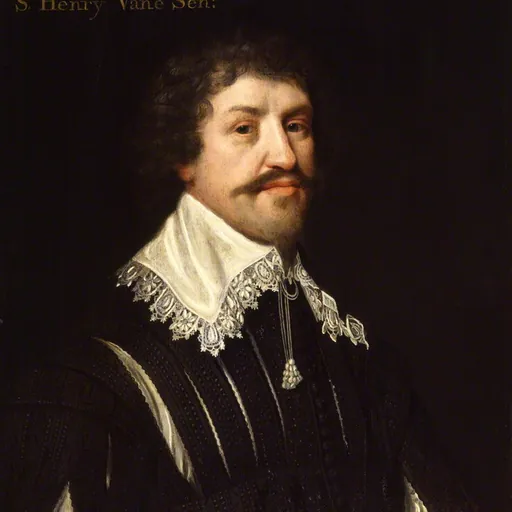
About Henry Vane the Elder
Lived 1589 – 1655 (aged 65–66). Henry Vane the Elder was an English politician.
Sir Henry Vane (18 February 15891655), known as the Elder to distinguish him from his son, was an English politician who sat in the House of Commons at various times between 1614 and 1654. He served King Charles in many posts including secretary of state, but on the outbreak of the English Civil War joined the Parliamentary cause. He was the third cousin of Francis Fane, 1st Earl of Westmorland.
Origins and education Vane was the eldest son of Henry Vane or Fane of Hadlow, Kent, by his second wife, Margaret (daughter of Roger Twysden of East Peckham, Kent, and Anne Wyatt).
He matriculated at Brasenose College, Oxford, on 15 June 1604 and was admitted a student of Gray's Inn in 1606. He was knighted by James I on 3 March 1611.
Political advancement At the age of twenty-three he married Frances Darcy, daughter of Thomas Darcy of Tolleshunt D'Arcy, Essex. Immediately after his marriage, writes Vane in an autobiographical sketch, 'I put myself into court, and bought a carver's place by means of the friendship of Sir Thomas Overbury, which cost me £5,000.' Next year he devoted the £3,000 of his wife's portion to purchasing from Sir Edward Gorges a third part of the subpoena office in chancery, and later so ingratiated himself with the King that James gave him the reversion of the whole office for forty years.
In 1617, Sir David Foulis sold him the post of cofferer to Charles, Prince of Wales, and he continued to hold this office after Charles had become king. In about 1629 he became Comptroller of the Household in place of John Savile, 1st Baron Savile of Pontefract. Finally, in September 1639 he was made Treasurer of the Household. However he took no important part in the debates of the House of Commons of England. George, the second son, born in 1618, was knighted on 22 November 1640. He was parliamentary High Sheriff of Durham in September 1645, and apparently treasurer of the committee for the county. Many of his letters to his father on the affairs of the county are printed in the calendar of domestic state papers. He married Elizabeth, daughter and heiress of Sir Lionel Maddison of Rogerly, Durham, and was buried at Long Newton in the same county on 1 May 1679. (3rd son's name?) Charles, the fourth son, matriculated at Magdalen College, Oxford, on 17 March 1637. On 16 January 1650 the parliament appointed him agent of the Commonwealth at Lisbon, in which capacity he demanded Prince Rupert's expulsion from Portuguese ports, but was obliged to leave and take refuge on board Blake's fleet. William was a soldier in Dutch service. Walter, knight, was also a soldier in the Dutch service. He seems to have been royalist in his sympathies, and a large number of intercepted letters from him to friends in England are printed in the 'Thurloe Papers.' In 1665 Charles II employed him as envoy to the elector of Brandenburg. Vane was colonel of a Regiment of Foot in the English service in 1667, and on 12 August 1668 was appointed colonel of what was known as the Holland regiment. He was killed serving under the Prince of Orange at the Battle of Seneffe in August 1674, and was buried at the Hague. Margaret married Sir Thomas Pelham, 2nd Baronet of Halland, Sussex. Frances married Sir Robert Honywood of Pett, Sussex. Anne married Sir Thomas Liddell of Ravensworth, Durham Elizabeth married Sir Francis Vincent of Stoke d'Abernon, Surrey.
In fiction In the alternate history 1632 Series, Vane appears in the short story "The Masque." King Charles read about his future execution in a book that is sent back in time (along with the entire town it's in). Vane flees England before he can be executed, and ends up serving in a government-in-exile along with Stafford. Upon reading about their future rivalry, Vane adopts the same attitude toward Stafford even though the circumstances leading to their original enmity have not yet happened and never will.
Don’t just read it —
keep it.
Full-length biographies made to live with: read them, listen on the way to work, watch them tonight.
- E-book
- Audio
- Video
Instant download · yours to keep · every purchase keeps this site free
Important facts
People in Henry Vane the Elder's life
Named in this biography and alive at the same time




Related people
Same field, nearest in time

Contemporaries
People whose lives overlapped Henry Vane the Elder's




Frequently asked questions
Who was Henry Vane the Elder?
English politician
When was Henry Vane the Elder born?
Henry Vane the Elder was born on 18 February 1589.
When did Henry Vane the Elder die?
Henry Vane the Elder died in 1655.
What was Henry Vane the Elder's occupation?
Henry Vane the Elder was a politician.
What nationality was Henry Vane the Elder?
Henry Vane the Elder was English.
Sources & further reading
· Wikipedia: Henry Vane the Elder
· DBpedia: Henry Vane the Elder
Cite this page
APA: Biography.guide. (2026). Henry Vane the Elder. https://biography.guide/henry-vane-the-elder/
MLA: "Henry Vane the Elder." Biography.guide, https://biography.guide/henry-vane-the-elder/.
Chicago: "Henry Vane the Elder." Biography.guide. https://biography.guide/henry-vane-the-elder/.
Data last updated: 2026-09-21 · Spot an error? Report a correction.
Portrait: Wikimedia Commons · author & licence
Page generated 2026-09-27 04:59 UTC