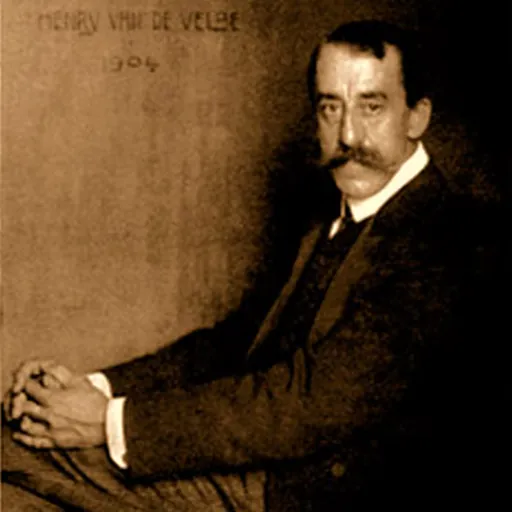
About Henry van de Velde
Lived 1863 – 1957 (aged 94). Henry van de Velde was a Belgian and German architect, designer, painter, university teacher, engineer and interior designer.
Henry Clemens van de Velde (; 3 April 1863 – 15 October 1957) was a Belgian painter, architect, interior designer, and art theorist. Together with Victor Horta and Paul Hankar, he is considered one of the founders of Art Nouveau in Belgium. He worked in Paris with Siegfried Bing, the founder of the first gallery of Art Nouveau in Paris. Van de Velde spent the most important part of his career in Germany and became a major figure in the German Jugendstil. He had a decisive influence on German architecture and design at the beginning of the 20th century.
Early life Henry Van de Velde was born in Antwerp, Belgium, where he studied painting under Charles Verlat at the famous Royal Academy of Fine Arts, Antwerp. He then went on to a year's study with the painter Carolus-Duran in Paris. As a young painter he was strongly influenced by Paul Signac and Georges Seurat and soon adopted a neo-impressionist style, and pointillism. In 1889 he became a member of the Brussels-based artist group "Les XX". After Vincent van Gogh exhibited some work on the yearly exhibition of Les XX, Van de Velde became one of the first artists to be influenced by the Dutch painter. During this period he developed a lasting friendship with the painter Théo van Rysselberghe and the sculptor Constantin Meunier.
Career
In 1890, Van de Velde wrote that "there will be no place in the society of the future for anything which is not of use to everyone." They collaborated on a number of projects together, including designing wallpapers and female clothing. Their first house, the Villa Bloemenwerf in Uccle, was Van de Velde's first attempt at architecture and was inspired by the British Arts and Crafts Movement. Its exterior closely resembled the Red House of William Morris. Maria Sèthe designed the garden surrounding the house.
Van de Velde also designed interiors and furniture for the influential art gallery "L'Art Nouveau" of Samuel Bing in Paris in 1895, the shop from which Art Nouveau took its name. He participated in Bing's pavilion at the Paris Universal Exposition of 1900 and showed his own work.
Van de Velde was strongly influenced by John Ruskin and William Morris's English Arts and Crafts movement
The Manuscript on Ornament Van De Velde played the role in elaborating an aesthetic theory a synthesis of the two opposite poles of rational conception associated with particular understanding of the ornamental function. The Manuscript on Ornament sheds further light on this aesthetic theory, and the role played therein by the notion of ornament. It constitutes an important document in the sequence of his intention of publishing a "historical—theoretical" treatise on design.
Selected works
1895–96: "Villa Bloemenwerf", Van de Velde's first private residence, in Uccle (Brussels), Belgium 1895: Interior decoration of Siegfried Bing's art Gallery "Maison de l'art nouveau" in Paris, France 1898: Monument to Count Frédéric de Mérode in Brussels, Belgium 1900–02: Interior of the Folkwang Museum in Hagen, Germany 1902–03, 1911 (extension): "Villa Esche" in Chemnitz, Germany 1903: Extension and interior decoration of the Nietzsche Archive in Weimar, Germany 1906–07: Clubhouse of the "Chemnitzer Lawn-Tennis-Club" in Chemnitz, Germany (demolished) 1907–08: "Hohenhof", mansion for Karl Ernst Osthaus in Hagen, Germany 1907–08: "Haus Hohe Pappeln", Van de Velde's private residence in Weimar, Germany 1909–11: "Ernst-Abbe-Denkmal", memorial for Ernst Abbe in Jena, Germany (in collaboration with the sculptors Max Klinger and Constantin Meunier) 1912–13: Palace for Graf Dürckheim in Weimar, Germany 1913–14: "Werkbund-Theater", theatre at the Deutsche Werkbund exhibition in Cologne, Germany 1913–14: "Villa Schulenburg" in Gera, Germany 1913–14: Wohnhaus für den Fabrikanten Dr. Theo Koerner in Chemnitz, Germany 1927–28: "La Nouvelle Maison", Van de Velde's private residence in Tervuren, Belgium 1929: "Wolfers House" in Ixelles (Brussels), Belgium 1929–31: Home for the elderly of the 'Minna und James Heinemann-Stiftung' in Hanover, Germany 1933–35: Polyclinic and "Villa Landing" for Dr. Adriaan Martens in Astene near Ghent, Belgium 1933–38: Library of Ghent University with "Boekentoren" in Ghent, Belgium 1936–42: "Technische School", school building in Leuven, Belgium 1937: Belgian Pavilion at the 1937 Paris Exposition 1937: "Station Blankenberge", railway station in Blankenberge, Belgium 1939: Belgian Building for the 1939 New York World's Fair, now at Virginia Union University in Richmond, Virginia
Don’t just read it —
keep it.
Full-length biographies made to live with: read them, listen on the way to work, watch them tonight.
- E-book
- Audio
- Video
Instant download · yours to keep · every purchase keeps this site free
Important facts
People in Henry van de Velde's life
Named in this biography and alive at the same time





Related people
Same field, nearest in time



Contemporaries
People whose lives overlapped Henry van de Velde's


Frequently asked questions
Who was Henry van de Velde?
Belgian painter, architect and interior designer (1863-1957)
When was Henry van de Velde born?
Henry van de Velde was born on 3 April 1863 in Antwerp.
When did Henry van de Velde die?
Henry van de Velde died on 25 October 1957 in Zurich, Oberägeri.
What was Henry van de Velde's occupation?
Henry van de Velde was an architect, designer, painter, university teacher, engineer and interior designer.
What nationality was Henry van de Velde?
Henry van de Velde was Belgian and German.
Sources & further reading
· Wikipedia: Henry van de Velde
Cite this page
APA: Biography.guide. (2026). Henry van de Velde. https://biography.guide/henry-van-de-velde/
MLA: "Henry van de Velde." Biography.guide, https://biography.guide/henry-van-de-velde/.
Chicago: "Henry van de Velde." Biography.guide. https://biography.guide/henry-van-de-velde/.
Data last updated: 2026-09-21 · Spot an error? Report a correction.
Portrait: Wikimedia Commons · author & licence
Page generated 2026-09-27 05:00 UTC