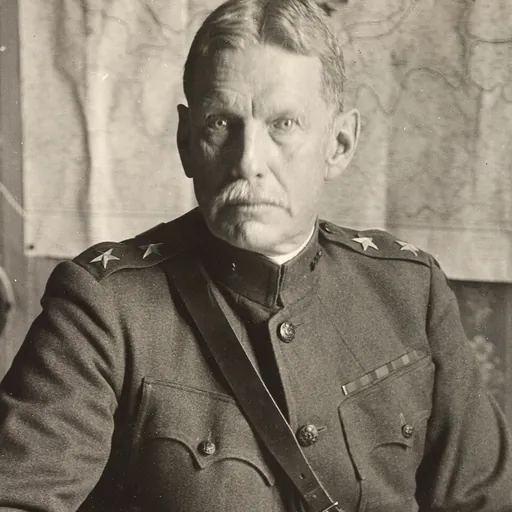
Henry Tureman Allen
(1859-1930) United States Army general
About Henry Tureman Allen
Lived 1859 – 1930 (aged 71). Henry Tureman Allen was an American explorer, soldier and military personnel.
Major General Henry Tureman Allen (April 13, 1859 – August 29, 1930) was a senior United States Army officer known for exploring the Copper River in Alaska in 1885 along with the Tanana and Koyukuk rivers by transversing of wilderness, an accomplishment which Nelson A. Miles compared to that of Lewis and Clark.
Born in Sharpsburg, Kentucky, Allen graduated from West Point in 1882, and was commissioned as a second lieutenant of cavalry. He served on the staff of General Nelson A. Miles. He later served as a military attaché to Russia (1890–1895) and Germany (1897–1898). Allen also served in the Spanish–American War in the Battle of El Caney. He was then stationed to the Philippines to serve as military governor of Leyte in 1901. Eventually he organized and commanded the Philippine Constabulary, before going on in 1904 as an observer with the Japanese Army in Korea.
During World War I, Allen was promoted to brigadier general and given command of the 90th Division, a National Army (present-day United States Army Reserve) division based in Texas. His instructions were to bring them to full strength and convey them to the Western Front in June 1918. He succeeded Pierrepont Noyes as U.S. Commissioner in the Inter-Allied Rhineland High Commission.
Early life and education Allen was born on April 13, 1859, in Sharpsburg, Kentucky. His parents were Susan (Shumate) and Sanford Allen and he was the thirteenth of fourteen children. After attending Peeks Mill Military Academy, Allen attended Georgetown College and graduated in 1878. Then, intent on a military career, he transferred to the United States Military Academy (USMA) at West Point, New York. Once he graduated from the academy in June 1882, he accepted a commission in the cavalry. Among his classmates there at the academy were several men who would, like Allen himself (who graduated 20th in a class of 37), eventually attain the rank of brigadier general or higher during their military careers, such as Edward Burr, Lansing H. Beach, Adelbert Cronkhite, John T. Thompson, Charles Treat, Edward A. Millar, Richard W. Young, Benjamin Alvord Jr., George W. McIver, William H. Sage, Thomas B. Dugan, and William H. Allaire.
From 1888 until 1890, Allen worked as an instructor at West Point.
Early military career Allen was very satisfied when he was first assigned to serve in Alaska in 1884. He wrote to his fiancée that, "I am willing to forgo almost any benefit that I might receive by going East for an attempt at exploration in Alaska." At the time Allen was ranked as a lieutenant and served as General Nelson A. Miles's aide-de-camp. He supervised Lieutenant William R. Abercrombie's shipments from Sitka to Nuchek. Allen was later sent by Miles to search for Abercrombie, whom Miles had sent to explore the Copper River. Eventually, Allen discovered Abercrombie close to the mouth of the river. Due to the moving glaciers and rough terrain, Abercrombie did not succeed in going more than up the river.
Following the expeditions of Frederick Schwatka, which covered a lot of Alaskan land but did not contribute much to a map of the area, and Abercrombie, who had failed to make it through the lower canyons of the Copper, Allen devised a plan to explore both the Tanana and Copper rivers, which were two of the biggest uncharted rivers in Alaska. Miles gave permission for Allen to go ahead with his plan, however Miles had wanted at minimum four to ten men and one medical officer to be included on the trip. Allen insisted on only three men including himself and General Philip Sheridan finally approved of Allen's original trio plan. With Sgt. Cady Robertson and Pvt. Fred Fickett and $2,000, in the spring of 1885, Allen arrived at the Copper River Delta. Allen's plan of action was to reach the headwaters of the Copper River on ice. Though he had little proper food, faced freezing rain, and difficult terrain, Allen continued to move ahead north along the river. John Bremner joined the expedition when Allen came to Taral, an Indian village. Although Allen's supplies were dwindling, he was able to explore the Chitina River, the Copper River's major tributary. During the expedition, Allen learned how to build and navigate skin boats like the Indians in the region. With these boats they moved upriver, losing more and more provisions along the way. On one occasion they had to eat "rotten, wormy meat." and first men to chart the rugged river and one of the highest mountain ranges in North America. When one of the enlisted men and Bremner received scurvy from their poor diets, Allen refrained from exploring the Tanana to its headwaters and decided to head to a trading post at its mouth. The post was more than away and they were to pass through land supposedly belonging to hostile Indians. Briefly after arriving at the Tanana, Allen met the reportedly hostile natives and learned relieving that they were only interested in the pills Allen had with him. or yellow fever and had to go back to the United States to recover.
Allen was promoted to the rank of captain in the regular army in the autumn of 1898 and went back to Berlin, Germany as an attaché. Wanting to see battle again in 1899, he transferred to the 43d Volunteer Infantry as a major. He was placed in command of the 3rd Battalion on the island of Samar. During this period, he managed to successfully recruit members for the Philippine Scouts and fight against insurgents. After peace was achieved on Samar, Allen commanded one of the three sections of Leyte. He gave fair treatment to the local civilians and even worked on several projects to improve Leyte. Allen wanted strict observance of the laws of war and led patrols to enforce them. He became known as "Iron Commandante" to the locals due to his strict, but humane style of governing.
Sergeant John H. Cochrane of Company A, 357th Infantry, 90th Division, receives the Distinguished Service Cross from Allen in the Valley of the Meuse, just south of Stenay, Meuse, France, November 16, 1918.
Following even more training in northeastern Dijon, on August 24, the 90th Infantry Division entered a sector of the front on the eastern side of the St. Mihiel salient. At the time Pershing, now a full general and Commander-in-Chief (C-in-C) of the AEF on the Western Front (while also commanding the newly created U.S. First Army), was getting ready for his first major offensive–closing off the salient (see Battle of Saint-Mihiel). Allen's 90th Division was to form the right pivot in the offensive. It started early on September 12 when the offensive began. After a rolling barrage, the division kept moving ahead. Over the next nine hours, Allen's men captured their objectives and by September 16, the Americans had reduced the salient. After the salient was eliminated, Pershing planned for the American forces to attack west at Meuse-Argonne. In the beginning, Allen's unit stayed close to St. Mihiel, covered sectors already left vacant by the troops who went west, and grouped together their positions. Once the Meuse–Argonne battle had become more intense, Allen and his men entered the lines close to Bantheville. The 90th advanced slowly and Allen relieved officers who he found to be incompetent or weak. The division was able to get through the Meuse River near Stenay only several days before the signing of the Armistice of November 11, 1918, which ended hostilities.
Later life and death From 1919 to 1923, Allen acted as a military governor of the American zone of occupation around Coblenz. He was also a member of the Inter-Allied Rhineland and High Commission. While he attempted to represent the interests of the United States, he was not provided with any specific guidance or instructions from the War and State departments. Increasingly, he acted in restraining the ambitions of the French in the region.
Allen served as the executive officer and vice-president of the American Olympic Committee during the 1924 Summer Olympics. In 1928, despite being nearly seventy-years-old, Allen was considered as a vice-presidential running mate for Democrat Al Smith, and received 21 votes in the balloting that resulted in the nomination of Joseph T. Robinson. Allen was buried in Arlington National Cemetery under a monument designed by the sculptor Albert Jaegers. Pershing was one of the pallbearers at the burial.
Personal life Henry Tureman Allen married his wife, Dora Johnston (1860–1932), on July 12, 1887. There were three children: Jeanette (1888–1962), Henry Jr. (1889–1971) and Daria (Dasha) (1892–1977). Jeanette was married to Lieutenant General Frank M. Andrews, after whom Andrews Air Force Base is named. Allen was also a known polo enthusiast. In 1941, an attack transport formerly known as the Wenatchee and the President Jefferson was taken over by the U.S. navy and renamed Henry T. Allen. The Alaskan geologist, Alfred Hulse Brooks, once wrote that, "No man through his own individual explorations has added more to our knowledge of Alaska than Lieutenant Allen.". Allen, Northern Samar town in the Philippines is named in his honor.
Popular culture Eowyn Ivey's 2016 book To the Bright Edge of the World was inspired by the official reports of Allen's 1885 exploration of Alaska and the diaries of his expedition members.
Don’t just read it —
keep it.
Full-length biographies made to live with: read them, listen on the way to work, watch them tonight.
- E-book
- Audio
- Video
Instant download · yours to keep · every purchase keeps this site free
Important facts
People in Henry Tureman Allen's life
Named in this biography and alive at the same time






Related people
Same field, nearest in time

Contemporaries
People whose lives overlapped Henry Tureman Allen's


Frequently asked questions
Who was Henry Tureman Allen?
(1859-1930) United States Army general
When was Henry Tureman Allen born?
Henry Tureman Allen was born on 13 April 1859 in Sharpsburg.
When did Henry Tureman Allen die?
Henry Tureman Allen died on 29 August 1930 in Buena Vista.
What was Henry Tureman Allen's occupation?
Henry Tureman Allen was an explorer, soldier and military personnel.
What nationality was Henry Tureman Allen?
Henry Tureman Allen was American.
Sources & further reading
· Wikipedia: Henry Tureman Allen
· DBpedia: Henry Tureman Allen
Cite this page
APA: Biography.guide. (2026). Henry Tureman Allen. https://biography.guide/henry-tureman-allen/
MLA: "Henry Tureman Allen." Biography.guide, https://biography.guide/henry-tureman-allen/.
Chicago: "Henry Tureman Allen." Biography.guide. https://biography.guide/henry-tureman-allen/.
Data last updated: 2026-09-20 · Spot an error? Report a correction.
Page generated 2026-09-27 05:09 UTC