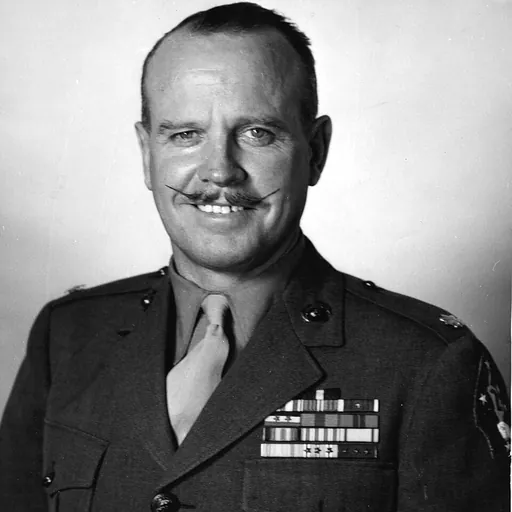
Henry Pierson Crowe
Decorated USMC veteran of banana wars, World War II, Korea
About Henry Pierson Crowe
Lived 1899 – 1991 (aged 92). Henry Pierson Crowe was an American military officer and chief of Police.
Henry Pierson Crowe (March 7, 1899 – June 27, 1991) was a Marine of World War I, the Banana Wars, World War II, and the Korean War.
Biography Henry "Jim" Pierson Crowe was born March 7, 1899, in Boston, Kentucky, the fourth of the five children of Samuel Lee Crowe (1865–1921) and Alvada T. Crowe (1868–1942). After attending high school at Mount Pulaski, Illinois, for three years, he entered the Marine Corps on October 28, 1918. After boot camp at Marine Corps Recruit Depot Parris Island, he served in port security at Brest, France, under General Smedley D. Butler (after the World War I Armistice), returned as a private first class, and was discharged December 1919. He reenlisted in 1921.
He commanded 2d Battalion, 8th Marines, at Tarawa and Saipan. At Tarawa, his battalion landed from the USS Heywood (APA-6) on Beach Red-3.
He was awarded the Navy Cross and British Distinguished Service Cross at Tarawa, and the Purple Heart with Gold Star in lieu of a second award for wounds received at Saipan.
Lieutenant Colonel Crowe served with the 8th Marines in New Zealand and Hawaii before he returned to the United States in September 1944, for treatment of wounds sustained at Saipan. He was released from the U.S. Naval Hospital at San Diego in March 1945, and the following month was named Training Officer of Fleet Marine Force, Pacific, at Pearl Harbor, Territory of Hawaii.
After the war's end, Lt Col Crowe served briefly with the 29th Marines in China, and with Marine Garrison Forces, 14th Naval District, at Pearl Harbor. He returned to the United States in March 1946, and after duty at San Diego and Quantico, Virginia, entered the Senior Course in the Amphibious Warfare School at Quantico in September 1947. He completed the course in May 1948, and reported to the 1st Marine Division at Camp Pendleton, California, the following month. There, he served as a battalion executive officer, as division special services officer, played himself in a cameo in the film Sands of Iwo Jima and was executive officer of the 1st Shore Party Battalion before taking command of the unit in July 1950.
He arrived in Japan in August 1950 to assist in preparations for the Inchon landing in Korea. He remained with the 1st Shore Party Battalion, 1st Marine Division from September 1950 to May 1951 and was awarded the two Legions of Merit with Combat "V" (one by the army) for outstanding service during the Inchon-Seoul Campaign and Wonsan landing. He returned to the United States in May 1951.
Lieutenant Colonel Crowe was promoted to colonel in December 1951, while serving as chief of the Tactical School Section, Troop Training Unit, Amphibious Training Command, at Coronado, California. He later served there as chief of the Administrative Schools Section before assuming command of the headquarters and service battalion at Marine Corps Recruit Depot San Diego, in January 1953. He was assigned additional duties as a technical advisor for the movie Battle Cry (December 1953–June 1954). Following his detachment from San Diego, he completed his final tour of duty June 1957 to March 1960, as commanding officer, Marine Barracks, Norfolk Naval Shipyard, Portsmouth, Virginia.
Colonel Crowe retired from active duty March 1, 1960, after 40 years service in the Marine Corps, including years as an enlisted man and seven and a half years as a warrant officer. Immediately after retirement, he served as Chief of Police in Portsmouth, Virginia, for nine years, retiring in 1969. He died on June 27, 1991, in Portsmouth after a long illness. As he had instructed, his remains were cremated and his ashes scattered at sea.
He was memorialized in the Tarawa diorama at the Marine Corps Museum, then in the Washington Navy Yard, that depicted him standing on the coconut log seawall.
In addition to the decorations already mentioned, Col Crowe's awards also include the Presidential Unit Citation Ribbon with three bronze stars; the Good Conduct Medal with three bronze stars; the World War I Victory Medal; the Expeditionary Medal; the Second Dominican Campaign Medal; the Second Nicaraguan Campaign Medal; the China Service Medal; the American Defense Service Medal; the Asiatic-Pacific Area Campaign Medal with three bronze stars; the World War II Victory Medal; the National Defense Service Medal; the Korean Service Medal with three bronze stars and the United Nations Service Medal.
Navy Cross Crowe's leadership during action against enemy Japanese forces at Betio Island earned him the Navy Cross.
The citation reads:
Awards and honors Colonel Crowe's medals and decorations include:
Don’t just read it —
keep it.
Full-length biographies made to live with: read them, listen on the way to work, watch them tonight.
- E-book
- Audio
- Video
Instant download · yours to keep · every purchase keeps this site free
Important facts
Related people
Same field, nearest in time



Contemporaries
People whose lives overlapped Henry Pierson Crowe's


Frequently asked questions
Who was Henry Pierson Crowe?
Decorated USMC veteran of banana wars, World War II, Korea (1899–1991)
When was Henry Pierson Crowe born?
Henry Pierson Crowe was born on 7 March 1899 in Boston.
When did Henry Pierson Crowe die?
Henry Pierson Crowe died on 27 June 1991 in Portsmouth.
What was Henry Pierson Crowe's occupation?
Henry Pierson Crowe was a military officer and chief of Police.
What nationality was Henry Pierson Crowe?
Henry Pierson Crowe was American.
Sources & further reading
· Wikipedia: Henry Pierson Crowe
· DBpedia: Henry Pierson Crowe
Cite this page
APA: Biography.guide. (2026). Henry Pierson Crowe. https://biography.guide/henry-pierson-crowe/
MLA: "Henry Pierson Crowe." Biography.guide, https://biography.guide/henry-pierson-crowe/.
Chicago: "Henry Pierson Crowe." Biography.guide. https://biography.guide/henry-pierson-crowe/.
Data last updated: 2026-09-22 · Spot an error? Report a correction.
Portrait: Wikimedia Commons · author & licence
Page generated 2026-09-27 05:02 UTC