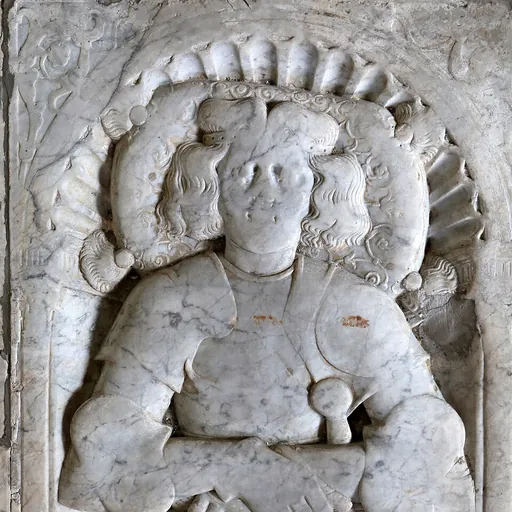
Henry II of Nassau-Siegen
Count of Nassau-Siegen, Vianden and Diez
About Henry II of Nassau-Siegen
Lived 1414 – 1451 (aged 37). Henry II of Nassau-Siegen was a count of Vianden and count of Diez.
Count Henry II of Nassau-Siegen (7 January 1414 – 18 January 1451), :de:Heinrich II. Graf von Nassau-Siegen, official titles: Graf zu Nassau, Vianden und Diez, Herr zu Breda, was since 1442 Count of Nassau-Siegen (a part of the County of Nassau), of Vianden and of half Diez. He descended from the Ottonian Line of the House of Nassau.
Biography Henry was born on 7 January 1414 as the second son of Count Engelbert I of Nassau-Siegen and Lady Joanne of Polanen. Already on 18 May 1415, a contract was made for his first marriage, allocating Vianden, St. Vith and Bütgenbach to him. However, the County of Vianden had already been assigned to Henry by the marriage contract on 18 May 1415. Also in that year, Henry, his brother John and their distant cousin Count John I, Count of Nassau-Beilstein were granted Greifenstein Castle as a fief and a part of the proceeds from the toll in Lahnstein. Together with his brother, Henry inherited the property of their uncle Count John II with the Helmet in May 1443. On 30 July 1441, Frederick ordered Engelbert and Count Godfrey VIII of Eppstein-Münzenberg to accept the County of Diez as a fief from Archbishop James.
On the same day the King informed Henry and Godfrey that he had granted Archbishop James the County of Diez as a fief together with all its appurtenances. Thereafter they and their heirs were to receive the county from Archbishop James as a fief, as they and their ancestors had had it as a fief from the Roman Emperors and Kings until now. The king ordered Henry and Godfrey and their heirs to receive and possess the said county and its appurtenances from Archbishop James and his successors, to behave in accordance with the obligations of their fathers and to send Archbishop James for himself and his heirs charters about it. Then he released them from all feudal obligations with which they were bound to the king and the empire because of the said county, and decreed that in case of violation the county or the part of it which the violator possessed, would revert to James, his successors and the Electorate of Trier.
On 30 June 1442 James invited Henry to St. Maximin's Abbey on 15 July to settle their dispute. Henry requested on 7 July a waer affschryfft (true copy) of his father's charter to Archbishop Otto. On 13 July James sent a letter from Frederick III, in which the latter confirmed the sealed charter of 1420, to Henry. On 30 August 1442, Frederick appointed Count palatine Louis IV as a judge to act as the king's deputy in the dispute between Henry and James, to summon and interrogate the disputing parties and to reach a reconciliation. In the event that a settlement did not succeed, Louis was authorised to come to a judgment. The king stipulated that Louis' decision would be valid in the same way as his own. In a letter from Louis to James dated 16 August 1443, not only Henry but also his brother John IV and their uncle John II are mentioned as opponents of the archbishop. Henry and John IV complained to James on 20 October 1443 about pledges by him in onser erebschafft (in our inheritance). In his answer of 2 November 1443 James referred both counts to the court day planned by Louis.
A solution was apparently not reached there, because on 6 October 1444, following a complaint by James against Henry and John about the counties of Nassau and Diez and other fiefs, Frederick appointed Archbishop Dietrich of Mainz, as judge and gave him power of attorney to schedule a trial between the two parties on his behalf, and then to render a judgment. The king again stipulated that Dietrich's decision would be valid in the same way as a decision of his own, and exhorted the archbishop to let justice take its course even in the event one of the parties did not appear at the hearing. Dietrich's verdict is unknown.
On 24 July 1451 Frederick granted James, because Henry and Godfrey had not received the County of Diez from James, although more than a year and a day had elapsed since the royal letter was proclaimed to them, and also because Godfrey had pledged his share of the county without the King's and archbishop's consent, all the rights that had reverted to the King and the kingdom on account of the failure to take it as a fief and the pledging. Finally, on 4 November, James granted Henry's brother and heir John the county as a fief.
Death and burial
In connection with the Jubilee proclaimed by Pope Nicholas V for 1450, Henry undertook a pilgrimage to Rome. On the journey back, he died on 18 January 1451 at Radicofani in Tuscany, about 30 km north of Lake Bolsena. Sources mention both plague and malaria as possible causes of death. It is obvious to assume that Henry was on his way to Siena, about 25 km north of San Quirico d'Orcia, to make his appearance before King Frederick III. It was in Siena that the first so-called meeting of Portugal took place on 8 February 1451. That marriage between Frederick III and Princess Eleonor of Portugal had been mediated by the Bishop of Siena, Eneas Silvio Piccolomini, who later became Pope Pius II.
In order to prevent further wear of the tombstone, an unusual solution was chosen: the tombstone was bricked into the wall horizontally, i.e. with the long side resting on the floor. This may have been done as early as the 18th century. Later, they did not even refrain from building a wall against the head-end as a support for the stairs to a new pulpit, which was closed by an iron gate that conveniently was hammered into the tombstone. This is how a Dutch visitor found the tombstone in 1928, who complained that the unfortunate arrangement made it difficult to take a proper photograph of the tombstone. Nothing was known about the person depicted. According to local tradition, a certain Count of Nassau died at Radicofani and was interred in this church at his own request. The aforementioned visitor, however, was able to find the original text of the epitaph in the church archives, which read as follows: 'HENRICO GERMANICO NASSOVII VIANDENII DIETCEQUE COMITI ILLUSTRI A JUBILEO REDEUNTI SACRUM OBIIT XV KAL FEBRUARII MCCCCLI' (English translation: 'Dedicated to the illustrious German Count Henry of Nassau, Vianden and Diez died on the return journey from the Jubilee 18 January 1451'). to Countess Genoveva of Virneburg (,
From the marriage of Henry and Genoveva only one daughter was born: Ottilie (before or on 18 April 1437 – July 1493 ), married: in 1449/1450 to Count Philip the Younger of Katzenelnbogen (1427 ). on 3 June 1475 to Count Oswald I of Tierstein ( – before 1488 ). Oswald was governor in the Alsace, the Sundgau and the Breisgau and councillor in Lorraine and the Electorate of Cologne. to Lady Irmgard of Schleiden-Junkerath , daughter of Lord John III of Schleiden-Junkerath and Countess Joanne of Blankenheim. The second marriage remained childless. Great-great-grandparents
Great-grandparents
Grandparents
Parents
Don’t just read it —
keep it.
Full-length biographies made to live with: read them, listen on the way to work, watch them tonight.
- E-book
- Audio
- Video
Instant download · yours to keep · every purchase keeps this site free
Important facts
Related people
Same field, nearest in time


Contemporaries
People whose lives overlapped Henry II of Nassau-Siegen's



Frequently asked questions
Who was Henry II of Nassau-Siegen?
Count of Nassau-Siegen, Vianden and Diez (1442-1451)
When was Henry II of Nassau-Siegen born?
Henry II of Nassau-Siegen was born on 7 January 1414.
When did Henry II of Nassau-Siegen die?
Henry II of Nassau-Siegen died on 18 January 1451 in Radicofani.
What was Henry II of Nassau-Siegen's occupation?
Henry II of Nassau-Siegen was a count of Vianden and count of Diez.
Sources & further reading
· Wikipedia: Henry II of Nassau-Siegen
· DBpedia: Henry II of Nassau-Siegen
Cite this page
APA: Biography.guide. (2026). Henry II of Nassau-Siegen. https://biography.guide/henry-ii-of-nassau-siegen/
MLA: "Henry II of Nassau-Siegen." Biography.guide, https://biography.guide/henry-ii-of-nassau-siegen/.
Chicago: "Henry II of Nassau-Siegen." Biography.guide. https://biography.guide/henry-ii-of-nassau-siegen/.
Data last updated: 2026-09-20 · Spot an error? Report a correction.
Portrait: Wikimedia Commons · author & licence
Page generated 2026-09-27 04:58 UTC