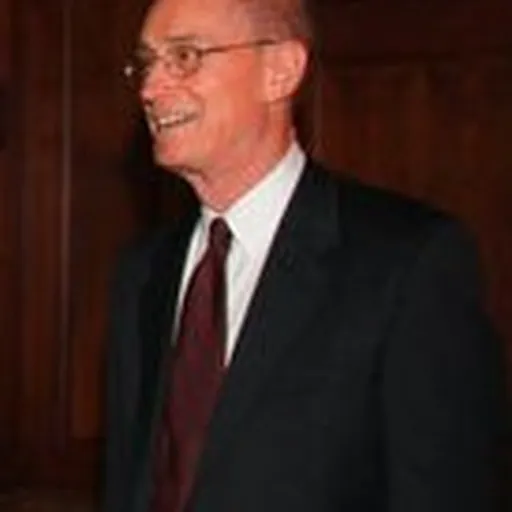
About Henry Eyring
Lived 1901 – 1981 (aged 80). Henry Eyring was an American chemist and university teacher, known for Transition state theory.
Henry Eyring (February 20, 1901 – December 26, 1981) was a Mexico-born United States theoretical chemist whose primary contribution was in the study of chemical reaction rates and intermediates. Eyring developed the absolute rate theory or transition state theory (TST) of chemical reactions, connecting the fields of chemistry and physics through atomic theory, quantum theory, and statistical mechanics.
History Eyring, a third-generation member of the Church of Jesus Christ of Latter-day Saints (LDS Church), was reared on a cattle ranch in Colonia Juárez, Chihuahua, a Mormon colony, for the first 11 years of his life. His father, Edward Christian Eyring, practiced plural marriage; Edward married Caroline Romney (1893) and her sister, Emma Romney (1903), both daughters of Miles Park Romney, the great-grandfather of Mitt Romney.
In July 1912, the Eyrings and about 4,200 other immigrants were driven out of Mexico by violent insurgents during the Mexican Revolution and moved to El Paso, Texas. After living in El Paso for approximately one year, the Eyrings relocated to Pima, Arizona, where he completed high school and showed a special aptitude for mathematics and science. He also studied at Gila Academy in Thatcher, Arizona, now Eastern Arizona College. One of the pillars at the front of the main building still bears his name, along with that of his sister Camilla's husband, Spencer W. Kimball, later an LDS Church president.
Eyring earned a bachelor's degree in mining engineering at the University of Arizona by working in a copper mine. He then received a fellowship from the US Bureau of Mines fellowship and earned a master's degree in metallurgy. Having seen the high rates of accidents in the mines, and breathed sulfur fumes from blast furnaces at a smelter, he chose to do his Ph.D. in chemistry. He received his doctoral degree in chemistry from the University of California, Berkeley in 1927
Princeton University recruited Eyring as an instructor in 1931, where he continued until 1946. In 1946, he was offered a position as dean of the graduate school at the University of Utah (U of U), with professorships in chemistry and metallurgy.
A prolific writer, Eyring authored more than 600 scientific articles, ten scientific books, and a few books on the subject of science and religion. He received the Wolf Prize in Chemistry in 1980 and the National Medal of Science in 1966 for developing the absolute rate theory or TST of chemical reactions, one of the most important developments of 20th-century chemistry. The Nobel Prize organization admitted that "Strangely, Eyring never received a Nobel Prize"; the Royal Swedish Academy of Sciences apparently did not understand Eyring's theory until it was too late to award him the Nobel. The academy awarded him the Berzelius Medal in 1977 as partial compensation. Sterling M. McMurrin believed Eyring should have received the Nobel Prize but was not awarded it because of his religion.
Eyring was elected president of the American Chemical Society in 1963 and the Association for the Advancement of Science in 1965.
Personal life Eyring married Mildred Bennion. She was a native of Granger, Utah, who had a degree from the U of U and served as head of the physical education department there. She met Eyring while pursuing a doctorate at the University of Wisconsin. They had three sons. The oldest, Edward M. "Ted" Eyring was an emeritus professor of chemistry at the U of U. The second, Henry B. Eyring is an LDS Church apostle, while the youngest son, Harden B. Eyring, was a higher education administrator for the State of Utah. Eyring's wife, Mildred, died June 25, 1969, in Salt Lake City, Utah. On August 13, 1971, he married Winifred Brennan in the LDS Church's Salt Lake Temple.
Eyring was a member of the LDS Church throughout his life. His views of science and religion were captured in this quote: "Is there any conflict between science and religion? There is no conflict in the mind of God, but often there is conflict in the minds of men." Eyring also feared overeager defenders of faith would discard new scientific findings because of apparent contradictions. He encouraged parents and teachers to distinguish between "what they know to be true and what they think may be true," to avoid clumping them together and "throwing the baby out with the bath."
As a member of the LDS Church, Eyring served as a branch president, district president, and, for over twenty years, a member of the general board of the Deseret Sunday School Union. As of 2026, his son, Henry B. Eyring, continues as a member of the church's First Presidency, after first being called, and is also the president of the Quorum of the Twelve Apostles.
Awards
AAAS Newcomb Cleveland Prize (1932) Bingham Medal (1949) of the Society of Rheology Peter Debye Award in Physical Chemistry (1964) National Medal of Science (1966) Irving Langmuir Award (1967) Linus Pauling Award (1969) Elliott Cresson Medal (1969) from the Franklin Institute Golden Plate Award of the American Academy of Achievement (1974) T. W. Richards Medal (1975) Priestley Medal (1975) Berzelius Medal (1979) Wolf Prize (1980) Member of International Academy of Quantum Molecular Science Member of U.S. National Academy of Sciences Member of the American Philosophical Society Member of the American Academy of Arts and Sciences
Scientific publications: books
Henry Eyring authored, co-authored, or edited the following books or journals: A generalized theory of plasticity involving the virial theorem The activated complex in chemisorption and catalysis An examination into the origin, possible synthesis, and physical properties of diamonds Annual Review of Physical Chemistry Basic chemical kinetics Deformation Kinetics with Alexander Stephen Krausz Electrochemistry Kinetic evidence of phase structure Modern Chemical Kinetics Non-classical reaction kinetics Physical Chemistry, an Advanced Treatise (1970) Quantum Chemistry Reactions in condensed phases The significance of isotopic reactions in rate theory Significant Liquid Structures Some aspects of catalytic hydrogenation Statistical Mechanics Statistical Mechanics and Dynamics Theoretical Chemistry: Advances and Perspectives. Volume 2 The Theory of Rate Processes in Biology and Medicine with Frank H. Johnson and Betsy Jones Stover Theory of Optical Activity (Monographs on Chemistry series) with D.J. Caldwell Time and Change Valency
Religious publications: books Reflections of a Scientist (1983) The Faith of a Scientist. Bookcraft, Inc. (1967); Science and Your Faith in God: A Selected Compilation of Writings and Talks by Prominent Latter-Day Saints Scientists on the Subjects of Science and Religion. Bookcraft, Inc. (1958); compiled by Paul R. Green and featuring the writings of Henry Eyring and others
Don’t just read it —
keep it.
Full-length biographies made to live with: read them, listen on the way to work, watch them tonight.
- E-book
- Audio
- Video
Instant download · yours to keep · every purchase keeps this site free
Important facts
more
Eyring, Eyring H, Eyring H., Eyring H. E., Eyring HEFamily & relationships
People in Henry Eyring's life
Named in this biography and alive at the same time







Related people
Same field, nearest in time



Contemporaries
People whose lives overlapped Henry Eyring's


Frequently asked questions
Who was Henry Eyring?
Mexican-born American theoretical chemist (1901-1981)
When was Henry Eyring born?
Henry Eyring was born on 20 February 1901 in Colonia Juárez.
When did Henry Eyring die?
Henry Eyring died on 26 December 1981 in Salt Lake City.
What was Henry Eyring's occupation?
Henry Eyring was a chemist and university teacher.
What was Henry Eyring known for?
Henry Eyring was known for Transition state theory.
What nationality was Henry Eyring?
Henry Eyring was American.
Sources & further reading
· DBpedia: Henry Eyring (chemist)
Cite this page
APA: Biography.guide. (2026). Henry Eyring. https://biography.guide/henry-eyring/
MLA: "Henry Eyring." Biography.guide, https://biography.guide/henry-eyring/.
Chicago: "Henry Eyring." Biography.guide. https://biography.guide/henry-eyring/.
Data last updated: 2026-09-21 · Spot an error? Report a correction.
Portrait: Wikimedia Commons · author & licence
Page generated 2026-09-27 05:01 UTC