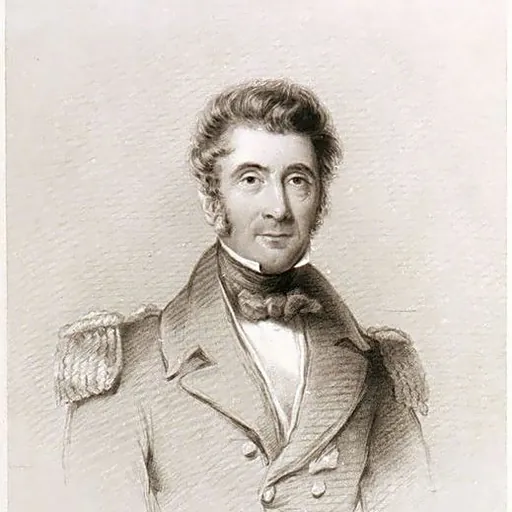
About Henry Ducie Chads
Lived 1788 – 1868 (aged 80). Henry Ducie Chads was a British naval officer.
Admiral Sir Henry Ducie Chads, (24 February 1788 – 7 April 1868) was an officer in the Royal Navy who saw action from the Napoleonic Wars to the Crimean War.
Family background Chads was born in Marylebone, London, the eldest son of Captain Henry Chads, R.N. (died on 20 October 1799) and his wife, Susannah. He was baptised at three weeks old at St Marylebone Parish Church.
Career
Chads entered the Royal Naval Academy in Portsmouth as a 12-year-old on 25 October 1800, and in 1803 embarked aboard the 74-gun ship of the line HMS Excellent,
In December 1812, as senior Lieutenant of the frigate HMS Java, he distinguished himself in the battle between that ship and the American frigate Constitution. Captain Lambert having been mortally wounded, Chads (himself severely wounded) continued the struggle, until compelled to surrender after nearly four hours' fighting. This action secured promotion and the command of the sloop Columbia. Chads afterwards served at Guadeloupe in 1815. In 1823, he was prominent in the expedition against Rangoon, as a result of which he was made post-captain on 25 July 1825, created a Companion of the Bath, and received the thanks of the Government of India, and praise in the British House of Commons. He was next engaged in forcing the passage of the Bocca Tigris prior to the First Opium War in September 1834, aboard , which he commanded from 1834 to 1837.
In 1841-5 he was on the Chinese station in command of , and then commanded the Royal Navy's gunnery school HMS Excellent. Chads reformed the whole system of naval gunnery, both as regards weight of metal and rapidity of fire. He was promoted to rear-admiral on 12 January 1854 and, flying his flag in HMS Edinburgh, was third in command of the fleet sent to the Baltic under Sir Charles Napier, who claimed that Chads 'knew more about gunnery than any man in the service'. He was one of the leaders in the bombardment and capture of the fortress of Bomarsund. He struck his flag in 1855, and as a reward for his services was created a Knight Commander of the Bath. From 1856 to the end of 1858, he was Commander-in-Chief, Queenstown, being promoted to vice-admiral on 24 November 1858, and then to full admiral on 3 December 1863. In 1865 was created Knight Grand Cross of the Bath.
In literature Chads makes a brief appearance, in his heroic role as First Lieutenant of the Java, in the novel The Fortune of War by Patrick O'Brian.
Don’t just read it —
keep it.
Full-length biographies made to live with: read them, listen on the way to work, watch them tonight.
- E-book
- Audio
- Video
Instant download · yours to keep · every purchase keeps this site free
Important facts
People in Henry Ducie Chads's life
Named in this biography and alive at the same time

Related people
Same field, nearest in time





Contemporaries
People whose lives overlapped Henry Ducie Chads's





Frequently asked questions
Who was Henry Ducie Chads?
British Royal Navy admiral (1788-1868)
When was Henry Ducie Chads born?
Henry Ducie Chads was born on 24 February 1788 in Marylebone.
When did Henry Ducie Chads die?
Henry Ducie Chads died on 7 April 1868 in Southsea.
What was Henry Ducie Chads's occupation?
Henry Ducie Chads was a naval officer.
What nationality was Henry Ducie Chads?
Henry Ducie Chads was British.
Sources & further reading
· Wikipedia: Henry Ducie Chads
Cite this page
APA: Biography.guide. (2026). Henry Ducie Chads. https://biography.guide/henry-ducie-chads/
MLA: "Henry Ducie Chads." Biography.guide, https://biography.guide/henry-ducie-chads/.
Chicago: "Henry Ducie Chads." Biography.guide. https://biography.guide/henry-ducie-chads/.
Data last updated: 2026-09-20 · Spot an error? Report a correction.
Portrait: Wikimedia Commons · author & licence
Page generated 2026-09-27 04:58 UTC