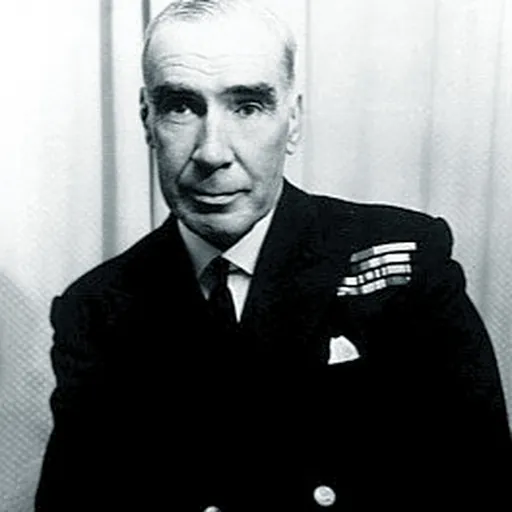
About Henry Burrell
Lived 1904 – 1988 (aged 83). Henry Burrell was an Australian military personnel.
Vice Admiral Sir Henry Mackay Burrell, (13 August 1904 – 9 February 1988) was a senior commander in the Royal Australian Navy (RAN). He served as Chief of the Naval Staff (CNS) from 1959 to 1962. Born in the Blue Mountains, Burrell entered the Royal Australian Naval College in 1918 as a 13-year-old cadet. His first posting at sea was aboard the cruiser . During the 1920s and 1930s, Burrell served for several years on exchange with the Royal Navy, specialising as a navigator. During World War II, he filled a key liaison post with the US Navy, and later saw action as commander of the destroyer , earning a mention in despatches.
Promoted captain in 1946, Burrell played a major role in the formation of the RAN's Fleet Air Arm, before commanding the flagship in 1948–49. He captained the light aircraft carrier in 1953–54, and was twice Flag Officer of the Australian Fleet, in 1955–56 and 1958. Burrell was appointed a Commander of the Order of the British Empire in 1955 and a Companion of the Order of the Bath in 1959. As CNS, he began a major program of acquisitions for the Navy, including new helicopters, minesweepers, submarines and guided-missile destroyers. He also acted to reverse a plan by the government of the day to dismantle the Fleet Air Arm. Knighted in 1960, Burrell retired to his farm near Canberra in 1962 and published his memoirs, Mermaids Do Exist, in 1986. He died two years later, aged 83.
Early life and career Henry Mackay Burrell was born at Wentworth Falls, in the Blue Mountains district of New South Wales. He was the third child and only son of schoolteacher Thomas Burrell and his wife, Eliza. Henry's father, who had emigrated from England, joined the Australian Imperial Force aged 55 during World War I, seeing active service in Egypt. aged 13. A keen sportsman, he competed in rugby union, tennis and hockey, winning colours for hockey. Burrell graduated from the college in 1921 and became a midshipman the next year. In April 1925, he was promoted to sub-lieutenant, rising to lieutenant by July 1926. Described as being "egalitarian" and "approachable", his familiarity with ratings earned him the criticism of Devonshires captain. Burrell, however, believed that a close relationship between officers and men was necessary for the smooth running of a ship. After completing the Royal Navy's staff course in 1938, he returned to Australia and was appointed staff officer (operations) at the Navy Office, Melbourne, in March 1939. It was Burrell's first shore-based position, and he spent the next four months bringing naval sections of the War Book (preparations for war) up to date. Burrell's "full knowledge of Australian naval plans and resources" led to Prime Minister Robert Menzies personally nominating him to participate in staff talks with representatives of the Royal Navy and US Navy in October. Burrell was credited with helping to foster closer cooperation between the two navies in the Pacific region.
Posted to Britain, Burrell was appointed commanding officer of the newly commissioned N-class destroyer on 15 September 1941. The ship's first operation was transporting a Trades Union Congress delegation led by Sir Walter Citrine to Archangel, Russia. After returning to Britain, she steamed to the Indian Ocean to join Admiral Sir James Somerville's Eastern Fleet at Addu Atoll, Maldives, on 26 February 1942. Transferred back to the Indian Ocean, Burrell led Norman in the second campaign of the Battle of Madagascar in September, and was mentioned in despatches on 19 February 1943 for his "bravery and resource" during the operation. By this time Norman was escorting convoys in the Pacific, before deploying to the South Atlantic for anti-submarine duties in April–May.
The news was the greatest thrill for us all ... My words cannot express their joy at deliverance to say nothing of ours. — Commander Burrell on finding survivors of HMAS Perth in a camp at Sendai, Japan On a mission to one such camp at Sendai, Burrell located crewmen from the light cruiser , which had been sunk in the early hours of 1 March 1942 during the Battle of Sunda Strait; 320 of her complement of 680 survived the sinking, 105 dying in captivity.
Post-war career Captain Burrell (right) and crew beside a Bristol Sycamore helicopter on HMAS Vengeance, c. 1954 Burrell's first appointment following the cessation of hostilities was as commander of the 10th Destroyer Flotilla. From October 1948 to the end of 1949, Burrell served as commanding officer of the heavy cruiser , flagship of the RAN. Posted to Britain in 1950, he attended the Imperial Defence College, London, and spent two years as Assistant Australian Defence Representative.
Completing his tour as captain of Vengeance, Burrell briefly resumed the role of Deputy Chief of the Naval Staff in August 1954. Burrell was appointed a Commander of the Order of the British Empire in the 1955 New Year Honours. In February he became Flag Officer of the Australian Fleet, with the acting rank of rear admiral; this was made substantive in July. Burrell was posted soon afterwards to the Navy Office, Canberra, to redevelop the service's officer structure, leading to a new General List of officers' seniority. He served as Second Naval Member (Personnel) from September 1956 until January 1958, when he again became Flag Officer of the Australian Fleet. Burrell was raised to vice admiral on 24 February and became First Naval Member, the Chief of the Naval Staff (CNS).
As CNS, Vice Admiral Burrell had to contend with a threat by Defence Minister Athol Townley to disband the Navy's fixed-wing Fleet Air Arm capability by 1963, but gained approval for a major vessel re-equipment drive that was to include new submarines, destroyers, minesweepers, and auxiliaries. This led among other things to the procurement of British s, selected by Burrell when his original preference for an Australian-built craft proved too expensive, as well as s and the Navy's first purpose-designed hydrographic survey ship. The CNS and his minister enjoyed a close working relationship; Burrell declared that Gorton "deserves our thanks for his efforts", and Gorton called Burrell "one of the most honest, sincere and most dedicated sailors".
The purchase of the destroyers signalled a shift in reliance for equipment from Britain to the United States that was contrary to prevailing Australian defence policy at the time, particularly in what historian Jeffrey Grey described as "the most British of the Australian services, the RAN", and provoked pressure from the Royal Navy and UK shipbuilders, which had lobbied for purchase of their . Burrell later declared that the superiority of the US weapons system was a key factor in his preference for the Adams design over the County class. On a mission overseas to discuss trends and acquisitions in January 1960, he was rebuffed by Britain's Chief of the Defence Staff, Admiral of the Fleet Lord Mountbatten, who mistakenly thought him responsible for the imminent dissolution of the RAN's Fleet Air Arm, but warmly welcomed by the US Chief of Naval Operations, Admiral Arleigh Burke. He was appointed a Knight Commander of the Order of the British Empire in the Queen's Birthday Honours, gazetted on 3 June 1960. In June 1961, he met with his opposite numbers in the Army and Air Force at a Chiefs of Staff Committee conference to discuss the necessity of Australia acquiring nuclear weapons; the chiefs agreed that the probability such a capability would be required was remote but that it should remain an option under certain circumstances, a position the defence forces maintained during the ensuing decade.
Retirement
Burrell made his farewell to the Australian Fleet aboard HMAS Melbourne at Jervis Bay on 8 February 1962. He left the Navy on 23 February, and was succeeded as CNS by Vice Admiral Hastings Harrington. Burrell retired to Illogan Park, his property near Braidwood in the Southern Tablelands of New South Wales. In retirement Burrell enjoyed horse racing as a gambler and as the owner of several successful mounts.
Burrell suffered a serious heart attack in 1980, having been diagnosed with cardiac problems shortly after his retirement from the Navy. His wife Ada died in August 1981. He died on 9 February 1988 in Woden Valley Hospital. Survived by his three children, Burrell was buried in Gungahlin, Australian Capital Territory, after a private funeral.
Don’t just read it —
keep it.
Full-length biographies made to live with: read them, listen on the way to work, watch them tonight.
- E-book
- Audio
- Video
Instant download · yours to keep · every purchase keeps this site free
Important facts
People in Henry Burrell's life
Named in this biography and alive at the same time


Related people
Same field, nearest in time



Contemporaries
People whose lives overlapped Henry Burrell's




Frequently asked questions
Who was Henry Burrell?
Senior Royal Australian Navy commander (1904-1988)
When was Henry Burrell born?
Henry Burrell was born on 13 August 1904 in Wentworth Falls.
When did Henry Burrell die?
Henry Burrell died on 9 February 1988 in Canberra.
What was Henry Burrell's occupation?
Henry Burrell was a military personnel.
What nationality was Henry Burrell?
Henry Burrell was Australian.
Sources & further reading
· DBpedia: Henry Burrell (admiral)
Cite this page
APA: Biography.guide. (2026). Henry Burrell. https://biography.guide/henry-burrell/
MLA: "Henry Burrell." Biography.guide, https://biography.guide/henry-burrell/.
Chicago: "Henry Burrell." Biography.guide. https://biography.guide/henry-burrell/.
Data last updated: 2026-09-23 · Spot an error? Report a correction.
Portrait: Wikimedia Commons · author & licence
Page generated 2026-09-27 05:06 UTC