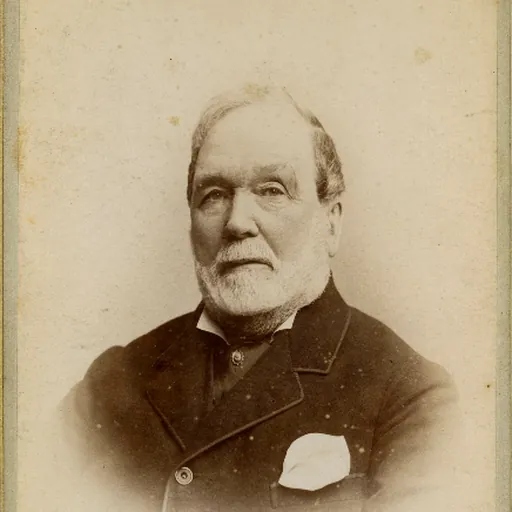
Henry Bloom Noble
Eminent Businessman and Philanthropist
About Henry Bloom Noble
Lived 1816 – 1903 (aged 86). Henry Bloom Noble was a British.
Henry Bloom Noble JP (18 June 1816 – 2 May 1903) was an English Cumbrian-born philanthropist and businessman who at the time of his death was the richest resident of the Isle of Man. Noble bequeathed a large amount of his vast fortune to the people of the Isle of Man, resulting in numerous civic amenities such as recreation grounds, swimming baths, a library and a hospital.
Biography Early life Henry Noble was born in the village of Clifton, Westmorland (now part of Cumbria) on 18 June 1816, the first son of John Noble and Mary (née Bloom). It is said that he came from a poor failed farming family, his father finding work as a customs official. The security was a mortgage on the company, which was paid off in a short time, following the Isle of Man Steam Packet Company's acquisition of the Isle of Man, Liverpool and Manchester Steamship Company in 1888.
A certain amount of skulduggery surrounds the transaction of the money. Henry Noble was one of the founders of the Isle of Man Bank, and at the time of the purchase of the Douglas Water Works Company, the Town Commissioners banked their money with Dumbell's Bank. Noble refused a cheque drawn on Dumbell's Bank, but insisted on cash. with a further penalty of £5,000 ten days later, and so on. The property was the former Isle of Man residence of the Dukes of Atholl. Before 1850 Queen Victoria proposed buying it as a more suitable royal residence than Osborne House. It is said many people scoffed at the amount which Noble had paid, scornfully predicting that he would in no way recover the amount he had invested. However the value went up as a result of the increasing affluence of the town, to such a degree that in 1898 Noble refused an offer of £120,000 (£15,200,000 as of 2018). Upon his death the Villa Marina was bequeathed to the town of Douglas.
Noble's last open property purchase was that of the former residence of Colonel Shum for the sum of £5,400, on land where today the Sefton Hotel and the Gaiety Theatre stand. The local Hospital Committee had earmarked the land for a hospital site, but Noble, as the chief owner of property in the proximity, thwarted this attempt. In less than five years Noble had sold the site for £15,000 the site undergoing development.
Personal life Because of Noble's business dealings it was inevitable that he attracted the ire of others, being accused of sharp practice on more than one occasion.
Marriage In April 1862 Henry Noble married Rebecca Thompson, a granddaughter of Calcott Heywood (who had been a captain in the Manx Fencibles). They lived initially at the corner of Hope Street and Peel Road, until Noble bought the Villa Marina which was to become their home. The marriage produced no children. Provision was also made by the trustees of the fund for the maintenance of a nurse in the parish of Lonan. not including the land.
Noble's Park Purchased in 1909 with money from the Noble Trust, Noble's Park and Recreation Grounds provide the major recreational grounds in Douglas. The first sustained, powered and controlled flight on the Isle of Man took off in July 1911 from Noble's Park, a Farnham biplane piloted by Claude Graham-White. A council committee approached the owners finally agreeing on a purchase price of £8,750 (£1,023,000 as of 2018). In addition the Borough Surveyor had costed the amount required to put the baths into working order and condition to be £1,000 (£118,000 as of 2018).
In response, John Clarke, Secretary of the Trustees, wrote to the council advising that the Trustees were willing to make a bequest of £10,000 (£1,169,000 as of 2018), citing that the acquisition of the Victoria St baths would be of immense benefit to the town of Douglas, however citing the following proviso: That the baths be called the Henry Bloom Noble Public Baths All rents from properties let, and monies received from the bathers, to be expended in the maintenance of the premises, and all profits to be expended improving the baths Arrangements to be made for free swimming classes for school children at least one day per week during the winter months The baths to be vested in the Corporation of Douglas
Don’t just read it —
keep it.
Full-length biographies made to live with: read them, listen on the way to work, watch them tonight.
- E-book
- Audio
- Video
Instant download · yours to keep · every purchase keeps this site free
Important facts
People in Henry Bloom Noble's life
Named in this biography and alive at the same time



Contemporaries
People whose lives overlapped Henry Bloom Noble's



Frequently asked questions
Who was Henry Bloom Noble?
Eminent Businessman and Philanthropist
When was Henry Bloom Noble born?
Henry Bloom Noble was born on 18 June 1816 in Clifton.
When did Henry Bloom Noble die?
Henry Bloom Noble died on 2 May 1903 in Douglas.
What nationality was Henry Bloom Noble?
Henry Bloom Noble was British.
Sources & further reading
· Wikipedia: Henry Bloom Noble
Cite this page
APA: Biography.guide. (2026). Henry Bloom Noble. https://biography.guide/henry-bloom-noble/
MLA: "Henry Bloom Noble." Biography.guide, https://biography.guide/henry-bloom-noble/.
Chicago: "Henry Bloom Noble." Biography.guide. https://biography.guide/henry-bloom-noble/.
Data last updated: 2026-09-23 · Spot an error? Report a correction.
Portrait: Wikimedia Commons · author & licence
Page generated 2026-09-27 05:05 UTC