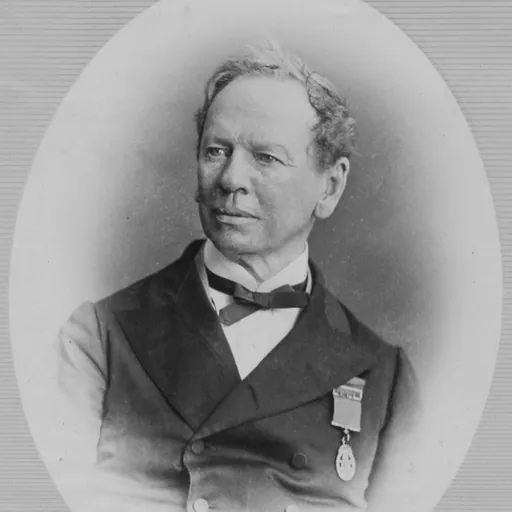
About Henry Black
Lived 1798 – 1873 (aged 74). Henry Black was a Canadian lawyer, judge and politician.
Henry Black , Q.C., LL.D. (hon.c.) (December 18, 1798 – August 16, 1873) was a lawyer, political figure, and judge in the Province of Canada, and later in the province of Quebec. He was the judge in the Court of Vice-Admiralty for the Quebec City district for most of his adult life. During that time, he was briefly a member of the Special Council which governed Lower Canada following the Lower Canada Rebellions of 1837 and 1838. He also served one term in the Legislative Assembly of the Province of Canada, as a member for Quebec City.
He died unmarried at age 74, still carrying out his duties as vice-admiralty judge, as he had done for thirty-seven years.
Early life and family Black was born in Quebec City in 1798, son of James and Margaret Black. His father was a native of Jedburgh, Scotland. He attended a private school in Quebec run by a Presbyterian minister, Dr Daniel Wilkie. He then studied and worked as an articled student-at-law, and was admitted to the bar in 1820.
By 1831, Black was prosperous enough to buy the seigneurie of Deschambault. He went on to serve as the president of the court for thirty-seven years.
Political career Special Council of Quebec
In 1837, the political tensions in Lower Canada reached a peak, and the Lower Canada Rebellion broke out. In response, the British Parliament passed a statute to suspend the Parliament and government of Lower Canada, and created the Special Council to govern the provinces. In 1840, Black was named to the Special Council, a position he held for the next year.
Legislative Assembly of the Province of Canada
Following the rebellions in Lower Canada and Upper Canada, the British government decided to merge the two provinces into a single province, the Province of Canada. Under the Union Act, 1840, there was a single Parliament for the new Province, composed of an elected Legislative Assembly and an appointed Legislative Council. The Governor General retained a strong position in the government.
The first Governor General for the new province, Lord Sydenham, was determined that the elections would return a majority in favour of his policies supporting the new union. The constituency of Quebec City was entitled to two members. Sydenham ensured that two of the candidates would be government supporters: Black, and James Gibb, who was a strong supporter of the union. However Gibbs realised he did not have popular support and withdrew. The elections were by open voting, not secret ballot, and Sydenham pressured voters who were government officials to vote for Black. He was elected, gaining 145 of 148 votes cast by government officials and pensioners. (The second successful candidate, David Burnet, was an independent.)
Throughout his term in Parliament, Black was a supporter of the Governor General, as a member of the "British Tories" group from Lower Canada. In one of the key votes in the first session in 1841, he voted in favour of the union. For the rest of the four years of the Parliament, Black consistently voted for governments supported by the Governor General. He opposed the developing Reform group, led by Louis-Hippolyte Lafontaine and Robert Baldwin. While in the Assembly, Black was involved in some criminal law reforms.
During the 1860s, an issue arose because there were no courts with admiralty jurisdiction over the Great Lakes, which were increasingly used for shipping. Black suggested that the jurisdiction of the Vice-Admiralty Court in Quebec should be extended to the Great Lakes, but the imperial authorities rejected the possibility. At that time, the jurisdiction of admiralty courts was limited to tidal waters. Since the Great Lakes were not tidal, the admiralty courts could not be given jurisdiction over them.
Black was a corresponding member of the Massachusetts Historical Society from 1840 until his death. He had family connections to Massachusetts, which he visited from time to time. He was also on friendly terms, both personally and professionally, with Chancellor James Kent of New York and Justice Joseph Story of the Supreme Court of the United States.
Black died of an attack of erysipelas in Cacouna, Quebec, in 1873, where he had gone in the summer to take the baths. His funeral was held at the Anglican Cathedral of the Holy Trinity in Quebec City.
His obituary in a contemporary Quebec City newspaper, L’Événement, stated: "He was a man of profound learning, and on no subject was his erudition found wanting. The oldest lawyers consulted him, and his advice was law. He showed great kindness and interest in his dealings with young people who had recourse to his superior knowledge."
Honours 1836: appointed King's Counsel (which became "Queen's Counsel" on the accession of Queen Victoria); 1846: received an honorary degree of Doctor of Laws from Harvard; 1862: named a Companion in the Order of the Bath.
Don’t just read it —
keep it.
Full-length biographies made to live with: read them, listen on the way to work, watch them tonight.
- E-book
- Audio
- Video
Instant download · yours to keep · every purchase keeps this site free
Important facts
People in Henry Black's life
Named in this biography and alive at the same time




Related people
Same field, nearest in time



Contemporaries
People whose lives overlapped Henry Black's





Frequently asked questions
Who was Henry Black?
Canadian lawyer, judge and politician
When was Henry Black born?
Henry Black was born on 18 December 1798 in Quebec City.
When did Henry Black die?
Henry Black died on 16 August 1873 in Cacouna.
What was Henry Black's occupation?
Henry Black was a lawyer, judge and politician.
What nationality was Henry Black?
Henry Black was Canadian.
Sources & further reading
· DBpedia: Henry Black (Quebec judge)
Cite this page
APA: Biography.guide. (2026). Henry Black. https://biography.guide/henry-black-lawyer/
MLA: "Henry Black." Biography.guide, https://biography.guide/henry-black-lawyer/.
Chicago: "Henry Black." Biography.guide. https://biography.guide/henry-black-lawyer/.
Data last updated: 2026-09-23 · Spot an error? Report a correction.
Portrait: Wikimedia Commons · author & licence
Page generated 2026-09-27 05:07 UTC