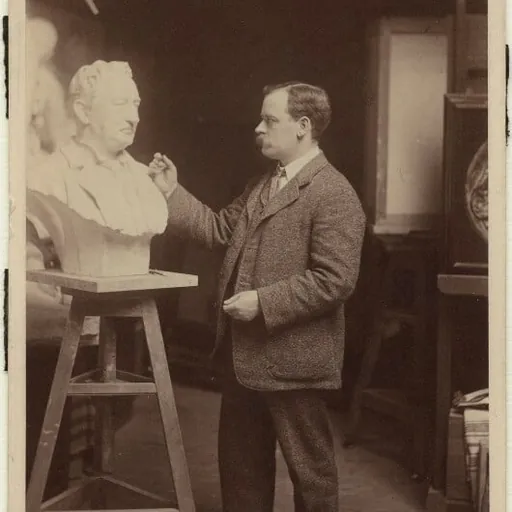
About Henry Alfred Pegram
Lived 1862 – 1937 (aged 74). Henry Alfred Pegram was a British sculptor.
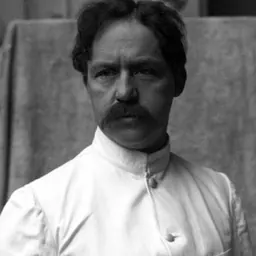
Henry Alfred Pegram (27 July 1862 – 26 March 1937) was a British sculptor and exponent of the New Sculpture movement.
Life
Pegram was born in London and received his first artistic education at the West London School of Art. Already in 1881 and in 1883 he won prizes at the National Art Competitions. In 1881, he entered the Royal Academy schools, where he again won prizes in 1882, 1884, and 1886. In 1887 he left the school and worked until 1891 as assistant to Hamo Thornycroft. He became a member of the Art Workers' Guild in 1890, an Associate of the Royal Academy in 1904 and finally a Royal Academician in 1922. From 1890, Pegram was commissioned for numerous building decorations and statues. In 1913, he was one of the ten sculptors selected to work on the city hall of Cardiff, for which he sculpted the figure of Llewelyn the Last.
Pegram was a cousin to the Brocks of Cambridge, a family with four brothers who worked as painters and illustrators in a large studio at their family home in Cambridge. His eldest daughter, Doris Joan Pegram (12 June 18861 November 1979), married one of the brothers, the artist and illustrator H. M. Brock (11 July 187521 July 1960) on 7 September 1912. The illustrator Fred Pegram (19 December 187023 August 1937), and his brother, the sculptor and medallist Alfred Bertram Pegram (17 January 187314 January 1941) were first cousins to both Henry Alfred and the Brocks.
Henry Alfred Pegram died of a cerebral haemorrhage, on 26 March 1937 in his home, 72 Belsize Park Gardens, Belsize Park, Hampstead, London.
Prizes Bronze medal at the Paris International Exhibition of 1889 (for Death Liberating a Prisoner) Gold medal at Dresden, 1897 (for The Last Song) Ignis Fatuus or Misleading Light (1889). "The Bather" friezes at Buckingham Gate no. 20, Westminster, London (now the High Commission of Eswatini). Stone frieze at the Aston Webb building of the Birmingham University (1907). Statue of Cecil Rhodes in Cape Town (1910). Nereus and Galatea (1911). Victory on the War memorial at Cunard building, Liverpool. Hylas (1922), installed in 1933 in the Rose garden, Regent's Park, London. Preston Cenotaph in Market Square, Preston, Lancashire (1926). Statue of Sir Robert Hart in Shanghai.
Don’t just read it —
keep it.
Full-length biographies made to live with: read them, listen on the way to work, watch them tonight.
- E-book
- Audio
- Video
Instant download · yours to keep · every purchase keeps this site free
Important facts
People in Henry Alfred Pegram's life
Named in this biography and alive at the same time




Related people
Same field, nearest in time



Contemporaries
People whose lives overlapped Henry Alfred Pegram's


Frequently asked questions
Who was Henry Alfred Pegram?
British artist (1862–1937)
When was Henry Alfred Pegram born?
Henry Alfred Pegram was born on 27 July 1862 in London.
When did Henry Alfred Pegram die?
Henry Alfred Pegram died on 25 March 1937 in Hampstead.
What was Henry Alfred Pegram's occupation?
Henry Alfred Pegram was a sculptor.
What nationality was Henry Alfred Pegram?
Henry Alfred Pegram was British.
Sources & further reading
· Wikipedia: Henry Alfred Pegram
· DBpedia: Henry Alfred Pegram
Cite this page
APA: Biography.guide. (2026). Henry Alfred Pegram. https://biography.guide/henry-alfred-pegram/
MLA: "Henry Alfred Pegram." Biography.guide, https://biography.guide/henry-alfred-pegram/.
Chicago: "Henry Alfred Pegram." Biography.guide. https://biography.guide/henry-alfred-pegram/.
Data last updated: 2026-09-23 · Spot an error? Report a correction.
Portrait: Wikimedia Commons · author & licence
Page generated 2026-09-27 05:06 UTC