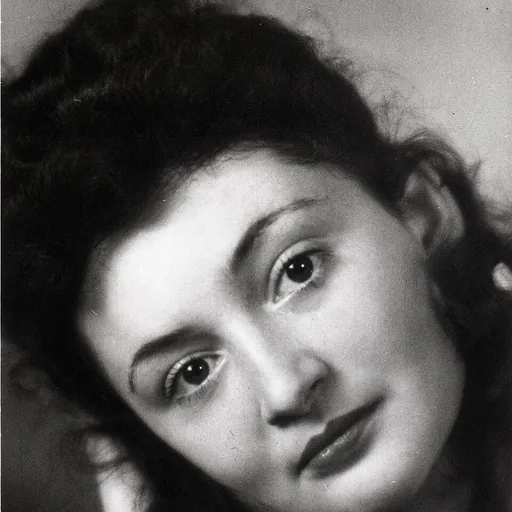
About Henriette von Schirach
Lived 1913 – 1992 (aged 78). Henriette von Schirach was a German writer and art collector.
Henriette "Henny" von Schirach (née Hoffmann; 2 February 1913 – 18 January 1992) was a German writer and wife of Baldur von Schirach, former Reichsjugendführer (Reich Youth Leader) and Gauleiter in Vienna. Henriette von Schirach is one of the few people known to have challenged Adolf Hitler personally about the Holocaust.
Early life Henriette Hoffmann was the eldest child of Adolf Hitler's personal photographer Heinrich Hoffmann and was born to his first wife, Therese "Nelly“ Baumann (1886–1928), a former singer and actress. Along with her brother Heinrich Jr ("Heini" ) (1916–1988), she spent her childhood in Schwabing. Her house was an early Nazi stronghold, and in 1920 her father, a nationalist and anti-Semitic German Workers' Party (DAP) member joined its successor, the Nazi Party. Henriette was nine years of age when she first met Hitler, who frequently came to the Hoffmann house for dinner. Hitler may have made a pass at her when she was 17:
From 1923 onwards, her father became the personal photographer of Hitler and made a fortune selling images of Hitler. In 1931, Henriette met Baldur von Schirach, the former leader of the Nazi Student League and the youngest of Hitler's entourage. The couple married on 31 March 1932 in Munich, with Adolf Hitler and Ernst Röhm as witnesses. The reception took place in Hitler's private apartment. (1938–1980), and Richard (1942–2023). Henriette identified herself with the goals of her husband, who held sole control over the educational system of the German Reich. He was appointed by Hitler as Gauleiter and Reich Governor of Reichsgau Wien, and moved with his family to Vienna.
Confrontation with Hitler
In 1943, Henriette saw a group of Jewish women deported from Amsterdam. An SS soldier had offered to sell her valuables stolen from them. She thought she could speak openly to Hitler, having known him since she was a child. When she raised the issue during a visit to the Berghof on 24 June 1943, Hitler was enraged: "That's all I need, you coming to me with this sentimental twaddle. What concern are these Jewish women to you?" The Schirachs left in disgrace, and were never invited to the Berghof again.
There are several versions of this meeting. Her husband Baldur von Schirach described the incident at the Nuremberg trials (although Henriette had already described the incident in public before then): "The silence was icy, and after a short time Hitler merely said, 'This is pure sentimentality.' That was all. No further conversation took place that evening. Hitler retired earlier than usual." According to Baldur von Schirach, he and Henriette had planned the confrontation to take place over three evenings, beginning with a discussion of Ukraine, with Henriette's protest on the first or second evening, and a discussion of Vienna on the third evening.
According to Hitler's Luftwaffe adjutant Nicolaus von Below, earlier in the day Baldur von Schirach had argued that the war had to be stopped. Hitler later said, "He knows as well as I do that there is no way out. I might as well shoot myself in the head as think of negotiating peace." Hitler made it clear he no longer wanted anything to do with Schirach.
In a 1989 BBC documentary "The Fatal Attraction of Adolf Hitler", Henriette recounted what had happened:
In the ZDF documentary Hitler's Henchmen (episode "Schirach, Corrupter of the Youth"), she recounted, "The German officers there said to me, 'When you see Hitler, tell him that what he's doing in Holland is crazy. We've made enemies of the Dutch. We're behaving badly, locking people up.' I was horrified. I hadn't known. I said, 'I've seen that we're doing terrible things and the soldiers are ashamed, and we're...' Then there was a terrible quarrel."
The incident was also recounted by Traudl Junge, Hitler's last private secretary, in her memoir Until the Final Hour and documentaries such as Blind Spot: Hitler's Secretary. Junge said, "The Führer got up, and said something like 'Stupid sentimentality', or 'Don't interfere in things you don't understand.' Then he withdrew and the evening was over." The divorce was finalized in October 1950.
She sent Baldur a damning final letter, writing,
"Have you at any time, instead of sitting in your cell studying philosophy, Latin, French, writing poetry, and thinking how to straighten out your position in history, as you call it, actually faced reality and wondered where the next meal was coming for your wife and children? You isolated yourself from everything and everyone, your head forever in the clouds as it almost always has been from the day of our marriage. As the years went by, I realized more than ever that your idealistic obsessions and dreams were taking you further from me and the children... I was ready to face death with you. Your answer to me was, "I cannot take my life. First I must make my place and my work clear before history." As always, you would not face facts. Had I taken poison, it would have saved me untold suffering in my fight to live and keep my children alive. I have expressed my feeling so many times before to you, but you have always preferred to ignore them as being distasteful. Reality has always been distasteful to you... I intend to divorce you immediately.
Jacob lost custody of Henriette's children, due to excessive beatings. Custody was transferred to the Bad Tölz welfare department. Richard remained with Henriette and Peter Jacob, and they moved to Munich. Henriette was industrious, starting a film company "Paris Film" with Jacob. She made use of statements by Jacob, her father and his housekeeper that pictures and furniture were her legitimate property. The Schirachs' home was confiscated, however Henriette repeatedly forced her way in to make off with items.
Billy F. Price, a Texan entrepreneur and collector of Hitler's paintings, worked with the Schirach family to attempt to recover Heinrich Hoffmann's collection of Hitler's watercolours, and Heinrich's entire collection of photographs, which had been confiscated by the US government. The intention was that Price would then buy the paintings from the Schirach family. Henriette continued these efforts after her father's death, and they continued after Henriette's death in the legal case Price v. United States.
Books Der Preis der Herrlichkeit, 1956, Wiesbaden: Limes Verlag (The Price of Glory. Second edition, Munich: Herbig, 1976, ) Anekdoten um Hitler: Geschichten aus einem halben Jahrhundert, 1980, Türmer-Verlag, (Anecdotes about Hitler: Stories from half a century) Frauen um Hitler, Munich: Herbig, 1983, (Women Around Hitler)
Don’t just read it —
keep it.
Full-length biographies made to live with: read them, listen on the way to work, watch them tonight.
- E-book
- Audio
- Video
Instant download · yours to keep · every purchase keeps this site free
Important facts
People in Henriette von Schirach's life
Named in this biography and alive at the same time

Related people
Same field, nearest in time


Contemporaries
People whose lives overlapped Henriette von Schirach's





Frequently asked questions
Who was Henriette von Schirach?
German writer, Hitler's private secretary (1913–1992)
When was Henriette von Schirach born?
Henriette von Schirach was born on 2 February 1913 in Schwabing.
When did Henriette von Schirach die?
Henriette von Schirach died on 18 January 1992 in Munich.
What was Henriette von Schirach's occupation?
Henriette von Schirach was a writer and art collector.
What nationality was Henriette von Schirach?
Henriette von Schirach was German.
Sources & further reading
· Wikipedia: Henriette von Schirach
· DBpedia: Henriette von Schirach
Cite this page
APA: Biography.guide. (2026). Henriette von Schirach. https://biography.guide/henriette-von-schirach/
MLA: "Henriette von Schirach." Biography.guide, https://biography.guide/henriette-von-schirach/.
Chicago: "Henriette von Schirach." Biography.guide. https://biography.guide/henriette-von-schirach/.
Data last updated: 2026-09-22 · Spot an error? Report a correction.
Portrait: Wikimedia Commons · author & licence
Page generated 2026-09-27 05:03 UTC