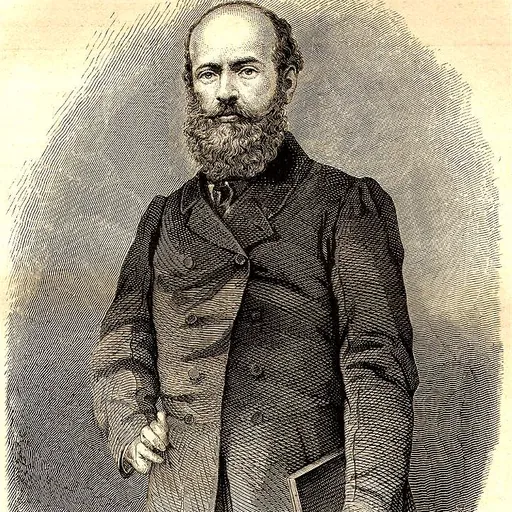
About Henri Mouhot
Lived 1826 – 1861 (aged 35). Henri Mouhot was a French explorer, naturalist, botanist and entomologist, known for Angkor.
Alexandre Henri Mouhot (; 15 May 1826 – 10 November 1861) was a French naturalist and explorer of the mid-19th century. He was born in Montbéliard, Doubs, France, near the Swiss border. He died near Luang-Prabang, Laos. He is remembered mostly in connection to Angkor. Mouhot's tomb is located just outside of Ban Phanom, to the east of Luang Prabang.
Early life
Mouhot traveled throughout Europe with his brother Charles, studying photographic techniques developed by Louis Daguerre. In 1856, he began devoting himself to the study of natural science. Upon reading The Kingdom and People of Siam by Sir John Bowring in 1857, Mouhot decided to travel to Indochina to conduct a series of botanical expeditions for the collection of new zoological specimens. His initial requests for grants and passage were rejected by French companies and the government of Napoleon III. The Royal Geographical Society and the Zoological Society of London lent him their support, and he set sail for Bangkok, via Singapore.
Expeditions
From his base in Bangkok in 1858, Mouhot made four journeys into the interior of Siam, Cambodia and Laos. Over a period of three years before he died, he endured extreme hardships and fended off wild animals, to explore some previously uncharted jungle territory.
On his first expedition, he visited Ayutthaya, the former capital of Siam (already charted territory), and gathered an extensive collection of insects, as well as terrestrial and river shells, and sent them on to England.
In January 1860, at the end of his second and longest journey, he reached Angkor (already charted territory) — an area spread over more than 400 km2., consisting of many sites of ancient terraces, pools, moated cities, palaces and temples, the most famous of which is Angkor Wat. He recorded this visit in his travel journals, which included three weeks of detailed observations. These journals and illustrations were later incorporated into Voyage dans les royaumes de Siam, de Cambodge, de Laos which were published posthumously.
Angkor
Mouhot is often mistakenly credited with "discovering" Angkor, although Angkor was never lost — the location and existence of the entire series of Angkor sites was always known to the Khmers and had been visited by several westerners since the 16th century. Mouhot mentions in his journals that his contemporary Father Charles Emile Bouillevaux, a French missionary based in Battambang, had reported that he and other Western explorers and missionaries had visited Angkor Wat and the other Khmer temples at least five years before Mouhot. Father Bouillevaux published his accounts in 1857: "Travel in Indochina 1848–1846, The Annam and Cambodia". Previously, a Portuguese trader Diogo do Couto visited Angkor and wrote his accounts about it in 1550, and the Portuguese monk Antonio da Magdalena had also written about his visit to Angkor Wat in 1586. Mouhot did, however, popularise Angkor in the West.
Perhaps none of the previous European visitors wrote as evocatively as Mouhot, who included interesting and detailed sketches. In his posthumously published Travels in Siam, Cambodia and Laos, Mouhot compared Angkor to the pyramids, for it was popular in the West at that time to ascribe the origin of all civilization to the Middle East. For example, he described the Buddha heads at the gateways to Angkor Thom as "four immense heads in the Egyptian style" and wrote of Angkor:
Mouhot also wrote that:
Such quotations may have given rise to the popular misconception that Mouhot had found the abandoned ruins of a lost civilisation. The Royal Geographical Society and The Zoological Society, both interested in announcing new finds, seemed to have encouraged the rumor that Mouhot — whom they had sponsored to chart mountains and rivers and catalog new species — had discovered Angkor. Mouhot himself erroneously asserted that Angkor was the work of an earlier civilization than the Khmer. For although the very same civilization which built Angkor was alive and right before his eyes, he considered them in a "state of barbarism" and could not believe they were civilized or enlightened enough to have built it. He assumed that the authors of such grandeur were a disappeared race and mistakenly dated Angkor back over two millennia, to around the same era as Rome. The true history of Angkor Wat was later pieced together from the book The Customs of Cambodia written by Temür Khan's envoy Zhou Daguan to Cambodia in 1295–1296 and from stylistic and epigraphic evidence accumulated during the subsequent clearing and restoration work carried out across the whole Angkor site. It is now known that the dates of Angkor's habitation were from the early ninth century to the early 15th century.
Itinerary in Southeast Asia Henri Mouhot's exploration covered 4,955 kilometers in Southeast Asia, in three years, six months and 13 days. The exact itinerary, as listed in Le Tour du Monde ("Around the World" journal), is as follows:
Link to the itinerary on Google Maps
Colonialism
Some have argued that Mouhot may have been a tool for French expansionism and the annexation of territories which followed shortly after his death. Mouhot himself, however, did not seem to be a hardcore colonialist, for he occasionally doubted the beneficial effects of European colonisation:
However, Mouhot appears in his notes as genuinely interested in South East Asia and its culture, and kept in mind the benefits he thought France could provide to those countries. He notably wrote in the Tour du Monde:
Works Mouhot's travel journals are immortalized in Voyage dans les royaumes de Siam, de Cambodge, de Laos et autres parties centrales de l'Indochine (published 1863, 1864). English title: Travels in the Central Parts of Indo-China, Cambodia and Laos During the Years 1858,1859, and 1860. Travels in Siam, Cambodia, Laos, and Annam. Henri Mouhot Travels in Siam, Cambodia and Laos, 1858-1860 Henri Mouhot, Michael Smithies - Travels in the Central Parts of Indo-China (Siam), Cambodia, and Laos During the Years 1858, 1859, and 1860. Mouhot, Henri— (B/W illustrations)
Don’t just read it —
keep it.
Full-length biographies made to live with: read them, listen on the way to work, watch them tonight.
- E-book
- Audio
- Video
Instant download · yours to keep · every purchase keeps this site free
Important facts
People in Henri Mouhot's life
Named in this biography and alive at the same time


Related people
Same field, nearest in time


Contemporaries
People whose lives overlapped Henri Mouhot's





Frequently asked questions
Who was Henri Mouhot?
French explorer (1826–1861)
When was Henri Mouhot born?
Henri Mouhot was born on 15 May 1826 in Montbéliard.
When did Henri Mouhot die?
Henri Mouhot died on 10 November 1861 in Luang Prabang.
What was Henri Mouhot's occupation?
Henri Mouhot was an explorer, naturalist, botanist and entomologist.
What was Henri Mouhot known for?
Henri Mouhot was known for Angkor.
What nationality was Henri Mouhot?
Henri Mouhot was French.
Sources & further reading
Cite this page
APA: Biography.guide. (2026). Henri Mouhot. https://biography.guide/henri-mouhot/
MLA: "Henri Mouhot." Biography.guide, https://biography.guide/henri-mouhot/.
Chicago: "Henri Mouhot." Biography.guide. https://biography.guide/henri-mouhot/.
Data last updated: 2026-09-21 · Spot an error? Report a correction.
Portrait: Wikimedia Commons · author & licence
Page generated 2026-09-27 04:59 UTC