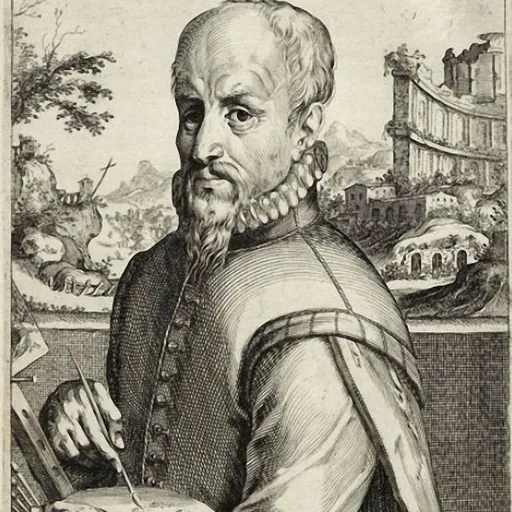
Hendrick van Cleve III
Flemish painter and engraver, ca. 1525 -
About Hendrick van Cleve III
Lived 1525 – 1590 (aged 64–65). Hendrick van Cleve III was a painter, draftsperson, teacher, graphic artist, artist and visual artist.
Hendrick van Cleve or Hendrik van Cleve III (c. 1525 in Antwerp – between 1590 and 1595) was a Flemish painter, draughtsman and designer of prints. He is known for topographical views, including views of Rome and the Vatican, as well as imaginary landscapes. Traditionally, a large number of depictions of the construction of the Tower of Babel have been attributed to him but most of these are now attributed to anonymous Flemish painters, who are referred to as 'The Hendrik van Cleve III Group'.
Life Hendrick van Cleve III was born in Antwerp around 1525 as the son of Willem van Cleve the Elder, a painter. He was the elder brother of Marten and of Willem and of three sisters. He is called "the third" to differentiate him from Hendrik van Cleve I (registered as a master of the Guild of St. Luke 1489/90) and Hendrick II (Guild of St. Luke, 1534), about whom little else is known. In Italy he made many drawings of mountain views, buildings and cityscapes, which he later used in his works. The subject is taken from the Book of Genesis 11:1-9. This narrates the story of the decision to build a city and a tower reaching into the heavens. The biblical character Nimrod was appointed to oversee the project's construction. This story was a rich source of subject matter for various late 16th and early 17th century Flemish painters. Their representations were inspired by the two works of 1563 by Pieter Bruegel the Elder on this subject matter (Kunsthistorisches Museum, Vienna; and Museum Boijmans Van Beuningen, Rotterdam). The story of the Tower of Babel is in essence a reflection on human impiety and hubris, a moral message already implicit in both Bruegel's paintings.
In the past many compositions depicting the Towers of Babel were attributed to Hendrick van Cleve III. However, only three representations of the Tower of Babel can be attributed to him in a more or less secure way:
a monogrammed and dated drawing (1584) in the Statens Museum in Copenhagen; a painting sold at Christie's London on 10 July 2002 (lot 19) as 'Circle of Abel Grimmer', which shares many similarities with the drawing in the Statens Museum; and a painting sold as by "Abel Grimmer's circle" at Sotheby's London on 18 April 2002 London (lot 7).
The drawing and two paintings show the characteristics of Hendrik van Cleve's interpretation and visualization of the parable of the Tower of Babel. The composition in all three is similar in that the tower placed in the middle and the large driveway starting at the front. The Tower structure is cone-shaped and the driveway swings to the top in a spiral. These elements reprise traditional representations which were widely used for this theme in the Middle Ages. At the same time van Cleve shows inventiveness in both the depiction of the Tower and the city in the background. He pays a lot of attention to the ornamentation of the Tower. The city in the background is richly decorated with basilicas and castles placed amidst the houses. Mannerism's interest in creating imaginary city panoramas is clearly present as well as ts fascination with the Arab world as is evident from the attire of the figures wearing turbans, the mosque and the symbol of the crescent moon. Babel was often identified with Cairo in the Middle Ages. On the left side of the foreground King Nimrod with his soldiers and the architects are depicted. The other figures in the foreground are painted with such precision that they can be identified as a man or a woman. Hendrick van Cleve distributes the other figures evenly throughout the foreground and often incorporates playful scenes. The landscape in the background has the typical characteristics of the world landscape of the 16th century and consists of rocky mountains and a meandering river in the distance.
The typical elements of van Cleve's drawing and paintings of the Tower of Babel are not present in the large body of compositions of the Tower of Babel that have traditionally been attributed to van Cleve. It is now believed that the latter were the work of unidentified painters active in Antwerp in the period between 1580 and 1600. These painters, who share other characteristics have been named "the Hendrick van Cleve III group". About 50 works have been attributed to the group.
In terms of composition, the works of the Hendrick van Cleve III group can be divided into two groups:
in the first group, two roads lead to the tower: the one on the left recalls a Roman aqueduct, the one on the right passes through a triumphal arch. The Tower has a circular base. An example is the panel of the Hamburger Kunsthalle.
In the second group, two roads intersect X-shaped just in front of the Tower. The Tower has a square base. For example, the panel of the Kröller-Muller Museum in Otterlo and the copper painting in the collection of Fondation Custodia in Paris.
Typical of the Hendrick van Cleve III group is the interest in architecture which was a feature of 16th century Mannerism. This is expressed in the depiction of a mishmash of Flemish architectural styles and classical elements such as aqueducts, half-columns, palazzos, triumphal arches, circular arches, sculptures and so on. They also had great fascination with the imaginary city of Babel. In the background there is invariably a city with smoking chimneys. In the foreground are numerous figures who are busy building the Tower. The perspective is generally exaggerated to make the Tower more impressive. The flip side of this is that the perspective is not correct and it appears that the viewer is looking at the tower from below.
Selected works of Hendrick van Cleve
Don’t just read it —
keep it.
Full-length biographies made to live with: read them, listen on the way to work, watch them tonight.
- E-book
- Audio
- Video
Instant download · yours to keep · every purchase keeps this site free
Important facts
more
Hendrick van Cleef III, Hendrick van Cleef, Henrico Clevio, Cleve, Kleef, Hendrik van Kleef, Hendrik van, III Cleef, Hendrick, III Van Cleef, Hendrick van Cleeff, Cleef, III van Cleve, III Cleve, Hendricus Clivensis Cleve, Henricus Clivensis, Hendrick van Cleef (III), Henry Cleef, Hendricus Clivensis Cleef, IIPeople in Hendrick van Cleve III's life
Named in this biography and alive at the same time

Related people
Same field, nearest in time

Contemporaries
People whose lives overlapped Hendrick van Cleve III's



Frequently asked questions
Who was Hendrick van Cleve III?
Flemish painter and engraver, ca. 1525 - (c.1525-1589)
When was Hendrick van Cleve III born?
Hendrick van Cleve III was born in 1525 in Antwerp.
When did Hendrick van Cleve III die?
Hendrick van Cleve III died in 1590 in Antwerp.
What was Hendrick van Cleve III's occupation?
Hendrick van Cleve III was a painter, draftsperson, teacher, graphic artist, artist and visual artist.
What nationality was Hendrick van Cleve III?
Hendrick van Cleve III's recorded nationality: Habsburg Netherlands.
Sources & further reading
· Wikipedia: Hendrick van Cleve III
· DBpedia: Hendrick van Cleve III
Cite this page
APA: Biography.guide. (2026). Hendrick van Cleve III. https://biography.guide/hendrick-van-cleve-iii/
MLA: "Hendrick van Cleve III." Biography.guide, https://biography.guide/hendrick-van-cleve-iii/.
Chicago: "Hendrick van Cleve III." Biography.guide. https://biography.guide/hendrick-van-cleve-iii/.
Data last updated: 2026-09-20 · Spot an error? Report a correction.
Page generated 2026-09-27 05:10 UTC