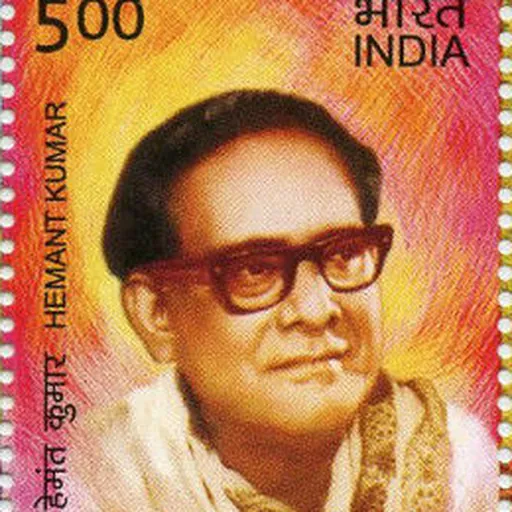
About Hemanta Mukhopadhyay
Lived 1920 – 1989 (aged 69). Hemanta Mukhopadhyay was an Indian singer, composer, lyricist, writer, film actor and manufacturer.
Hemanta Mukhopadhyay (; 16 June 1920 – 26 September 1989), known professionally as Hemanta Mukherjee and Hemant Kumar, was an Indian music director and a playback singer who primarily sang in Bengali and Hindi, along with several other Indian languages, including Marathi, Gujarati, Odia, Assamese, Tamil, Punjabi, Bhojpuri, Konkani, Sanskrit and Urdu. He was an artist in Bengali and Hindi film music, Rabindra Sangeet, and various other genres. He was the recipient of two National Awards for Best Male Playback Singer and was popularly known as the "Voice of God".
Early life and education Hemanta was born in Varanasi, Uttar Pradesh, at his maternal grandfather's residence, where his grandfather served as a physician. His paternal family originated from Jaynagar Majilpur and had migrated to Kolkata in the early 1900s. Growing up in Kolkata, he received his early education at Nasiruddin School before transferring to Mitra Institution School in Bhowanipore. During his school years, he formed lasting friendships with Subhash Mukhopadhyay, who would later become a celebrated poet, and writer Santosh Kumar Ghosh.
Hemanta enrolled in the Bengal Technical Institute at Jadavpur (now Jadavpur University) to pursue an engineering diploma. However, he left academics due to health issues and to pursue a career in music, despite his father's disapproval. He briefly experimented with literature and published a short story in the Bengali magazine Desh, but by the late 1930s, he had decided to dedicate himself entirely to music.
Early career Hemanta's debut as a playback singer came in 1940 with the Bengali film Rajkumarer Nirbbasan, where he sang under the musical direction of S.D. Burman. This was followed by Nimai Sanyas (1941), scored by Hariprasanna Das. In 1943, he composed his first original songs, "Katha Kayonako Shudhu Shono" and "Amar Biraha Akashe Priya", with lyrics by Amiya Bagchi. His entry into Hindi cinema occurred in 1942 with the film Meenakshi, followed by Irada (1944), under composer Amar Nath's direction.
Hemanta established himself as a prominent exponent of Rabindra Sangeet with his first recorded piece in the genre appearing in the Bengali film Priya Bandhabi (1944). The song "Pather Sesh Kothaye" marked the beginning of his journey with Tagore's compositions. That same year, he recorded his first non-film Rabindra Sangeet album under the Columbia label, featuring "Aamar Aar Habe Na Deri" and "Keno Pantha E Chanchalata". An earlier recording of "Aamaar mallikabone" for All India Radio/Akashvani has been lost to time. His directorial debut as a music director came with the Bengali film Abhiyatri in 1947. During this period, he worked alongside contemporary male vocalists including Jaganmay Mitra, Robin Majumdar, Satya Chowdhury, Dhananjay Bhattacharya, Sudhirlal Chakraborty, Bechu Dutta and Talat Mahmood. While his early recordings garnered critical acclaim, major commercial success eluded him until 1947.
Emergence as a national artist
In the mid-1940s, Hemanta became actively involved with the Indian People's Theatre Association (IPTA), where he formed a significant collaboration with fellow member and composer Salil Chowdhury. The devastating Bengal famine of 1943 and the inaction of both British authorities and wealthy Indians had been instrumental in IPTA's formation. His 1947 recording of "Gayer Badhu" ("The rural bride"), composed and written by Salil Chowdhury, marked a turning point in his career. This unconventional six-minute composition, recorded on both sides of a 78 rpm disc, departed from traditional Bengali song structure and romantic themes. Instead, it portrayed the tragic transformation of an idyllic rural life devastated by famine and poverty. The song's unprecedented success established Hemanta as a leading voice in eastern India, elevating him above his male contemporaries. This successful partnership with Salil Chowdhury continued through numerous popular collaborations in subsequent years. 1963 : BFJA Best Music Director Award (Hindi): "Bees Saal Baad":Won 1964 : BFJA Best Music Director Award: "Palatak": Won 1967 : BFJA Best Music Director Award: "Monihar": Won 1968 : BFJA Best Music Director Award: "Balika Badhu":Won 1970 : Padma Shri (Refused) 1972 : BFJA Best Male Playback Singer Award: Dhannyee Meye: Won 1975 : BFJA Best Male Playback Singer Award: Phuleswari: Won 1975 : BFJA Best Music Director Award: "Phuleawari": Won 1986 : National Film Award for Best Male Playback Singer: Lalan Fakir 1986 : Sangeet Natak Akademi Award for Creative and experimental music. 1986 : BFJA Best Music Director Award: "Bhalobasa Bhalobasa": Won 1987 : Padma Bhushan (Refused) 1987 : BFJA Best Music Director Award: "Pathbhola": Won 1988 : BFJA Best Music Director Award: "Aagoman": Won 1985 : Honorary D.Litt. by Visva-Bharati University 1986 : Sangeet Natak Akademi Award 1988 : Honorary D.Litt. by The University of Calcutta 1989 : Michael Madhusudan Award 2012 : Bangladesh Liberation War Honour, 2012 : Friends of Liberation War Honour (Posthumously) 1971 : The US government honored Hemanta by conferring him with the citizenship of Baltimore, Maryland; the first-ever singer of India to get US citizenship.
Death and legacy
On 26 September 1989, Hemant fell ill after returning from a concert in Dhaka. He died shortly after, due to a massive cardiac arrest. According to his daughter-in-law Moushumi Chatterjee, his last words were "Ki koshto, ki koshto ('such pain, such pain')."
Hemant's legacy still lives on through the songs that he has recorded during his lifetime, as well as the music he has composed. Due to the commercial viability of his songs, the Gramophone Company of India (or Saregama) still releases at least one album of his every year, repackaging his older songs. The Kolkata Metro's Hemanta Mukhopadhyay metro station is named after him. A Mumbai square is also named after him as Hemant Kumar Square.
Discography
English discography (as composer) Year Title1972 Siddhartha
Bengali discography (as composer) Total number of films: 147
Hindi discography (as composer) Year Title 1952 Anand Math 1954 Daku Ki LadkiFerryNaginJagritiSamratShart 1955 BahuBandishBhagwat MahimaLagan 1956 AnjaanArab Ka SaudagarBandhanDurgesh NandiniEk Hi RaastaHamara WatanInspectorLaaltenTaj 1957 BandiChampakaliEk JhalakHill StationKitna Badal Gaya InsaanMiss MaryPayalYahudi Ki LadkiFashion 1958 Do MastanePoliceSahara 1959 ChandHum Bhi Insaan Hai 1960 Girl FriendDuniya Jhukti HaiMasoom 1962 Bees Saal BaadMaa BetaSahib Bibi Aur Ghulam 1963 Bin Badal Barsaat 1964 Kohraa 1965 Do DilFaraar 1966 Biwi Aur MakaanSannataAnupama 1967 Majhli Didi 1968 Do Dooni Char 1969 KhamoshiRahgeerDevi Choudhurani 1970 Us Raat Ke Baad 1972 Bees Saal Pehle 1977 Do Ladke Dono Kadke 1979 Love in Canada
Discography in other languages (as a composer) Year Title 1961 Ayel Basant Bahar 1964 Balma Bada Nadaan 1955 Kanavane Kan Kanda Deivam (Tamil)
Discography (as playback singer)
Bengali film songs
Bengali non-film songs YearFilm SongComposer(s)LyricistCo-singer 1993 Ramkrishnayan "Ramkrishnayan" (part 1) Robin Chatterjee Achinta Kumar Sengupta Manna Dey, Banasree Sengupta "Ramkrishnayan" (part 2)
Footnotes
Don’t just read it —
keep it.
Full-length biographies made to live with: read them, listen on the way to work, watch them tonight.
- E-book
- Audio
- Video
Instant download · yours to keep · every purchase keeps this site free
Important facts
more
Hemanta Kumar Mukhopadhyay, Hemanta Kumar Mukherjee, Hemant KumarPeople in Hemanta Mukhopadhyay's life
Named in this biography and alive at the same time



Related people
Same field, nearest in time




Contemporaries
People whose lives overlapped Hemanta Mukhopadhyay's



Frequently asked questions
Who was Hemanta Mukhopadhyay?
Indian singer (1920–1989)
When was Hemanta Mukhopadhyay born?
Hemanta Mukhopadhyay was born on 16 June 1920 in Varanasi.
When did Hemanta Mukhopadhyay die?
Hemanta Mukhopadhyay died on 26 September 1989 in Kolkata.
What was Hemanta Mukhopadhyay's occupation?
Hemanta Mukhopadhyay was a singer, composer, lyricist, writer, film actor and manufacturer.
What nationality was Hemanta Mukhopadhyay?
Hemanta Mukhopadhyay was Indian.
Sources & further reading
· Wikipedia: Hemanta Mukhopadhyay
Cite this page
APA: Biography.guide. (2026). Hemanta Mukhopadhyay. https://biography.guide/hemanta-mukhopadhyay/
MLA: "Hemanta Mukhopadhyay." Biography.guide, https://biography.guide/hemanta-mukhopadhyay/.
Chicago: "Hemanta Mukhopadhyay." Biography.guide. https://biography.guide/hemanta-mukhopadhyay/.
Data last updated: 2026-09-21 · Spot an error? Report a correction.
Portrait: Wikimedia Commons · author & licence
Page generated 2026-09-27 05:00 UTC