About Hema Upadhyay
Lived 1972 – 2015 (aged 43). Hema Upadhyay was an Indian painter, photographer, sculptor, installation artist and artist.
Hema Upadhyay (born Hema Hirani; 18 May 1972 – 11 December 2015) was an Indian visual artist, based in Mumbai. She was known for photography and sculptural installations. She was active from 1998 until her death in 2015.
Early life and marriage
Born Hema Hirani on May 18, 1972, in Vadodra, Gujarat, India. She graduated from Maharaja Sayajirao University of Baroda with a BFA degree in 1995 in painting, and a MFA degree in 1997 in printmaking.
She met her future husband and fellow artist Chintan Upadhyay in 1992. The couple married in 1998, and settled in Mumbai. They worked together in many exhibitions, before filing for a divorce in 2010. They were officially divorced in 2014. Chintan then moved to Delhi; she lived in their flat on the Juhu-Tara road.
Early works
Hema had her first solo exhibition, titled Sweet Sweat Memories, at Gallery Chemould, now Chemould Prescott road (Mumbai), in 2001. The exhibition consisted of mixed media on paper works. In these works she has incorporated her own photographs to communicate her ideas of migration having moved to Bombay in 1998. Hema's paintings were usually characterised by the inclusion of small-collaged photographic self-portraits.
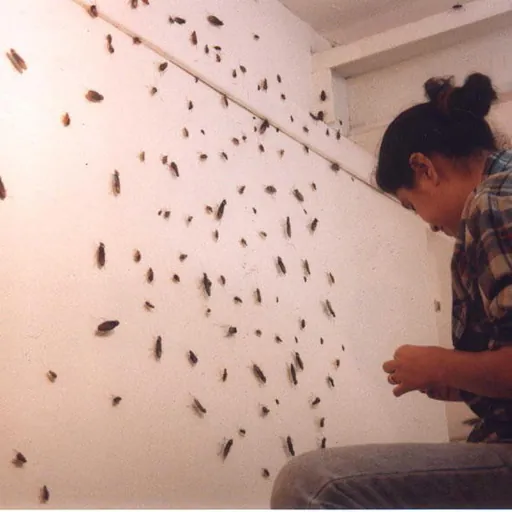
In 2001 Hema had her first international solo at Artspace, Sydney, and Institute of Modern Art, Brisbane, Australia, where she exhibited an installation titled The Nymph and the Adult (also exhibited at the 10th International Triennial – India held in New Delhi) she hand sculpted 2000 lifelike cockroaches, infesting the gallery with them. The work was intended to make viewers think about the consequences of military actions.
In collaboration with Chintan Upadhyay, she did a work titled Made in China, which spoke about mass consumerism, globalisation and a loss of identity through this. Her next collaboration was in 2006 when she collaborated with her mother, Bina Hirani, the work was titled Mum-my and was shown at the Chicago Cultural Centre.
Museum exhibitions
From 2004 onwards, Hema Upadhyay came up with installations that were part of various group shows at the Ullens Center for Contemporary Art Beijing, China; National Portrait Gallery Canberra, Australia; Centre Pompidou, Paris, France; Museum on the Seam, Jerusalem, Israel; MACRO museum, Rome, Italy; IVAM, Valencia, Spain; Mart Museum, Italy; Mori Art Museum, Tokyo, Japan; Hanger Bicocca, Milan, Italy; Chicago Cultural Centre, Chicago, USA; Ecole Nationale Superieure des Beaux Arts, Paris, France; Fukuoka Asian Art Museum, Fukuoka, Japan; Japan Foundation, Tokyo and the Henie Onstad Kunssenter, Oslo, Norway. A few months after Hema died, in 2016, her work was exhibited under the theme "Megacities Asia" at the Museum of Fine Arts, Boston.
She was the only Indian artist to be part of the inaugural exhibition for the Reopening of the MACRO museum, Rome. The exhibition was curated by Luca Massimi Barbero, Hema exhibited her installation titled Where the bees suck, there suck I.
Residencies and workshops
In 2010, Hema was invited to a residency at Atelier Calder, Sache, France. While there, she completed the work Only Memory has Preservatives, this work was inspired by the natural surroundings in Sache, but also reflected ideas that have been part of her practice. Hema tried to replicate the forest in her studio, though not in the literal sense. Using copyright free images of certain trees found in the area, she created a landscape work without using materials from nature.
In 2003 she was part of the Vasl residency in Karachi where she made a work titled Loco foco motto (which she later in 2007 exhibited in a group show at the Hanger Bicocca, Milan, Italy) that spoke about the India-Pakistan divide keeping in mind her own family history related to the partition of India. The works were also a break from her trademark symbolism, they were more craft oriented as she used matchsticks and glue to make chandeliers. Constructed of thousands of un-ignited matchsticks assembled into elaborate chandeliers, these pieces embody an important element of Hindu ritual, symbolising creation and destruction.
Her later works featured patterned surfaces, which quote from Indian spiritual iconography and traditional textile design, titled Killing Site. Dream a wish-wish a dream (2006) was the first large-scale installation that Hema did. At first glance her installation seems to be only a landscape of Bombay; however, it is actually a statement on the changing landscape by migrants who make Bombay.
Solo presentations 2012 Extra Ordinary, Faculty of Fine Arts Baroda, and Vadehra Art Gallery, New Delhi 2012 Mute Migration, Art Gallery of New South Wales, Sydney, Australia 2011–12 Princesses Rusted Belt, Studio La Citta, Verona Italy (Ex Cat) 2011 Moderniznation, Espace Topographie de l'Art, Festival D' Automne a Paris, Paris 2009 Where the bees suck, there suck I, Reopening of MACRO museum, Rome Italy 2008–09 Yours Sincerely, Gallery Nature Morte, New Delhi 2008 Universe revolves on, Singapore Tyler Print Institute, Singapore (Ex. Cat) 2004 Underneath, Gallery Chemould, Bombay (Ex. Cat) 2001–02 The Nymph and the Adult, Institute of Modern Art, Brisbane (Ex. Cat) 2001 Sweet Sweat Memories, Gallery Chemould, Bombay (Ex. Cat) 2001 The Nymph and the Adult, Art Space, Sydney
Group shows
Source: Represented by Bhambhani, she lost the case after the court ruled that Chintan's bedroom was his personal space. On the day of their murders, Chintan had paid 200,000 to Bhambhani as part of an alimony payout.
Hema had contracted out her art fabrication work to Vidyadhar Rajbhar (alias Gotu), the owner of Vanshraj Arts. She also stored her artwork at his warehouse. Vidyadhar's family had a close relationship with the family of her ex-husband Chintan. Chintan had also sponsored Vidyadhar's training in fabrication at Jaipur. According to Vidyadhar's associates, Hema owed Vidyadhar some money, and he had visited Hema's residence many times to seek the payment. Hema took along Bhambhani to examine the evidence.
The Rajbhars packed the dead bodies in cardboard boxes that they used to transport artwork. They then transported the bodies to the drain (nullah) in a temp truck driven by Vijay Kumar Rajbhar.
A Museum of Arts, Boston official, mourned the death of Hema. Her work was scheduled to be exhibited at the museum a few months after she died.
Police investigation
When Hema did not return home at night, her domestic help Mandal tried to contact her, only to find her mobile phone switched off. He then contacted her relatives and friends. The next morning, he registered a missing persons complaint. Bhambani's family also found his phone switched off, and registered a complaint.
On Saturday, around 7:30 pm, a sweeper noticed a hand in the boxes floating in the drain, opposite a crematorium in the Dahanukar Wadi area of Kandivali. He alerted the police, who retrieved the boxes. The bodies had been wrapped in transparent polyurethane sheets before being stuffed in the cardboard boxes. They were naked except for undergarments. Vijay informed the police about the other suspects, but insisted that he did not know that there were dead bodies inside the boxes. The police then arrested Azad and Pradeep. Vidyadhar is currently at large. The police have not completely ruled out Chintan as a suspect, due to his close acquaintance with Vidyadhar. The call detail record (CDR) of Chintan's phone shows that the two men exchanged several calls a fortnight before the murders. Hema's family as well as police suspect that Chintan paid Vidyadhar to commit her murder.
In October 2023, Chintan Upadhyay was convicted of murder and sentenced to life in prison by a Dindoshi court.
Don’t just read it —
keep it.
Full-length biographies made to live with: read them, listen on the way to work, watch them tonight.
- E-book
- Audio
- Video
Instant download · yours to keep · every purchase keeps this site free
Important facts
People in Hema Upadhyay's life
Named in this biography and alive at the same time


Related people
Same field, nearest in time

Contemporaries
People whose lives overlapped Hema Upadhyay's


Frequently asked questions
Who was Hema Upadhyay?
Indian visual artist (1972–2015)
When was Hema Upadhyay born?
Hema Upadhyay was born on 18 May 1972 in Vadodara.
When did Hema Upadhyay die?
Hema Upadhyay died on 11 December 2015 in Mumbai.
What was Hema Upadhyay's occupation?
Hema Upadhyay was a painter, photographer, sculptor, installation artist and artist.
What nationality was Hema Upadhyay?
Hema Upadhyay was Indian.
Sources & further reading
Cite this page
APA: Biography.guide. (2026). Hema Upadhyay. https://biography.guide/hema-upadhyay/
MLA: "Hema Upadhyay." Biography.guide, https://biography.guide/hema-upadhyay/.
Chicago: "Hema Upadhyay." Biography.guide. https://biography.guide/hema-upadhyay/.
Data last updated: 2026-09-21 · Spot an error? Report a correction.
Portrait: Wikimedia Commons · author & licence
Page generated 2026-09-27 04:58 UTC