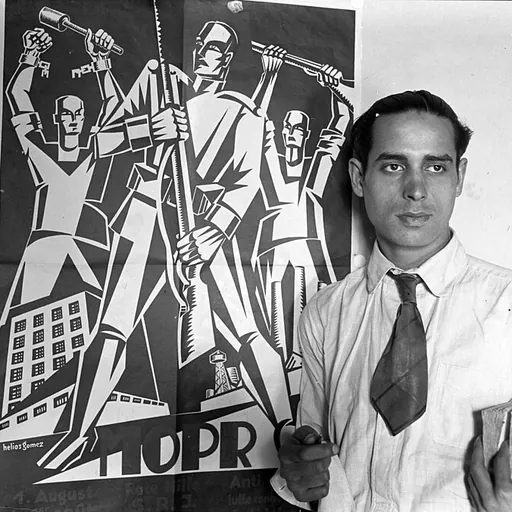
About Helios Gómez
Lived 1905 – 1956 (aged 51). Helios Gómez was a Spanish painter, poet, writer, anarcho-syndicalist, poster artist and illustrator.
Helios Gómez Rodríguez (1905–1956) was a Spanish painter, anarchist communist activist and writer. Born into a working class Calé family, he worked as a painter for the Spanish anarchist movement from an early age. His involvement in the movement forced him to flee Spain, and during his time in Europe he developed his artistic influences and was alerted to the rise of fascism.
Upon his return to Spain, he joined the Communist Party of Spain (PCE), seeing it as the force that was best organised to resist fascism. By the end of the Spanish Civil War, he returned to anarchism, but was forced to flee following the victory of the Nationalists. From the 1940s, when he was imprisoned by the Francoist dictatorship, he began focusing on his writing and presenting Romani themes through his creative work. His poetry was collected and published posthumously in 2006.
Biography Helios Gómez was born in 1905, in Triana, a predominantly Calé working class neighbourhood of Seville. From a young age, he worked as a painter and became involved in the Spanish anarchist movement. His occupation as an artist allowed him to be accepted by wider Spanish society, which considered Romani identity to be acceptable only through artistic expression, although anti-Romani sentiment would continue to be expressed towards him in press reports.
He published his first illustrations for the anarchist writer Felipe Alaiz and exhibited his early work at the radical art space Café Kursaal. Due to his activism, in 1927, he was forced to flee Spain. He then travelled throughout much of Western Europe, meeting members of avant-garde art movements and the labour movement. His time in Europe left an influence on his art style, which drew inspiration from cubism, expressionism and futurism. In 1930, he returned to Spain and settled in Barcelona, where he began working for the Confederación Nacional del Trabajo (CNT) as a printmaker for its newspapers, posters and books.
By this time, he had decided to renounce anarchism and join the Communist Party of Spain (PCE), as he felt the international communist movement was best organised to combat the threat of rising fascism. He participated in communist rallies, which saw him imprisoned in Barcelona's Model prison, and fought in the ranks of the Communist Party of Spain during the Spanish Civil War. Months after the outbreak of the war, he gave an interview with the left magazine . Introduced by the paper as a "famous Gypsy illustrator and revolutionary artist", he spoke about the anti-fascist cause as a means to overcome anti-Romani sentiment and praised the Soviet Union for its social integration of Romani people in Russia. By 1938, he had rejoined the anarchist movement and oversaw the printing layout of the newspaper El frente. When the Nationalists launched their Catalonia Offensive, he fled the country and was subsequently interned in French concentration camps.
After the war, when news began to emerge about the Romani Holocaust, he began to present himself more openly as a Romani person. He especially began to assert his Romani identity after his imprisonment by the Francoist dictatorship, when he was forced to paint the chapel in Barcelona's Model prison. Imprisoned from 1945 to 1946 and 1948 to 1954, he began focusing most of his efforts on his literary work. During this period, he wrote: two essays, including one on Romani art; two historical fiction novels, Gabrielillo Vargas, gitano rojo and Historia de los gitanos; an autobiographical epic poem titled Erika; and over 100 poems. Romani themes were present throughout his written works of this period, with Spanish artist suggesting that he was motivated to assert his identity in a regime that suppressed the rights of Romani people.
In 1956, Helios Gómez died in Barcelona.
Legacy Helios Gómez is best known for his work as a graphic artist, which he employed in service of the Spanish labour movement. According to Spanish historians and , Helios Gómez had an indisputably important role in the visual depiction of Spanish workers and anti-fascist themes during the 1930s.
Relatively less attention has been paid to his literary work, which he took up from 1942 onwards. His poetry was published posthumously in 2006, as part of the collection Poemas de lucha y sueño. Less has also been written about his political activism. Gómez, along with Mariano R. Vázquez, was cited by Sierra and Profundo as a notable example of Romani participation in the Spanish anarchist movement. Profundo himself said that Gómez's lasting legacies were in his artistic creations and his commitment to social process, as well as how his Romani identity affected each of them.
Through the Associació Cultural Helios Gómez, his son Gabriel Gómez has recovered and promoted his works.
Selected works
Don’t just read it —
keep it.
Full-length biographies made to live with: read them, listen on the way to work, watch them tonight.
- E-book
- Audio
- Video
Instant download · yours to keep · every purchase keeps this site free
Important facts
Related people
Same field, nearest in time



Contemporaries
People whose lives overlapped Helios Gómez's




Frequently asked questions
Who was Helios Gómez?
Spanish artist (1905–1956)
When was Helios Gómez born?
Helios Gómez was born on 27 May 1905 in Seville.
When did Helios Gómez die?
Helios Gómez died on 19 September 1956 in Barcelona.
What was Helios Gómez's occupation?
Helios Gómez was a painter, poet, writer, anarcho-syndicalist, poster artist and illustrator.
What nationality was Helios Gómez?
Helios Gómez was Spanish.
Sources & further reading
Cite this page
APA: Biography.guide. (2026). Helios Gómez. https://biography.guide/helios-gomez/
MLA: "Helios Gómez." Biography.guide, https://biography.guide/helios-gomez/.
Chicago: "Helios Gómez." Biography.guide. https://biography.guide/helios-gomez/.
Data last updated: 2026-09-20 · Spot an error? Report a correction.
Portrait: Wikimedia Commons · author & licence
Page generated 2026-09-27 04:57 UTC