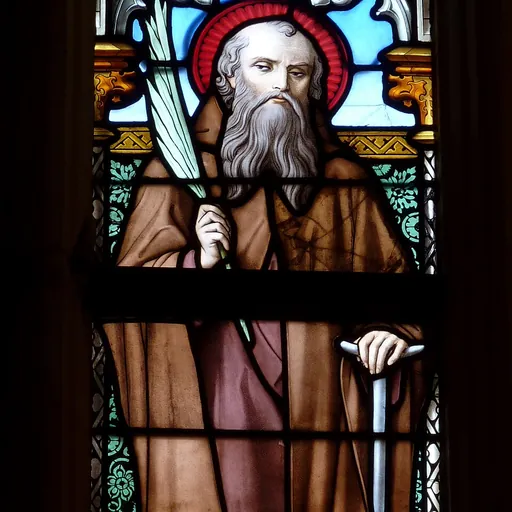
Helier
6th century ascetic hermit, is patron saint of Jersey
About Helier
Lived 500 – 555. Helier was a hermit.
Helier (died 555) was a 6th-century ascetic hermit. He is the patron saint of Jersey in the Channel Islands, and in particular of the town and parish of Saint Helier, the island's capital. He is also invoked as a healing saint for diseases of the skin and eyes.
Legend Early years Hellerius or Helier was born to pagan parents in Tongeren (now in Belgium). His father was Sigebert, a nobleman from Tongeren and his mother was Lusigard.
Jersey A medieval chapel was constructed over "St. Helier's Bed", the hollow in the rock where Helier sheltered. The Hermitage rock is the focus of the annual pilgrimage
Helier, however, found the monastic community did not provide the quiet he required to devote himself fully to a life of contemplation. Marculf had received pleas from the few inhabitants of the island called Gersut, or Agna, now called Jersey, which was all but depopulated due to repeated attacks by pirates. The inhabitants requested someone to help them, and bring the gospel to them as they had no shepherd to guide them.
Marculf sent Helier and a companion, Romard, to Jersey where he found a small community of fishermen on the sand dunes where the modern town of St Helier was to develop. Helier settled on a tidal islet, nowadays known as the Hermitage Rock, next to L'Islet, the tidal island now occupied by the 16th century Elizabeth Castle. Romard would travel back and forth between the hermitage on this rock and the fishing village.
From his vantage point on his rock, Helier could see the sails of approaching attackers and would signal to the shore, whereupon the inhabitants would scatter into the surrounding marshes, thereby frustrating the attackers' bloodlust. Small dark clouds on the horizon are still known in Jèrriais as les vailes dé St. Hélyi (the sails of St. Helier).
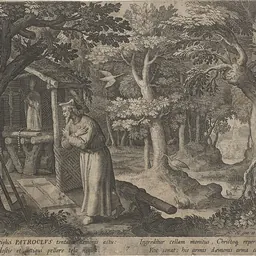
Helier remained at his hermitage in fasting and prayer for about fifteen years. The story is that around 555 he was martyred by marauding pirates who beheaded him with an axe – hence the crossed axes on the parish crest.
Miracles Helier is recorded as performing one healing miracle in Jersey, curing a lame man named Anquetil.
Once while Marculf was visiting, a band of raiders arrived. They prayed and made the sign of the cross and a great storm arose that destroyed the raiders ships.
Charles Grosset notes that the Passion of St. Helier, written in the 10th or 11th century, draws upon two very much earlier lives of Marculf (A and B), and amends them to suit the narrative. Grosset's conclusion is that the life of Helier is extremely poorly documented, and like Balleine, he considers it largely fictional. He sees the writer as having "been given the task of writing a life of the hermit Helier, who lived in Jersey and has a few bare facts known about him: the cave where he lived, healing of the sick, and death at the hands of pirates. He discovered a similar sounding name to Helier in the district of Tongres, and also a hermit called Eletus in the Life of St. Marcouf. He did not hesitate to identify Helier with the near namesake in Tongres, or to make an identification with Eletus, taking the story of a miracle set on an island whose place-name was not to be found on the map."
According to A.M. Bellows, the oldest Life of St. Marculf mentions an island called Agna with only thirty inhabitants and a hermit called Eletus. This has been identified with Jersey and Helier, but this is largely a reading back into the story the identifications made in the Passion of St. Helier, a much later work. In Bellows's opinion that Jersey could have so few inhabitants (thirty) at the time compared to Guernsey, in the much better documented visits of Sampson, stretches credulity too far. If a Channel Island is chosen, one the size of Herm would be more suitable.
That there was a town given the name "St. Helier" is not by itself proof that Helier existed, or, if he did exist, visited Jersey. The original attribution might have been to Hilary of Poitiers, and became corrupted over time, particularly during the Dark Ages, when the Diocese of Dol was laid waste by invasions of pagans. However, the hermitage rock and linked Priory on the Islet of Elizabeth Castle have a long history. There would certainly seem to be enough evidence to support the idea of a hermit, and later, an eremitic community which gradually evolved.
Further, the Passion of St. Helier was written at a much later date, when the original attributions had been masked by time; it is clearly a work which draws upon any available sources of other saints for stories, and it is this Life that makes the identification of Marculf's Eletus with Helier.
Don’t just read it —
keep it.
Full-length biographies made to live with: read them, listen on the way to work, watch them tonight.
- E-book
- Audio
- Video
Instant download · yours to keep · every purchase keeps this site free
Important facts
Related people
Same field, nearest in time





Contemporaries
People whose lives overlapped Helier's



Frequently asked questions
Who was Helier?
6th century ascetic hermit, is patron saint of Jersey
When was Helier born?
Helier was born in 500 in Tongeren.
When did Helier die?
Helier died in 555 in Jersey.
What was Helier's occupation?
Helier was a hermit.
Sources & further reading
Cite this page
APA: Biography.guide. (2026). Helier. https://biography.guide/helier/
MLA: "Helier." Biography.guide, https://biography.guide/helier/.
Chicago: "Helier." Biography.guide. https://biography.guide/helier/.
Data last updated: 2026-09-23 · Spot an error? Report a correction.
Portrait: Wikimedia Commons · author & licence
Page generated 2026-09-27 05:07 UTC