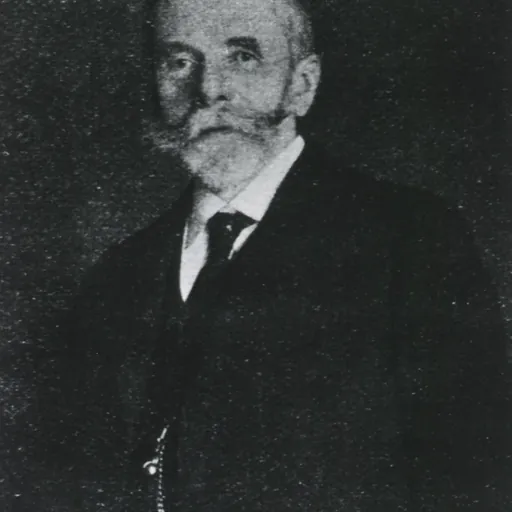
About Heinrich Quincke
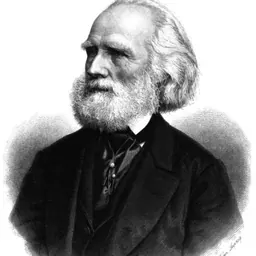
Lived 1842 – 1922 (aged 79). Heinrich Quincke was a German physician, internist, university teacher and surgeon.
Heinrich Irenaeus Quincke (26 August 1842 – 19 May 1922) was a German internist and surgeon. His main contribution to internal medicine was the introduction of the lumbar puncture for diagnostic and therapeutic purposes. After 1874, his main area of research was pulmonary medicine.
Biography Born at Frankfurt an der Oder, Heinrich was the son of prominent physician Hermann Quincke and the younger brother of physicist Georg Hermann Quincke. He received his doctorate in 1863 from the University of Berlin, having studied previously at the University of Heidelberg and at the University of Würzburg under Rudolf Virchow and Albert von Kölliker.
In 1865, Quincke worked with physiologist Ernst Wilhelm von Brücke at the University of Vienna, and in 1866, he became the assistant to the surgeon Robert Ferdinand Wilms. He was an Assistenzarzt (subordinate physician) in internal medicine under Friedrich Theodor von Frerichs at the Charité in Berlin until 1870.
In 1873, Quincke became a professor of internal medicine at the University of Berne. Five years later, he moved to the University of Kiel and became a professor emeritus in 1908. He died in Frankfurt am Main, where he had been giving lectures until his death.
Quincke received an honorary doctorate (LL.D) from the University of Glasgow in June 1901.
Discoveries
He was perhaps the first (1882) to recognize angioedema, which is often referred to as "Quincke's edema". "Quincke's pulse", with redness and pallor seen under the fingernails, is one of the signs of aortic insufficiency. "Quincke's puncture" is a somewhat outdated eponym for lumbar puncture, used for the examination of the cerebrospinal fluid in numerous diseases such as meningitis and multiple sclerosis. In 1893 he described what is now known as idiopathic intracranial hypertension, which he labeled "serous meningitis".
Don’t just read it —
keep it.
Full-length biographies made to live with: read them, listen on the way to work, watch them tonight.
- E-book
- Audio
- Video
Instant download · yours to keep · every purchase keeps this site free
Important facts
People in Heinrich Quincke's life
Named in this biography and alive at the same time

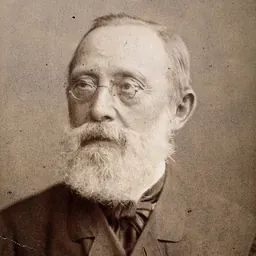
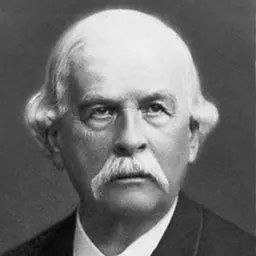

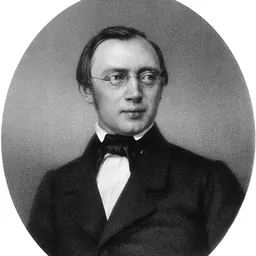
Related people
Same field, nearest in time



Contemporaries
People whose lives overlapped Heinrich Quincke's

Frequently asked questions
Who was Heinrich Quincke?
German physician (1842–1922)
When was Heinrich Quincke born?
Heinrich Quincke was born on 26 August 1842 in Frankfurt (Oder).
When did Heinrich Quincke die?
Heinrich Quincke died on 19 May 1922 in Frankfurt.
What was Heinrich Quincke's occupation?
Heinrich Quincke was a physician, internist, university teacher and surgeon.
What nationality was Heinrich Quincke?
Heinrich Quincke was German.
Sources & further reading
Cite this page
APA: Biography.guide. (2026). Heinrich Quincke. https://biography.guide/heinrich-quincke/
MLA: "Heinrich Quincke." Biography.guide, https://biography.guide/heinrich-quincke/.
Chicago: "Heinrich Quincke." Biography.guide. https://biography.guide/heinrich-quincke/.
Data last updated: 2026-09-21 · Spot an error? Report a correction.
Portrait: Wikimedia Commons · author & licence
Page generated 2026-09-27 05:00 UTC