
Heinrich Kroll
German flying ace
About Heinrich Kroll
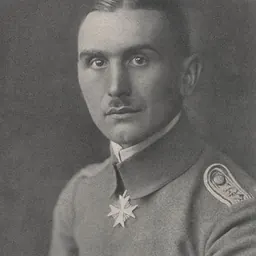
Lived 1894 – 1930 (aged 35). Heinrich Kroll was a German fighter pilot.
Oberleutnant Henrich Claudius Kroll (3 November 1894 – 21 February 1930) Pour le Merite, Knight's Cross of the Royal House Order of Hohenzollern, Saxony's Albert Order Knight Second Class with Swords, Iron Cross First and Second Class, was a World War I fighter ace credited with 33 victories.
Early life Kroll was born in the village of Flatzby near Flensburg, Germany, on 3 November 1894. He was the son of a school teacher. Kroll the younger also aspired to become a teacher. He passed his examinations at Kiel and was being credentialed as a teacher when World War I started. From there he transferred into Reserve Regiment No. 92. He earned an Iron Cross Second Class, and was commissioned an officer in May 1915.
On 12 February 1917, Kroll was awarded the Iron Cross First Class. It was about this time that Kroll wrote about the difficulty of confirming victories: "It is difficult to get confirmation of a victory–especially the first one! It must be confirmed by our own ground troops ... this is even more difficult if hazy conditions prevail."
After being shot down and forced to land by a Caudron in November 1916, Kroll's first victory was on 1 May 1917, over a Spad. He downed four more Spads in May, his fifth victory being one of the most significant victories; on 25 May 1917, he shot down and killed the man who was then the second highest scoring ace in the French Air Force, René Dorme.
Kroll in command
This victory was influential in Kroll being appointed commanding officer of Royal Saxon Jasta 24 on 1 July 1917. He would command this unit, with brief interregnums, until just before the end of the war.
He would score once in July, on the 20th.
On 27 September 1917 with his score at 12, he received the first Pfalz D.III assigned to his Jasta. The Pfalz would almost end his life. Kroll apparently still used his Albatros D.V, marked with a taijitu on a tan background. Kroll considered the Pfalz to be the Albatros's inferior in performance; he thought the Pfalz the slower of the two planes, climbed no better, but could be faster in a dive. Whichever aircraft he used, he rounded off 1917 by scoring his 15th victory on 4 December.
On 25 January 1918, after he shot down a Bristol F.2b Fighter for number 17, steadily racking up his score, mostly against enemy fighters. An SE-5a fell on 9 August 1918 to finish his tally at 33.
Post-war
The end of the war saw him an Oberleutnant. He then joined the Hamburg Police as a captain. While there he witnessed the attempted Kapp Putsch against the Weimar government. In its aftermath he recovered the body of fellow fighter ace Rudolf Berthold, who had been murdered by German communists.
There followed a quiet period during which he was a clerk.
He joined the Hamburg Flying Club in 1928
Don’t just read it —
keep it.
Full-length biographies made to live with: read them, listen on the way to work, watch them tonight.
- E-book
- Audio
- Video
Instant download · yours to keep · every purchase keeps this site free
Important facts
People in Heinrich Kroll's life
Named in this biography and alive at the same time

Related people
Same field, nearest in time


Contemporaries
People whose lives overlapped Heinrich Kroll's


Frequently asked questions
Who was Heinrich Kroll?
German flying ace (1894–1930)
When was Heinrich Kroll born?
Heinrich Kroll was born on 3 November 1894 in Sörup.
When did Heinrich Kroll die?
Heinrich Kroll died on 21 February 1930 in Geesthacht.
What was Heinrich Kroll's occupation?
Heinrich Kroll was a fighter pilot.
What nationality was Heinrich Kroll?
Heinrich Kroll was German.
Sources & further reading
Cite this page
APA: Biography.guide. (2026). Heinrich Kroll. https://biography.guide/heinrich-kroll/
MLA: "Heinrich Kroll." Biography.guide, https://biography.guide/heinrich-kroll/.
Chicago: "Heinrich Kroll." Biography.guide. https://biography.guide/heinrich-kroll/.
Data last updated: 2026-09-20 · Spot an error? Report a correction.
Page generated 2026-09-27 05:23 UTC