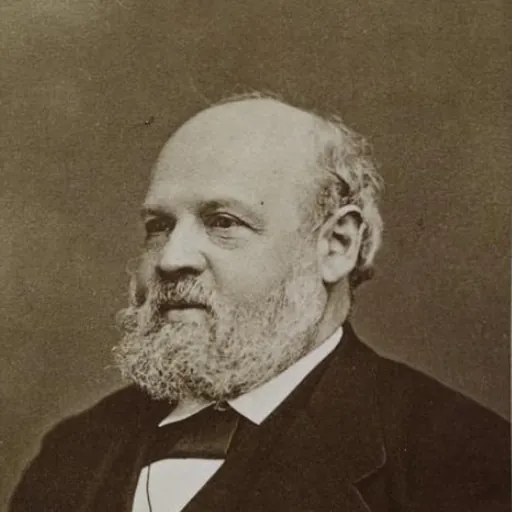
About Heinrich Geißler
Lived 1814 – 1879 (aged 64). Heinrich Geißler was a scientific glassblower, inventor, measuring instrument maker, entrepreneur and glassblower, known for Geissler tube.
1862 Geißler discharge tube with holder in the Teylers Instrument Room. In 1856, his brother Wilhelm Geissler had worked together with Van der Willigen, the future conservator of the Physical Cabinet of Teylers Museum. After that, Heinrich Geissler made his well-known glass discharge tubes in Bonn. Johann Heinrich Wilhelm Geißler (26 May 1814 in Igelshieb – 24 January 1879) was a skilled glassblower and physicist, famous for his invention of the hand pumped Geissler mercury vacuum pump in the mid-1850's and in 1857, the Geissler tube, made of glass and used as a low pressure gas-discharge tube; these two inventions were critical technologies leading to the discovery of the electron.
Geissler descended from a long line of craftsmen in the Thüringer Wald and in Bohemia.
The Geissler tube was used for entertainment throughout the 1800s and evolved around 1910 into commercial neon lighting. Advances in Plucker and Geissler's discharge tube technology developed into the Crookes tube, with which the electron was discovered in 1897, and in 1906 into the amplifying vacuum tube, the basis of electronics and long-distance communication technologies like radio and television.
Geissler was awarded an honorary doctorate in 1868.
References and articles
Publications Miller, H. A. (1945). Luminous tube lighting, dealing with the principles of the luminous tube, with a summary of the materials and equipment involved, and technical data concerning discharge-tube light sources. London: G. Newnes. Kassabian, Mihran Krikor Roentgen rays and electro-therapeutics: with chapters on radium and phototherapy. Publisher: J.B. Lippincott Company Philadelphia & London, 1910 - Lippincott's New Medical Series. Edited by Francis R. Packard, M.D Davis, H. B. O. (1981). Electrical and electronic technologies: a chronology of events and inventors to 1900. Metuchen, N.J.: Scarecrow Press. Phillips, C. E. S. (Charles Edmund Stanley): Bibliography of X-ray literature and research, 1896–1897: being a ready reference index to the literature on the subject of roentgen or X-rays. Publisher: The Electrician Print. and Pub. Co., London 1897 Heinrich Geissler 1838, page 16, Historical Retrospect in: Charles E. S. Philips
Don’t just read it —
keep it.
Full-length biographies made to live with: read them, listen on the way to work, watch them tonight.
- E-book
- Audio
- Video
Instant download · yours to keep · every purchase keeps this site free
Important facts
Contemporaries
People whose lives overlapped Heinrich Geißler's






Frequently asked questions
Who was Heinrich Geißler?
physicist (1814–1879)
When was Heinrich Geißler born?
Heinrich Geißler was born on 26 May 1814 in Igelshieb.
When did Heinrich Geißler die?
Heinrich Geißler died on 24 January 1879 in Bonn.
What was Heinrich Geißler's occupation?
Heinrich Geißler was a scientific glassblower, inventor, measuring instrument maker, entrepreneur and glassblower.
What was Heinrich Geißler known for?
Heinrich Geißler was known for Geissler tube.
What nationality was Heinrich Geißler?
Heinrich Geißler's recorded nationality: Duchy of Saxe-Meiningen.
Sources & further reading
Cite this page
APA: Biography.guide. (2026). Heinrich Geißler. https://biography.guide/heinrich-geissler/
MLA: "Heinrich Geißler." Biography.guide, https://biography.guide/heinrich-geissler/.
Chicago: "Heinrich Geißler." Biography.guide. https://biography.guide/heinrich-geissler/.
Data last updated: 2026-09-21 · Spot an error? Report a correction.
Portrait: Wikimedia Commons · author & licence
Page generated 2026-09-27 04:59 UTC