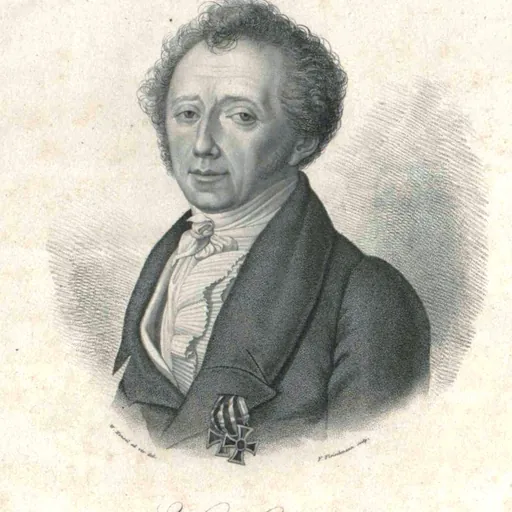
About Heinrich Clauren
Lived 1771 – 1854 (aged 83). Heinrich Clauren was a German writer, poet lawyer, beamter, editing staff and bookseller.
Carl Gottlieb Samuel Heun (20 March 1771 – 2 August 1854), better known by his pen name Heinrich Clauren, was a German author.
Biography Born on 20 March 1771 in Doberlug, Lower Lusatia. Heun went into the Prussian civil service, and wrote in his spare time. He published under the pseudonym H. Clauren (an anagram of Carl Heun), and became one of the most popular authors of fiction for the middle class in the first half of the nineteenth century.
In 1825, Wilhelm Hauff published a parody of Heun's novels, ('The Man in the Moon'), imitating his style, and published under his pen name H. Clauren. Heun brought a lawsuit against Hauff, and won, leading Hauff to write another book, (1826), successfully destroying the reputation of Heun's works. The following year Carl Herloßsohn also parodied Clauren by publishing a novel in Clauren's name, (1827) and mocked Clauren's plays in his (1827).
Heun's collected works were published in 25 volumes as in 1851. He died on 2 August 1854 in Berlin. A. J. Day describes how many themes and ideas in Frankenstein are a reflection of , and uses passages from Heun's "" to compare to both the novel and Shelley's recollection of her inspiration in the preface to the novel.
Another of his short stories, "", may have been one of the sources of inspiration for Edgar Allan Poe's "The Fall of the House of Usher" (1839), as translated by Joseph Hardman as "The Robber's Tower" in Blackwood's Magazine.
In Thomas Mann's Buddenbrooks (1901), the young Miss Antonie Buddenbrook is found reading Clauren's novel Mimili.
Translations
A number of Clauren's works have been translated into English: "" and "" were translated by John Kortz as "Northern Love" and "The Humours of Love" in Interesting Memoirs of Four German Gentlemen (1819) "" was translated anonymously as "The Apparition" in The Repository of Arts (1821) "" was translated anonymously as "The Green Mantle of Venice: A True Story" in The Repository of Arts (1821–1822) "" was translated by Frederic Shoberl as "The Church-Yard of Schwytz" in Forget Me Not for 1823, and again by James David Haas as Liesli: A Swiss Tale (1826) "" was translated anonymously in Forget Me Not for 1824 "" was translated anonymously as "The Paper-Maker's Coffin" in The Edinburgh Literary Journal (1828) "" was freely translated by Joseph Hardman as "The Robber's Tower" in Blackwood's Magazine (1828), and more accurately by Dan Latimer as "The Robber's Castle" in Southern Humanities Review 24 (1990) "" was translated by George Godfrey Cunningham as "My Grandmother" in Foreign Tales and Traditions (1829) The first part of "" was translated by Marjorie Bowen as "The Grey Chamber" in Great Tales of Horror (1933), and again by Leonard Wolf as "The Gray Room: A True Story" in The Essential Frankenstein (1993); both parts of the story were translated by A. J. Day as "The Grey Room" in Fantasmagoriana: Tales of the Dead (2005), and again by Anna Ziegelhof as "The Grey Chamber: A True Story" in Fantasmagoriana Deluxe (2023) "" was translated by Pamela Selwyn as "Song of the Prussians" in Revisiting Prussia's Wars against Napoleon (2015)
Don’t just read it —
keep it.
Full-length biographies made to live with: read them, listen on the way to work, watch them tonight.
- E-book
- Audio
- Video
Instant download · yours to keep · every purchase keeps this site free
Important facts
People in Heinrich Clauren's life
Named in this biography and alive at the same time






Related people
Same field, nearest in time

Contemporaries
People whose lives overlapped Heinrich Clauren's



Frequently asked questions
Who was Heinrich Clauren?
German writer (1771-1854)
When was Heinrich Clauren born?
Heinrich Clauren was born on 20 March 1771 in Doberlug-Kirchhain, Doberlug.
When did Heinrich Clauren die?
Heinrich Clauren died on 2 August 1854 in Berlin.
What was Heinrich Clauren's occupation?
Heinrich Clauren was a writer, poet lawyer, beamter, editing staff and bookseller.
What nationality was Heinrich Clauren?
Heinrich Clauren was German.
Sources & further reading
Cite this page
APA: Biography.guide. (2026). Heinrich Clauren. https://biography.guide/heinrich-clauren/
MLA: "Heinrich Clauren." Biography.guide, https://biography.guide/heinrich-clauren/.
Chicago: "Heinrich Clauren." Biography.guide. https://biography.guide/heinrich-clauren/.
Data last updated: 2026-09-20 · Spot an error? Report a correction.
Portrait: Wikimedia Commons · author & licence
Page generated 2026-09-27 04:58 UTC