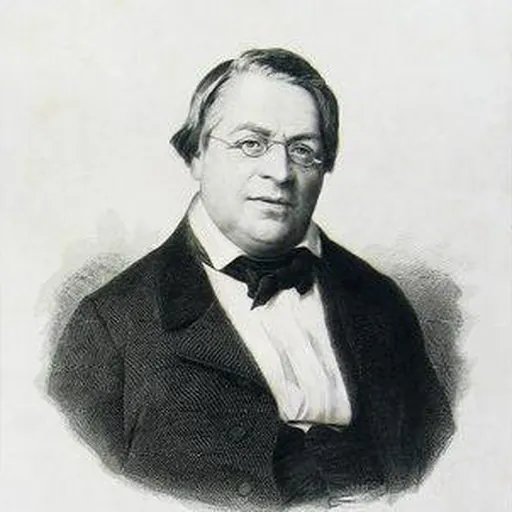
About Heinrich August Marschner
Lived 1795 – 1861 (aged 66). Heinrich August Marschner was a German conductor and composer.
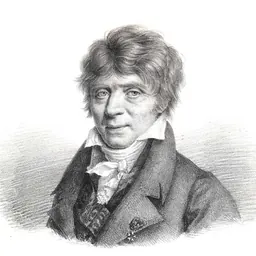
Heinrich Marschner, lithograph after a drawing by F. A. Jung, c. 1830 Heinrich August Marschner (16 August 1795 – 14 December 1861) was a German composer best known for his operas. He is considered to be the most important composer of German opera between Weber and Wagner.
Biography Marschner was born in Zittau, in southeastern Saxony, and was originally intended for a legal career. After a meeting with Beethoven around 1815–16, he decided to devote himself to music and became a private music teacher in Bratislava. From 1821 he worked as a stage composer and conductor at the municipal theatres in Dresden (from 1821), Leipzig (from 1827), and the Court Theatre at Hanover (from 1830), where the opera Hans Heiling (1833) established his name among the leading German opera composers of the time. He died in Hanover.
Legacy Marschner was widely regarded as one of the most important composers in Europe from about 1830 until the end of the 19th century. Marschner did not just toss off these works as an afterthought, but clearly devoted considerable time and effort to writing them. He gave the title "Grand Trio" to each of his works for piano, violin and cello, indicative of the importance he attached to them. In these pieces, one finds all of the emotions prevalent in the Romantic movement during the mid-19th century.
To the extent that Marschner is still remembered, it is largely for his operas Hans Heiling (1833), Der Vampyr (1828) and Der Templer und die Jüdin (1829), extremely popular in his lifetime. Marschner's ability to depict supernatural horror by musical means is especially evident in the first two operas as well as in some of his ballads, such as "" (c. 1839).
Next to his operas, Marschner's most significant musical contribution is to the Lied. The best of his works in this form are comparable with those by Carl Loewe. He also wrote a considerable amount of chamber music, including seven piano trios, as well as unaccompanied male choruses that were very popular in the nineteenth century. While Marschner's operas strongly influenced Wagner, his chamber music, songs, and his cantata (1842) were admired by Schumann, whose cantata Paradise and the Peri (1843) shows the older composer's influence. Marschner's Bagatelles for guitar (1814) have been taken up lately by some guitarists, and some of his chamber music is still very occasionally played. Among his operas, Hans Heiling and especially Der Vampyr have been adapted and revived in recent years with considerable success.
Selected works
Opera
Incidental music (Music to plays) Prinz Friedrich von Homburg, Op. 56 (1821) to the play by Kleist Schön Ella, Op. 27 (1822–3) to a play by Johann Friedrich Kind Der Goldschmied von Ulm (1856) to a play by Salomon Hermann Mosenthal Die Hermannsschlacht to the play by Kleist
Chamber music Piano trio No. 1 in A minor, Op. 29 Piano trio No. 2 in G minor, Op. 111 Piano trio No. 3 in F minor, Op. 121 Piano trio No. 4 in D major, Op. 135 Piano trio No. 5 in D minor, Op. 138 Piano trio No. 6 in C minor, Op. 148 Piano trio No. 7 in F major, Op. 167 Piano quartet No. 1 in B-flat major, Op. 36 Piano quartet No. 2 in G major, Op. 158
Solo music Douze Bagatelles pour la Guitarre, Op. 4
Don’t just read it —
keep it.
Full-length biographies made to live with: read them, listen on the way to work, watch them tonight.
- E-book
- Audio
- Video
Instant download · yours to keep · every purchase keeps this site free
Important facts
People in Heinrich August Marschner's life
Named in this biography and alive at the same time

Related people
Same field, nearest in time




Contemporaries
People whose lives overlapped Heinrich August Marschner's




Frequently asked questions
Who was Heinrich August Marschner?
German composer (1795–1861)
When was Heinrich August Marschner born?
Heinrich August Marschner was born on 16 August 1795 in Zittau.
When did Heinrich August Marschner die?
Heinrich August Marschner died on 14 December 1861 in Hanover.
What was Heinrich August Marschner's occupation?
Heinrich August Marschner was a conductor and composer.
What nationality was Heinrich August Marschner?
Heinrich August Marschner was German.
Sources & further reading
· Wikipedia: Heinrich August Marschner
Cite this page
APA: Biography.guide. (2026). Heinrich August Marschner. https://biography.guide/heinrich-august-marschner/
MLA: "Heinrich August Marschner." Biography.guide, https://biography.guide/heinrich-august-marschner/.
Chicago: "Heinrich August Marschner." Biography.guide. https://biography.guide/heinrich-august-marschner/.
Data last updated: 2026-09-23 · Spot an error? Report a correction.
Portrait: Wikimedia Commons · author & licence
Page generated 2026-09-27 05:06 UTC