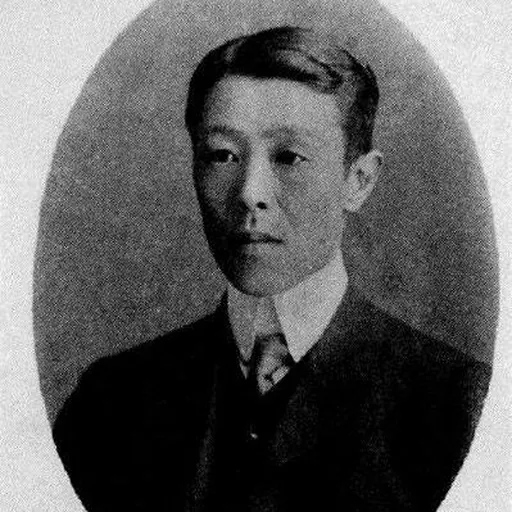
Heijiro Nakayama
Japanese pathologist and archaeologist
About Heijiro Nakayama
Lived 1871 – 1956 (aged 84). Heijiro Nakayama was a Japanese anthropologist, archaeologist, pathologist and kyushu University, known for Fukuoka Prefecture.
was a Japanese pathologist and archaeologist living in Fukuoka.
Life Heijiro Nakayama was born in 1871 in Kyoto City to a family of physicians. In 1874, he moved to Tokyo. During secondary school days, he was interested in archaeology and found remains, possibly, Yayoi pottery. He graduated from the Faculty of Medicine, Tokyo Imperial University and studied in Germany between 1903 and 1906. In the same ship was Sunao Tawara, also a pathologist. Nakayama became Professor of Pathology, Kyushu Medical University of Kyoto Imperial University, now Kyushu University at age 35. Nakayama's elder brother, Morihiko Nakayama served as Professor of Surgery at the same school. Nakayama's students included a Chinese physician Guo Moruo and Hakaru Hashimoto. Hashimoto thanked Nakayama for his guidance in his paper which led to the name of Hashimoto's thyroiditis. Nakayama studied the life cycle of Schistosoma japonicum.
Archaeology In 1909, he was accidentally infected with pyogenic bacteria during an autopsy, but fortunately survived. Since then, he completely discontinued pathological studies and started archaeology. Sunao Tawara, Professor of Pathology, pathologist of another department of Kyushu University undertook pathological studies.
Taishō era During the Taishō era (1912–1926), he exclusively wrote in Kohkogaku zasshi (Jpn J Archaeology), and he was criticized that he monopolized this journal, although this journal was open nationwide. In the early years of the Showa era, upon hearing the criticism, he discontinued his studies and turned to angling near his home, along the Hakata Bay. After the war, he taught archaeology to Dairoku Harada upon his return from military service.
Archaeological achievements Designation of Genko Borui. There was a long line of stone defense structure along the Hakata Bay, constructed against possible attack of the Yuan dynasty and Nakayama named it Genko Borui in 1913. Previously it had been called Ishitsuiji. He studied the site of King of Na gold seal, a national treasure of Japan which was given by China. It was discovered by a peasant on April 12, 1784, on Shikanoshima Island, Fukuoka. It is now stored in the Fukuoka city Museum. Discovery of various remains now considered belonging to the Yayoi era. Proposal of the site of Kōrokan, Japanese Government Foreign Affairs Site in Hakata. He proposed that it was in the Fukuoka Castle and this was verified after excavation in 1987.
Papers Historic remains around Fukuoka, Fukuoka Nichi Nichi Shimbun, 1912. The value of Genko Borui(Long stone fort against another invasion by Mongolia) in Fukuoka Nichi NichiShimbun, 1913. (He named the remains Genko Borui. The remains of the Intermediate Period (corresponding to Yayoi Period), Kokogaku Zasshi, Vol 7, Nr.10,11, Vol.8, 1,3, 1917–1918. Kohrokan, the foreign affairs bureau of Japan, is in the Fukuoka Castle. Kohkogaku Zasshi, 16,1926,17,1927. (1926–1927)
Don’t just read it —
keep it.
Full-length biographies made to live with: read them, listen on the way to work, watch them tonight.
- E-book
- Audio
- Video
Instant download · yours to keep · every purchase keeps this site free
Important facts
People in Heijiro Nakayama's life
Named in this biography and alive at the same time




Related people
Same field, nearest in time



Contemporaries
People whose lives overlapped Heijiro Nakayama's



Frequently asked questions
Who was Heijiro Nakayama?
Japanese pathologist and archaeologist (1871–1956)
When was Heijiro Nakayama born?
Heijiro Nakayama was born on 3 June 1871 in Kyoto.
When did Heijiro Nakayama die?
Heijiro Nakayama died on 29 April 1956 in Fukuoka.
What was Heijiro Nakayama's occupation?
Heijiro Nakayama was an anthropologist, archaeologist, pathologist and kyushu University.
What was Heijiro Nakayama known for?
Heijiro Nakayama was known for Fukuoka Prefecture.
What nationality was Heijiro Nakayama?
Heijiro Nakayama was Japanese.
Sources & further reading
Cite this page
APA: Biography.guide. (2026). Heijiro Nakayama. https://biography.guide/heijiro-nakayama/
MLA: "Heijiro Nakayama." Biography.guide, https://biography.guide/heijiro-nakayama/.
Chicago: "Heijiro Nakayama." Biography.guide. https://biography.guide/heijiro-nakayama/.
Data last updated: 2026-09-24 · Spot an error? Report a correction.
Portrait: Wikimedia Commons · author & licence
Page generated 2026-09-27 05:08 UTC