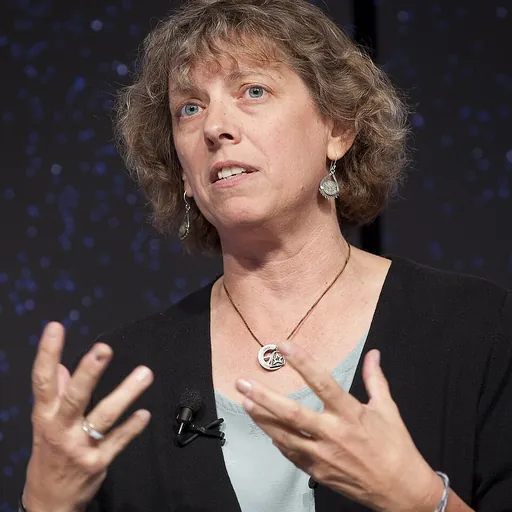
About Heidi B. Hammel
Born 1960. Heidi B. Hammel is an American astronomer.
Heidi B. Hammel (born March 14, 1960) is an American planetary astronomer who has extensively studied Neptune and Uranus. She was part of the team imaging Neptune from Voyager 2 in 1989. She led the team using the Hubble Space Telescope to view Shoemaker-Levy 9's impact with Jupiter in 1994. She has used the Hubble Space Telescope and the Keck Telescope to study Uranus and Neptune, discovering new information about dark spots, planetary storms and Uranus' rings. In 2002, she was selected as an interdisciplinary scientist for the James Webb Space Telescope.
Hammel spends increasing time as a science communicator. She is the 2002 recipient of the Carl Sagan Medal given to a scientist whose communications have greatly enhanced the general public's understanding of planetary science.
Education Hammel received her undergraduate degree from the Massachusetts Institute of Technology (MIT) in 1982 and her Ph.D. in physics and astronomy from the University of Hawaii in 1988. After a post-doctoral position at NASA's Jet Propulsion Laboratory, Pasadena, California, Hammel returned to MIT, where she spent nearly nine years as a principal research scientist in the Department of Earth, Atmospheric, and Planetary Sciences. AURA operates world-class astronomical observatories including the Hubble Space Telescope, the National Optical Astronomy Observatory, the National Solar Observatory, and the Gemini Observatory. Hammel became the executive vice president of the Association of Universities for Research in Astronomy (AURA) in 2010. In 2002, she was selected as an interdisciplinary scientist for the Hubble Space Telescope's successor, the James Webb Space Telescope, which launched in 2021. She was also a member of the Science Working Group for the giant segmented mirror telescope. She served on the joint NASA/NSF Exoplanet Taskforce, and on the Science and Technology Definition Team for NASA's Terrestrial planet Finder Coronograph mission.
Research Hammel's main areas of interest are ground and space-based astronomical observations of outer planets' atmospheres utilizing Adaptive optics (AO) technology.
Hammel has described her own research by saying:
The Hubble Space Telescope and the Keck Telescope with its new adaptive optics changed how planetary astronomers look at Uranus and Neptune. With Hubble's advanced cameras and improvements to the adaptive optics systems of the Keck telescope, astronomers became able to capture "unbelievably crisp images" and view many details that could not be seen before. Hammel's planetary research with Hubble and Keck has demonstrated that both Uranus and Neptune are dynamic worlds.
Voyager 2, Neptune
Hammel primarily studies the outer planets and their satellites, focusing on observational techniques. She was a member of the Imaging Science Team for the Voyager 2 encounter with the planet Neptune in 1989. As the leader of the ground team Hammel analyzed photos of this event taken from the Hubble Space Telescope. Hammel was the National Aeronautics and Space Administration's public face, explaining the science to television audiences worldwide.
Great Dark Spot, Neptune Hammel was on the team that first spotted Neptune's Great Dark Spot,
Weather and rings, Uranus With colleague Imke de Pater, Heidi Hammel has been studying Uranus with the Keck telescope since 2000.
As of 2014, her most recent research involved the imaging of Neptune and Uranus with the use of the Hubble Space Telescope, W. M. Keck Observatory, Mauna Kea Observatory, the NASA Infrared Telescope Facility (IRTF), Mauna Kea and other Earth-based observatories.
Recognition and public outreach Hammel has been awarded prizes both for her research (including the 1996 Harold C. Urey Prize of the American Astronomical Society Division for Planetary Sciences) and for her public outreach (such as the San Francisco Exploratorium's 1998 Public Understanding of Science Award). Hammel was elected a Fellow of the American Association for the Advancement of Science in 2000. She has also been lauded for her work in public outreach, including the 2002 Carl Sagan Medal for outstanding communication by an active planetary scientist to the general public; the Astronomical Society of the Pacific's 1995 Klumpke-Roberts Award for public understanding and appreciation of astronomy; and the 1996 "Spirit of American Women" National Award for encouraging young women to follow non-traditional career paths. Her biography "Beyond Jupiter: The Story of Planetary Astronomer Heidi Hammel" has been published by the United States National Academy of Sciences as part of the series "Women's Adventures in Science".
Hammel joined The Planetary Society's Board of Directors in 2005. On May 7, 2009 the Women's Board of the Adler Planetarium awarded Hammel with the 2009 Women in Space Science Award.
In June 2010, Hammel participated in the World Science Festival held in New York City, by the James Webb Space Telescope model in Battery Park. Hammel talked about the discoveries anticipated in 2014 with the launching of the James Webb Space Telescope, which will be the world's most powerful space telescope, being the successor to the Hubble Space Telescope. Other speakers included John C. Mather, a Nobel laureate and the Webb telescope's senior project scientist and Dr. John Grunsfeld, astronaut, physicist and "chief repairman" of the Hubble Space Telescope.
On November 2, 2010, The Association of Universities for Research in Astronomy announced the appointment of Hammel to the position of executive vice president. Hammel began her appointment on January 1, 2011.
The asteroid 3530 Hammel was named in her honor in 1996.
Filmography The Planets and Beyond, 2018 TV episode on the Science Channel Uranus & Neptune: Rise of the Ice Giants, 2018 TV episode in How the Universe Works, herself as Astronomer Hubble's Cosmic Journey, 2015 TV episode on the National Geographic Channel Naked Science, 2006–2008 2 TV episodes on the National Geographic Channel Hubble's Amazing Universe, 2008 TV episode Deadliest Planets, 2006 TV episode, as Dr. Heidi B. Hammel, senior research scientist Hubble: Secrets from Space, 1998 TV episode, as Professor Heidi Hammel
Personal quotes
Don’t just read it —
keep it.
Full-length biographies made to live with: read them, listen on the way to work, watch them tonight.
- E-book
- Audio
- Video
Instant download · yours to keep · every purchase keeps this site free
Important facts
People in Heidi B. Hammel's life
Named in this biography and alive at the same time





Related people
Same field, nearest in time




Contemporaries
People whose lives overlapped Heidi B. Hammel's




Frequently asked questions
Who is Heidi B. Hammel?
American astronomer
When was Heidi B. Hammel born?
Heidi B. Hammel was born on 14 March 1960 in California.
What is Heidi B. Hammel's occupation?
Heidi B. Hammel is an astronomer.
What nationality is Heidi B. Hammel?
Heidi B. Hammel is American.
Sources & further reading
Cite this page
APA: Biography.guide. (2026). Heidi B. Hammel. https://biography.guide/heidi-b-hammel/
MLA: "Heidi B. Hammel." Biography.guide, https://biography.guide/heidi-b-hammel/.
Chicago: "Heidi B. Hammel." Biography.guide. https://biography.guide/heidi-b-hammel/.
Data last updated: 2026-09-21 · Spot an error? Report a correction.
Portrait: Wikimedia Commons · author & licence
Page generated 2026-09-27 05:00 UTC