
About Hayyim ben Joseph Vital
Lived 1542 – 1620 (aged 77–78). Hayyim ben Joseph Vital was a Turkish rabbi, kabbalist, author and scholar.
Hayyim ben Joseph Vital (; Safed, October 23, 1542 (Julian calendar) / October 11, 1542 (Gregorian Calendar) – Damascus, 23 April 1620 ) was a rabbi in Safed and the foremost disciple of Isaac Luria. He recorded much of his master's teachings. After Vital's death, his writings began to spread and led to a "powerful impact on various circles throughout the Jewish world."
Early life
Born in Safed, as a young boy Hayyim Vital was educated by the scholar Moshe Alshich. Joseph Karo is said to have paid special attention to Vital's early talents and in 1557 requested that Alshich take special care in his education as he was destined to succeed his teacher in the world of Torah study. That same year, Vital first became acquainted with the kabbalist Isaac Luria, who would have a lasting influence on him.
Vital apparently married at a young age. It was an unhappy marriage, and when he left his wife, it is said the prophet Elijah appeared to him in a dream and led him to a beautiful garden, where he saw the pious of all ages, in the form of birds, flying through the garden and studying the Mishnah. In the center of the garden was God seated on a throne that was surrounded by the pious, resting on elaborate tapestries. Convinced by this vision that he was destined to become a kabbalist, Vital devoted the following two and a half years to the study of alchemy. Upon completing his studies, Elijah appeared to him again in a vision and told him that he would succeed in his efforts and write a commentary on the Zohar.
Study with Cordovero
When Luria arrived in Safed, Moses ben Jacob Cordovero had been the principal figure in the kabbalistic community for numerous years. "Cordovero was the teacher of what appears to have been a relatively loose-knit circle of disciples. The most important were Eliyahu de Vidas, Abraham ben Mordecai Galante, Moses Galante, Hayyim Vital, Abraham ben Eliezer Halevi, Elazar ben Moshe Azikri, Samuel Gallico, and an important kabbalist who studied with Cordovero for a short while in the 1560s, Mordechai Dato."
Evidence suggests that Isaac Luria also regarded Moses Cordovero as his teacher. Joseph ben Isaac Sambari (1640-1703), an Egyptian chronicler, testified that Cordovero was "the Ari's teacher for a very short time." Luria probably arrived in early 1570, and Cordovero died on June 27 that year (the 23d day of Tammuz). It is broadly accepted that Hayyim Vital emerged as the leading student within a year, so when Luria died in 1572 at the age of 38, Vital succeeded him. Since Luria had left almost none of his teachings in writing, Vital began to write down everything he had learned from his master.
Exile and return
Hayyim Vital arrived in Egypt in 1577 but soon returned to Ottoman Syria, visiting the village of Ein al-Zeitun and later Jerusalem. After that, he went to live in Damascus, where he began writing his first work. Most of the book consists of an exposition on the conjuring of clouds and a discourse on the classical planets, the seven heavens, and their corresponding metals. Upon completing his book, Vital returned to Jerusalem, where his former teacher, Moshe Alshich, ordained him "in the 1590s." After a time, however, Vital left Jerusalem for Safed, where he fell sick and was bedridden for an entire year.
He also authored Shaar HaGilgulim, a kabbalistic work on reincarnation, which became one of the Shemonah She'arim "Eight Gates."
Etz Hayyim
During this illness Joshua Ben-Nun, his closest follower, who had accompanied Vital on nearly every journey, managed to bribe Vital's younger brother, Moshe, with 50 gold coins to lend him Vital's writings, which were kept locked in a box. Moshe accordingly brought Joshua a large part of the manuscripts, and 100 copyists were immediately engaged and given 6 pages each: in just three days, they reproduced 600 pages. Although according to some reports Vital, upon learning of this, claimed that the papers which has been copied were not his writings, they were rapidly disseminated. The writings in question purported to contain the teachings of Luria rather than Vital's independent work.
The first printed edition was in eight volumes, known as the Shemonah She'arim, and some Kabbalists still use this version in the Sephardi world. The best-known recension was published later under the title Etz Hayyim ("Tree of Life"), in which the topics were arranged in a more systematic order, and the parts on ritual (the Peri Etz Hayyim) were kept separate from the parts on the underlying theology. In addition to a tribute to Luria, the work contains the assertion that it is one of God's greatest pleasures to witness the promotion of the teaching of the Kabbalah since this alone can assure the coming of the Messiah.
However, Vital still highly esteemed the teachings of his former teacher, kabbalist Moses Cordovero. He maintained that Cordovero often appeared to him in dreams.
One of Vital's most prominent opponents was Menahem Lonzano, who publicly denounced him in his work Imrei Emet.
Later life and death
On 20 Elul 1590, Vital received rabbinical ordination from his teacher Moshe Alshich. Four years later, in 1594, he settled permanently in Damascus, where he lectured every evening on the kabbalah. In 1604 Vital's sight began to fail; in 1620 he died while preparing to return to Safed. He was 77 years old when he died and was buried in the Jewish cemetery in Damascus.
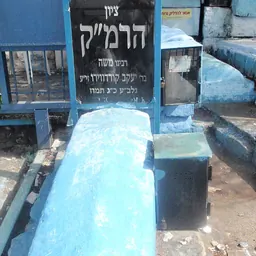
On April 26, 2025, Vital's grave was dug up and desecrated by vandals.
Don’t just read it —
keep it.
Full-length biographies made to live with: read them, listen on the way to work, watch them tonight.
- E-book
- Audio
- Video
Instant download · yours to keep · every purchase keeps this site free
Important facts
more
Ḥayyim ben Yosef, Moharḥaṿ, Calabrese, Harḥaṿ, Maharḥaṿ, MarḥaṿPeople in Hayyim ben Joseph Vital's life
Named in this biography and alive at the same time




Related people
Same field, nearest in time

Contemporaries
People whose lives overlapped Hayyim ben Joseph Vital's


Frequently asked questions
Who was Hayyim ben Joseph Vital?
Rabbi and kabbalist (1542-1620)
When was Hayyim ben Joseph Vital born?
Hayyim ben Joseph Vital was born in 1542 in Safed.
When did Hayyim ben Joseph Vital die?
Hayyim ben Joseph Vital died on 23 April 1620 in Damascus.
What was Hayyim ben Joseph Vital's occupation?
Hayyim ben Joseph Vital was a rabbi, kabbalist, author and scholar.
What nationality was Hayyim ben Joseph Vital?
Hayyim ben Joseph Vital was Turkish.
Sources & further reading
· Wikipedia: Hayyim ben Joseph Vital
· DBpedia: Hayyim ben Joseph Vital
Cite this page
APA: Biography.guide. (2026). Hayyim ben Joseph Vital. https://biography.guide/hayyim-ben-joseph-vital/
MLA: "Hayyim ben Joseph Vital." Biography.guide, https://biography.guide/hayyim-ben-joseph-vital/.
Chicago: "Hayyim ben Joseph Vital." Biography.guide. https://biography.guide/hayyim-ben-joseph-vital/.
Data last updated: 2026-09-20 · Spot an error? Report a correction.
Page generated 2026-09-27 04:59 UTC