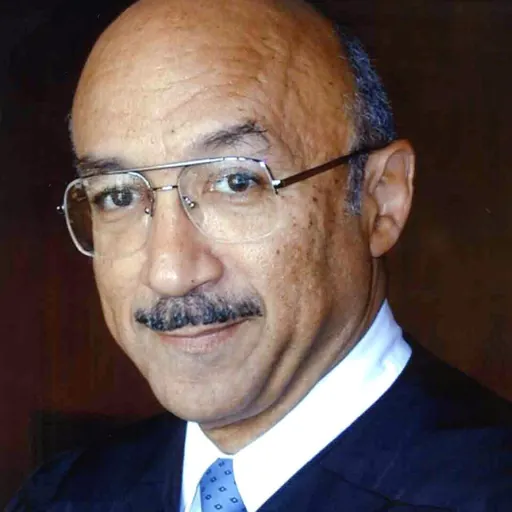
About Harry T. Edwards
Born 1940. Harry T. Edwards is an American lawyer and judge.
Harry Thomas Edwards (born November 3, 1940) is an American lawyer and jurist serving as a senior United States circuit judge of the United States Court of Appeals for the District of Columbia Circuit. He is also a professor of law at the New York University School of Law. Edwards was appointed to the D.C. Circuit in 1980 by President Jimmy Carter and served as its chief judge from 1994 to 2001. He assumed senior status in 2005.
Early life and education
Edwards was born on November 3, 1940, in New York City, the oldest of three children born to Arline Ross Edwards and George H. Edwards. His parents were divorced in 1950 and Edwards and his two sisters, Verne Debourg and Pamela Matthews, were raised by their mother. From 1952 to 1953, his mother attended Smith College, where she earned a Master's degree in social work. While his mother was away, Edwards lived with his grandparents, in the Harlem section of Manhattan. When his mother returned, the family moved to Long Island, where Edwards attended Uniondale High School and was president of the first graduating class.
Edwards received a Bachelor of Science degree from Cornell University in 1962 and a Juris Doctor from the University of Michigan Law School in 1965. When he graduated from Michigan, he was the only African American (law student or member of the faculty) in the law school. his stepmother, Esther Gordy Edwards, a senior vice president at Motown Record Company; and Berry Gordy, Jr., the founder of Motown Record Company.
Professional career: 1965–1980
Despite his very strong academic record in law school, Edwards had difficulty finding a job in the legal profession because he was black. Every major law firm to which he applied openly rejected him because of his race. It was only after Professor Russell Smith, his mentor at Michigan, interceded on his behalf that he was hired at Seyfarth, Shaw, Fairweather & Geraldson. He worked with the firm in Chicago from 1965 to 1970, specializing in labor law and collective bargaining.
In 1970, Edwards joined the faculty of the University of Michigan Law School and became the first African American to teach there. His teaching and scholarship focused on labor law, collective bargaining, labor law in the public sector, employment discrimination, arbitration, negotiations, and higher education and the law. In 1974, he and his then-wife Becky, and their children, Brent and Michelle, traveled to Brussels, Belgium, where Edwards was a Visiting Professor of Law at the Free University of Brussels. In 1975, Edwards accepted an invitation to visit at Harvard Law School. He was a Visiting Professor of Law at Harvard Law School during the 1975–76 school year and then accepted a tenured position on the law school faculty in 1976. During this period, he co-authored a book on Higher Education and the Law, which was a major shift in his academic work. In the spring of 1977, Edwards and his family returned to Ann Arbor, Michigan, where he rejoined the faculty of the University of Michigan Law School. In 1980, Edwards was the co-author of four different casebooks (the only legal scholar in the country at the time to achieve the feat).
In 1977, Edwards was nominated by President Carter and confirmed by the Senate to serve on the Board of Directors of Amtrak. He resigned his position with Amtrak when he was appointed to the United States Court of Appeals for the District of Columbia Circuit in 1980. From 1970 until 1980, Edwards served as neutral labor arbitrator on a number of major company and union arbitration panels; To address this situation, the President established merit selection panels to identify and recommend highly qualified female and minority attorneys for appointment to the federal bench. In 1979, the judicial selection panel for the United States Court of Appeals for the District of Columbia Circuit sent nine names to then-Attorney General Griffin Bell. From that list, President Carter nominated Patricia Wald, Abner Mikva, and Edwards to serve on the court. Ruth Bader Ginsburg was later nominated when an additional opening arose on the D.C. Circuit. Edwards was nominated by the President on December 6, 1979, to a seat vacated by Judge David L. Bazelon, and confirmed by the United States Senate on February 20, 1980, and he received his judicial commission on February 20, 1980. He was 39 years old when he joined the court, reputedly the youngest federal court of appeals judge sitting at the time. oversaw a complete reorganization of the Clerk's Office and Legal Division; implemented case management programs that helped to cut the court's case backlog and reduce case disposition times; successfully pursued congressional support for the construction of the William B. Bryant Annex to the E. Barrett Prettyman U.S. Courthouse; presided over the court's hearings in United States v. Microsoft; established programs to enhance communications with the lawyers who practice before the court; and received high praise from members of the bench, bar, and press for fostering collegial relations among the members of the court. He assumed senior status on November 3, 2005. Three other articles, "Collegial Decision Making in the U.S. Courts of Appeals" (July 2017); Edwards & Livermore, "The Pitfalls of Empirical Studies That Attempt to Understand the Factors Affecting Appellate Decisionmaking", 58 Duke L.J.1895 (2009); and "The Effects of Collegiality on Judicial Decision Making", 151 U. Pa. L. Rev. 1639 (May 2003), explain how appellate judges decide cases and refute the claim that the personal ideologies and political leanings of court of appeals judges are crucial determinants in their decision-making.
In the 2017 paper, In 2017, he amplified some of his thoughts on racial bias in a paper entitled “Reflections on Racial Stigmas and Stereotyping.”
Work with the National Academy of Sciences
In 2006, Edwards was appointed by the United States National Research Council at the National Academy of Sciences to serve as co-chair of the Committee on Identifying the Needs of the Forensic Science Community. The report said that rigorous and mandatory certification programs for forensic scientists were lacking, as were strong standards and protocols for analyzing and reporting on evidence. The report also indicated that there was a dearth of peer-reviewed, published studies establishing the scientific bases and reliability of many forensic methods and that many forensic science labs were underfunded, understaffed, and had no effective oversight.
Edwards also served on the Committee on Science, Technology, and Law at the National Academy of Sciences from 2013 to 2018. In 2016, he served as co-chair of the Senior Advisors to the President’s Council of Advisors on Science and Technology, which published a “Report to the President – Forensic Science in Criminal Courts: Ensuring Scientific Validity of Feature-Comparison Methods” (2016). From 2009 to 2018, Edwards wrote a number of papers and spoke out regularly in favor of reform in the forensic science community. In April 2019, the Judge received the Innocence Network Champion of Justice Award on behalf of the Committee on Identifying the Needs of the Forensic Science Community at the National Academy of Sciences. The award honors those who support efforts to reform the criminal justice system and prevent wrongful convictions.
Professional activities
Edwards is a member of the American Academy of Arts and Sciences; the Board of Directors, Institute for Judicial Administration, NYU School of Law; and a fellow of the American Bar Foundation. He was selected by William & Mary School of Law to receive their 2015 Marshall-Wythe Medallion, the highest honor conferred by the law faculty, recognizing members of the legal community who have demonstrated exceptional accomplishment in law; the Groat Alumni Award from Cornell University; the Society of American Law Teachers Award (for "Distinguished Contributions to Teaching and Public Service"); and he has received a number of honorary degrees. He has a son, Brent, who is a professor of comparative literature at Columbia University, a daughter, Michelle, and four grandchildren.
Selected works Books
Harry T. Edwards & Linda A. Elliott, Federal Standards of Review (3d ed. 2018).
Articles
Don’t just read it —
keep it.
Full-length biographies made to live with: read them, listen on the way to work, watch them tonight.
- E-book
- Audio
- Video
Instant download · yours to keep · every purchase keeps this site free
Important facts
People in Harry T. Edwards's life
Named in this biography and alive at the same time




Related people
Same field, nearest in time



Contemporaries
People whose lives overlapped Harry T. Edwards's


Frequently asked questions
Who is Harry T. Edwards?
United States federal judge
When was Harry T. Edwards born?
Harry T. Edwards was born on 3 November 1940 in New York City.
What is Harry T. Edwards's occupation?
Harry T. Edwards is a lawyer and judge.
What nationality is Harry T. Edwards?
Harry T. Edwards is American.
Sources & further reading
Cite this page
APA: Biography.guide. (2026). Harry T. Edwards. https://biography.guide/harry-t-edwards/
MLA: "Harry T. Edwards." Biography.guide, https://biography.guide/harry-t-edwards/.
Chicago: "Harry T. Edwards." Biography.guide. https://biography.guide/harry-t-edwards/.
Data last updated: 2026-09-20 · Spot an error? Report a correction.
Page generated 2026-09-27 05:10 UTC