Harry Raymond Eastlack
American medical patient
About Harry Raymond Eastlack
Lived 1933 – 1973 (aged 39). Harry Raymond Eastlack was an American, known for Fibrodysplasia ossificans progressiva.
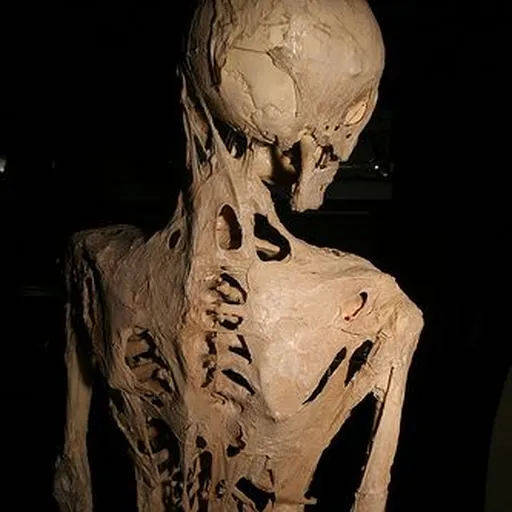
Harry Raymond Eastlack, Jr. (17 November 1933 – 11 November 1973) was an American man who became the subject of the most recognized cases of fibrodysplasia ossificans progressiva (FOP), a disease characterized by the ossification of fibrous connective tissue. His case is also particularly acknowledged, by scientists and researchers, for his contribution to medical advancement. After living with a rare, debilitating, and currently incurable genetic disease, Eastlack decided to have his skeleton and medical history donated to the Mütter Museum of the College of Physicians of Philadelphia in support of FOP research. His skeleton is one of the few FOP-presenting, fully articulated ones in existence, and it has proved valuable to the study of the disease.
As is characteristic of FOP patients, Eastlack did not demonstrate any possible sign of a disease at birth except for a malformation of the big toes. At the time it was not recognized as the first clinical sign of FOP. It was not until 1937 when the first heterotopic ossification symptom surfaced. By the time of his death, Eastlack's skeleton bore sheets of bone along the vertebrae that fused to and locked his skull, and branches of bone along his limbs, which immobilized his shoulders, elbows, hips, and knees. He died in Philadelphia of bronchial pneumonia six days before his 40th birthday. When he was three or four years old, in 1937, while playing with his sister Helene, on a local street, a car hit him and injured his leg. When he was taken to the hospital with this concern, the doctor took X-rays in which the bony deposits on his thigh muscles were revealed.
Eastlack's case of FOP progressed at a more rapid rate due to the number of intrusive surgeries he underwent. In 1948, at the age of 15, his jaw had become fused so he could no longer eat solid food and had to speak through clenched teeth. At a young age, he faced difficulty sitting down, as well. His hips were one of the first anatomical parts to become immobilized due to heterotopic ossification. Soon, bone formed across his upper arms and extended onto his sternum, tying his arms to his breast. Sheets of bone spread along his back and ribbons of bone extended from there to his skull, inhibiting proper head movement. The new bone growths throughout the years also caused juts of bone to form on his pelvis and thighs, and it caused both of his feet to become clubbed. As he approached the later stages of his life, he required assistance to stand and used a cane to be able to shuffle. During his time there, he broke his right leg, and the broken leg healed at an extremely odd angle. He spent the last years of his life being permanently disabled and bedridden and in severe and constant pain. He eventually developed bronchial pneumonia from the physical inactivity of his body. Due to the ossification of his ribs, his lungs could only expand very little, and this made it almost impossible for him to even cough. The International FOP Association is also granted Eastlack's skeleton for displaying and informational purposes in medical meetings and international FOP symposia, which physicians, researchers, and patients attend. After seeing his skeleton at this event, fellow FOP patient Carol Orzel decided to also donate her body to the museum. She died in February 2018, and in February 2019, her skeleton was put on display next to his.
Mentions in culture In the 2009 film inspired by Edgar Allan Poe's "The Tell-Tale Heart", Tell-Tale, Eastlack is mentioned and referred to as Harry Erlich. The mention occurs in a scene where characters are in a museum, and a skeleton is referred to. The scene provides some genuine facts, such as how Eastlack's skeleton does not require any wiring or glue to be held together in the museum because the fused bones hold it all in one piece.
Don’t just read it —
keep it.
Full-length biographies made to live with: read them, listen on the way to work, watch them tonight.
- E-book
- Audio
- Video
Instant download · yours to keep · every purchase keeps this site free
Important facts
People in Harry Raymond Eastlack's life
Named in this biography and alive at the same time


Contemporaries
People whose lives overlapped Harry Raymond Eastlack's




Frequently asked questions
Who was Harry Raymond Eastlack?
American medical patient (1933–1973)
When was Harry Raymond Eastlack born?
Harry Raymond Eastlack was born on 17 November 1933 in Philadelphia.
When did Harry Raymond Eastlack die?
Harry Raymond Eastlack died on 11 November 1973.
What was Harry Raymond Eastlack known for?
Harry Raymond Eastlack was known for Fibrodysplasia ossificans progressiva.
What nationality was Harry Raymond Eastlack?
Harry Raymond Eastlack was American.
Sources & further reading
· Wikipedia: Harry Raymond Eastlack
· DBpedia: Harry Raymond Eastlack
Cite this page
APA: Biography.guide. (2026). Harry Raymond Eastlack. https://biography.guide/harry-raymond-eastlack/
MLA: "Harry Raymond Eastlack." Biography.guide, https://biography.guide/harry-raymond-eastlack/.
Chicago: "Harry Raymond Eastlack." Biography.guide. https://biography.guide/harry-raymond-eastlack/.
Data last updated: 2026-09-23 · Spot an error? Report a correction.
Portrait: Wikimedia Commons · author & licence
Page generated 2026-09-27 05:05 UTC