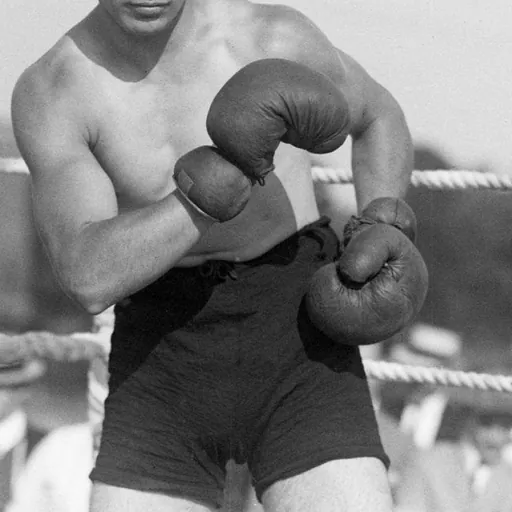
About Harry Greb
Lived 1894 – 1926 (aged 32). Harry Greb was an American boxer.
Fighting style
Greb had a highly aggressive swarming style of fighting, aided by quick movement and notable toughness. He also used dirty fighting tactics, including spinning his opponent and using the heel and laces of his gloves. Greb suffered several injuries in his career, including blindness in one eye. Greb suffered only 2 TKO losses in his career. The first was in his seventh fight when he was knocked out by Joe Chip, who heavily outweighed him; the second happened two years later when Greb broke the radius of his left arm against Kid Graves. Greb finished the round but was unable to continue the fight.
Professional career Harry Greb was born as Edward Henry Greb to a German immigrant father and mother of German descent, Pius and Annie Greb, who raised him in a working-class household. Greb began his professional boxing career in 1913 under manager James "Red" Mason, fighting mostly around his hometown of Pittsburgh. By 1915, he was fighting world-class opposition, notably Hall of Famer Tommy Gibbons and reigning middleweight champion George Chip, whom he faced twice during 1915–1916 in non-title fights. Greb would lose both fights by "newspaper" decision, which he would later avenge.
Greb would fight 37 times in 1917 (a record), winning 34 of those fights either officially or unofficially. Among his defeated opponents that year were the reigning light heavyweight champion Battling Levinsky (in a non-title fight), former light heavyweight champion Jack Dillon, middleweight George Chip and heavyweight Willie Meehan, who had beaten future heavyweight champion Jack Dempsey earlier in the year.
Despite all these results, Greb was still denied a chance to fight for a title. A February 1918 newspaper draw against Mike O'Dowd, who would go on to win the middleweight title during the year, and a newspaper loss to Billy Miske did not help in his effort. Greb would win his next 52 fights in a row. During that stretch, he beat future light heavyweight champion Mike McTigue, heavyweight contenders Billy Miske, Mike Gibbons, Bill Brennan, Jeff Smith, and Leo Houck 3 times each, and Battling Levinsky no less than four times during that stretch (6 times altogether) in newspaper decisions. Levinsky was the reigning light heavyweight champion at the time.
Vision problems In 1921, during a fight with light heavyweight Kid Norfolk, he was thumbed in the right eye, which is believed to have resulted in a retinal tear. The injury would eventually lead to permanent blindness. Greb won via a ten-round newspaper decision and was eligible to fight for the middleweight title. It is commonly believed that Greb completely lost sight in the eye after his fifth bout with Bob Roper, after which it took almost two months to recover. He was seen in a hospital with patches over both eyes. He kept the injury a secret from all but his wife and closest friends, fooling physicians during pre-fight physicals by memorizing the order of the letters on the eye chart (Greb would later lose some vision in his left eye and his gradual loss of sight led him to always go to bed with the light on).
After defending his title against Tommy Loughran, Greb granted Tunney a rematch. In a hotly disputed battle at Madison Square Garden in February 1923, Tunney regained his title by a highly controversial split decision. Multiple eyewitness reports state that Greb controlled the fight and battered Tunney, cutting and rocking him from punches on more than one occasion. But Tunney could fight back, unlike in the first encounter, and at some points, was competitive with Greb. The crowd booed heavily when Tunney was announced as the winner.
Greb and Tunney would meet three more times, with Tunney successfully defending his regained title in another fifteen-round about and then fighting to a no-decision newspaper draw, wherein most newspapers reported Greb the winner. Referee Matt Hinkel stated he would have ruled a draw, so the record books have it that way. The fifth battle was reminiscent of the first fight in their series, except this time, it was Tunney bludgeoning Greb for the duration of the bout. According to Tunney, near the end of the match, while the two fighters were locked in a clinch, Greb straightforwardly asked Tunney not to knock him out. Tunney reputedly consented to this request and later acknowledged the incident as the highest tribute he received in his career, stating, "Here was one of the greatest fighters of all time laying down his shield, admitting defeat and knowing I would not expose him."
Middleweight champion One month after losing his light heavyweight title to Tunney, Greb set his sights on middleweight champion Johnny Wilson; however, when Wilson's manager Marty Killelea refused to offer him the bout, Greb paid a few speakeasy servers in Pittsburgh and New York to serve him water in coloured tumblers and then feigned intoxication in a highly theatrical spectacle. When Killelea witnessed one of these performances, he assumed Greb was ripe for the taking and arranged for the bout to take place. On August 31, 1923, Greb faced Wilson for the world middleweight title, winning a 15-round decision. When referee Jack O'Sullivan stepped in to separate the fighters during a rough clinch, he asked Greb what he thought he was doing. Greb responded, "Gouging Johnny in the eye, can't you see?" During the first few rounds of the battle, Walker came out attacking Greb to the body as the defending champion tried to stave off cramps in both his legs. The middle rounds saw Greb starting to relax and control the pace of the bout while Walker could still land some eye-catching combinations. Greb took control during the championship round, and Greb was awarded a unanimous decision by the judges and retained the championship.
Later career At 32, a waning Greb was years past his best when he was matched with tricky southpaw Tiger Flowers (who was 31 at the time) in Madison Square Garden in February 1926. Flowers, a defensive specialist, countered Greb's attacks well and won a disputed decision after fifteen rounds to take Greb's middleweight title.
Retirement and death Greb retired following the second Flowers loss and relayed to a friend that he planned on opening a gym in downtown Pittsburgh. In September 1926, his right eye was removed and replaced with a glass prosthesis. However, complications occurred, and he died of heart failure on October 22, 1926, at 2:30 pm. In 1919 alone, he fought 45 fights and went 45–0, which is a record for the most victories in a single calendar year, and an achievement that is unlikely to be recreated by contemporary boxers due to changes in the sport.
Accolades
Greb was enshrined in The Ring magazine Hall of Fame in 1955, Pennsylvania Boxing Hall of Fame in 1958, Western Pennsylvania Sports Hall of Fame in 1970, the World Boxing Hall of Fame in 1980, and the International Boxing Hall of Fame as a first-class inductee in 1990. The Sporting News recognized Greb as the Fighter of the Decade for the 1920s.
Greb is ranked by BoxRec as the fourth greatest fighter of all time, pound for pound. the fourth greatest fighter of all time by historian and boxing commentator Max Kellerman and ranked as the #1 middleweight, the #13 light heavyweight, and the #2 pound-for-pound fighter of all time by the International Boxing Research Organization (IBRO) in 2006. In another poll by IBRO in 2019, Greb was ranked once again as the #1 middleweight, the #9 light heavyweight, and the #3 pound-for-pound fighter of all time.
Professional boxing record All information in this section is derived from BoxRec, unless otherwise stated.
Official record
All newspaper decisions are officially regarded as "no decision" bouts and are not counted in the win/loss/draw column.
Unofficial record
Record with the inclusion of newspaper decisions in the win/loss/draw column.
Titles in boxing Major world titles NYSAC middleweight champion (160 lbs) NBA (WBA) middleweight champion (160 lbs)
The Ring magazine titles The Ring middleweight champion (160 lbs)
Regional/International titles American light heavyweight champion (175 lbs)
Undisputed titles Undisputed middleweight champion
Don’t just read it —
keep it.
Full-length biographies made to live with: read them, listen on the way to work, watch them tonight.
- E-book
- Audio
- Video
Instant download · yours to keep · every purchase keeps this site free
Important facts
People in Harry Greb's life
Named in this biography and alive at the same time



Related people
Same field, nearest in time


Contemporaries
People whose lives overlapped Harry Greb's


Frequently asked questions
Who was Harry Greb?
American boxer (1894–1926)
When was Harry Greb born?
Harry Greb was born on 6 June 1894 in Pittsburgh.
When did Harry Greb die?
Harry Greb died on 22 October 1926 in Atlantic City.
What was Harry Greb's occupation?
Harry Greb was a boxer.
What nationality was Harry Greb?
Harry Greb was American.
Sources & further reading
Cite this page
APA: Biography.guide. (2026). Harry Greb. https://biography.guide/harry-greb/
MLA: "Harry Greb." Biography.guide, https://biography.guide/harry-greb/.
Chicago: "Harry Greb." Biography.guide. https://biography.guide/harry-greb/.
Data last updated: 2026-09-21 · Spot an error? Report a correction.
Portrait: Wikimedia Commons · author & licence
Page generated 2026-09-27 05:01 UTC