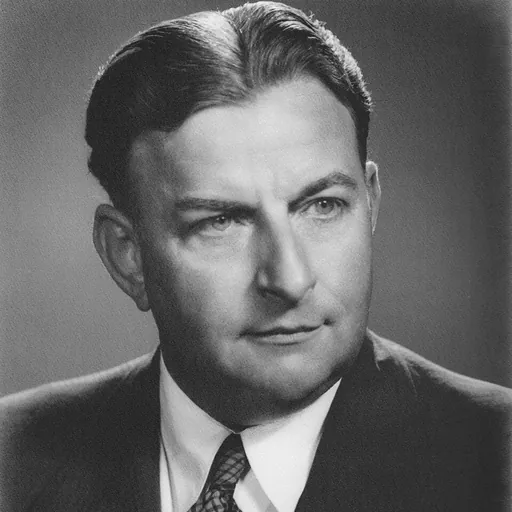
About Harry G. Garland
Lived 1899 – 1972 (aged 72). Harry G. Garland was an American businessperson.
Harry George Garland (November 28, 1899 – June 18, 1972) was founder and president of Garland Manufacturing Company in Detroit, Michigan, a company that he founded in 1935. As a result of his contributions to the production of equipment for the armed forces during World War II, he was recognized as one of the leaders of wartime Michigan. He sold Garland Manufacturing in 1947 and turned to a career of rescuing financially distressed companies, often as a court-appointed bankruptcy receiver. His receiverships included the Anker-Holth Manufacturing Co., Richmond & Backus Co., D. J. Healy Shops, Rocky River Paper Mill, and the F.L. Jacobs Company. Mr. Garland also served on the Macomb County, Michigan Board of Supervisors for almost 20 years. The Garland Lodge and Resort in Lewiston, Michigan, is named after him.
Early career Garland Manufacturing Company on Gratiot Avenue in Detroit, Michigan (c. 1945)
Harry G. Garland learned the trade of tool and die making in the factories of Chicago and Detroit. In 1917 he began his apprenticeship at the American Can Company in Chicago, and worked there for four years. Seeing the opportunities in Michigan, where the automobile industry was in full swing, he moved to Detroit in 1921 to join the Studebaker Company as a journeyman, and in 1923 he moved on to the Chrysler Corporation where he rose to the position of master mechanic at the former Maxwell automobile plant. The Marina was distinguished by the railroad system designed and constructed by Garland for transporting deep-keeled boats from the water to the storage areas and back.
Harry Garland sold Garland Manufacturing Company in 1947 to Herman Otto. Otto developed land owned by Garland Manufacturing in Lewiston, Michigan, into a major resort which opened in 1951. The resort was named after Harry Garland – the Garland Lodge and Resort. The bankruptcy of the F.L. Jacobs Company was described as “the nation's fourth largest corporate financing scandal of recent years”. The F.L. Jacobs Company had manufacturing plants in Michigan and a lavish New York office that Judge Thornton characterized as "a cesspool of violations".
As Garland and Pleiderer took on the task of untangling the convoluted financial affairs of the F. L. Jacobs Co., Harry Garland assumed the presidency of the two operating units of the company: Grand Rapids Metalcraft Corp. (which had been acquired by F.L. Jacobs in 1936) and Continental Die Casting Corp. At the end of 1959 the Detroit News reported that the losses of these two companies had been cut substantially, and by early 1960 Garland reported that the companies were running "in the black".
While operating Grand Rapids Metalcraft and Continental Die Casting profitably, Garland and Pfleiderer were able to retire the past obligations of the F.L. Jacobs Company and complete the reorganization. In seven years Garland and Pfleiderer took F.L. Jacobs, with a negative net worth of $15.1 million, and returned it to viability. The court, in its final ruling, heaped praise on Harry G. Garland and Arthur B. Pfleiderer noting that Grand Rapids Metalcraft Corp. and Continental Die Casting Corp. had been restored to "leaders in their fields".
As F.L. Jacobs emerged from bankruptcy, Garland was appointed as chairman of the company. Garland continued in this position until 1971 when he resigned the chairmanship in order to, as the Wall Street Journal reported, "turn the reins over to a younger man."
Other businesses Harry G. Garland with management of Anchor Steel and Conveyor Company in 1965: Ade Czarnecki (Chief Engineer), Harry Garland (President), Marshall Brenner (Vice President and General Manager), Ted Hegelman (Sales Manager).
During the 1960s Harry Garland also served as president of Anchor Steel and Conveyor Company in Dearborn, Michigan. At this company Garland completed the design, construction, and installation of a sophisticated conveyor system that transported huge crowds of visitors through General Motors' Futurama exhibit at the 1964 New York World's Fair. Garland's conveyor system carried 1400 seated visitors simultaneously through the Futurama diorama on a 15-minute ride through scenes of the Antarctic, the moon, the ocean floor, the jungle, mountains, desert, and the urban community of the future. The ride did not need to pause for passenger loading and unloading, as visitors boarded and exited from moving walkways synchronized precisely with the speed of the moving seats. During the course of the World's Fair nearly 26 million visitors were transported by this system. It was the Fair's most popular attraction.
Throughout the 1950s and 1960s, over and above his other corporate responsibilities, Harry Garland served as the representative in the Detroit area for Lake Shore, Inc., a manufacturing company in Michigan's Upper Peninsula. He was credited with establishing Lake Shore, Inc. as a major sub-contractor to the automotive industry.
Personal life
Garland was born in Joliet, Illinois, on November 28, 1899.
In 1952 the City of Detroit took possession of Garland's property by eminent domain to convert it into a park, and Garland moved to Grosse Pointe Shores in Lake Township. He built his home at Gaukler Point on the shore of Lake St. Clair and constructed a seaplane ramp from which he operated his Piper PA-18 "Super Cub" floatplane. As Township Supervisor he was a member of the Macomb County Board of Supervisors for nearly 20 years, and served as Chairman of the Airport Committee.
Garland and his wife Rose had three children: Harry (b. 1947), Judy (b. 1949), and Carol (b. 1951).
Don’t just read it —
keep it.
Full-length biographies made to live with: read them, listen on the way to work, watch them tonight.
- E-book
- Audio
- Video
Instant download · yours to keep · every purchase keeps this site free
Important facts
Family & relationships
People in Harry G. Garland's life
Named in this biography and alive at the same time

Related people
Same field, nearest in time
Contemporaries
People whose lives overlapped Harry G. Garland's



Frequently asked questions
Who was Harry G. Garland?
American businessman
When was Harry G. Garland born?
Harry G. Garland was born on 28 November 1899 in Joliet.
When did Harry G. Garland die?
Harry G. Garland died on 18 June 1972 in Detroit.
What was Harry G. Garland's occupation?
Harry G. Garland was a businessperson.
What nationality was Harry G. Garland?
Harry G. Garland was American.
Sources & further reading
Cite this page
APA: Biography.guide. (2026). Harry G. Garland. https://biography.guide/harry-g-garland/
MLA: "Harry G. Garland." Biography.guide, https://biography.guide/harry-g-garland/.
Chicago: "Harry G. Garland." Biography.guide. https://biography.guide/harry-g-garland/.
Data last updated: 2026-09-23 · Spot an error? Report a correction.
Portrait: Wikimedia Commons · author & licence
Page generated 2026-09-27 05:06 UTC