
About Harrison Birtwistle
Lived 1934 – 2022 (aged 87). Harrison Birtwistle was a British composer, music educator, film score composer and musician.
Sir Harrison Birtwistle (15 July 1934 – 18 April 2022) was an English composer of contemporary classical music best known for his operas, often based on mythological subjects. Among his many compositions, his better known works include The Triumph of Time and the operas The Mask of Orpheus (1986), Gawain (1991), and The Minotaur (2008). The last of these was ranked by music critics at The Guardian in 2019 as the third-best piece of the 21st century. Even his compositions that were not written for the stage often showed a theatrical approach. A performance of his saxophone concerto Panic during the BBC's Last Night of the Proms caused "national notoriety". Much of his youth was spent roaming the countryside near his home, and his frustration with the disruption of the nature by modern technology would affect his later work profoundly. Other youthful activities included the construction of amateur theatrical sets, and the subsequent imagining of dramas taking place inside them. Birtwistle became proficient enough to play in the local military-style band and also played in the orchestra that accompanied Gilbert and Sullivan productions and the local choral society's performances of Handel's Messiah. From around this time Birtwistle first composed, later describing his early pieces as "sub-Vaughan Williams".
In 1952 he entered the Royal Manchester College of Music in Manchester on a clarinet scholarship. While there he came in contact with contemporaries including Peter Maxwell Davies, Alexander Goehr, the pianist John Ogdon, and the trumpeter Elgar Howarth.
Composing career Birtwistle served as director of music at Cranborne Chase School from 1962 until 1965, before continuing his studies at Princeton University on a Harkness Fellowship, where he completed the opera Punch and Judy to a libretto by Stephen Pruslin. This work, together with Verses for Ensembles and The Triumph of Time, led to greater exposure for Birtwistle in the classical music world. The orchestral work The Triumph of Time, inspired by a woodcut by Pieter Bruegel, premiered in 1972. In 1975, he became musical director of the newly established Royal National Theatre in London, a post he held until 1983. for his epic opera The Mask of Orpheus. The following year, Birtwistle's saxophone concertante work Panic was premiered in the second half of the Last Night of the Proms, as the first piece of contemporary music ever, According to the Daily Telegraph, it met with incomprehension from many viewers.
In 1995, he was awarded the Ernst von Siemens Music Prize. At the 2006 Ivor Novello Awards he criticised pop musicians at the event for performing too loudly and using too many clichés.
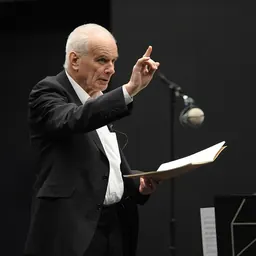
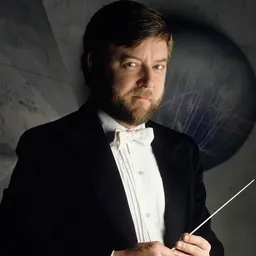
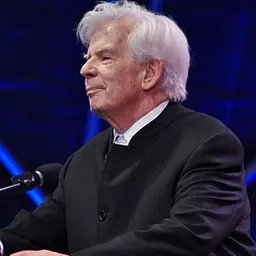
Among the musicians who performed his works are conductors Pierre Boulez, Sir Andrew Davis, Daniel Barenboim, Christoph von Dohnányi, Oliver Knussen but occasionally gave interviews. In 2019, he was interviewed for Composer of the Week on BBC Radio 3. He married Sheila Duff, a singer, in 1958. and Silas, are artists. Sheila died in 2012.
Music Style Birtwistle's music is not categorised as belonging to any particular school or movement. For a time, he was described as belonging to the Manchester School, a phrase invented as a parallel to the Second Viennese School to refer to Birtwistle, Goehr, and Davies.
Even when not creating a visual piece involving stage action, Birtwistle's musical output remained frequently theatrical in conception. The music does not follow the logic and rules of classical forms such as sonata form, but is structured more like a drama. Furthermore, different musical instruments can almost be seen to take the part of different characters in the drama. This is especially apparent in a performance of Secret Theatre (1984). For various portions of the piece, a number of the instrumentalists perform in a soloist capacity. For this, they leave their seat in the ensemble and stand separately, to one side of the ensemble, returning to the group when they are no longer given that role.
Works
Source:
Opera Punch and Judy (1966–1967) The Mask of Orpheus (1973–84) Gawain (1990) The Second Mrs Kong (1993–94) The Last Supper (2000) The Minotaur (2008) The Corridor, chamber opera (2009) The Cure (2014–15)
Other music Refrains and Choruses (1957), wind quintet The Triumph of Time (1971–72), orchestra Silbury Air (1976–77), chamber orchestra Secret Theatre (1984), chamber ensemble Panic (1995), alto saxophone, jazz drum kit and orchestra Theseus Game (2002), large ensemble with two conductors (2002) In Broken Images (2011), large ensemble (after the antiphonal music of Gabrieli) Songs from the Same Earth (2012–13), tenor and piano Responses (2013–14), piano concerto Deep Time (2016), orchestra
Honours and awards 1986 Grawemeyer Award for Music Composition, University of Louisville 1989 Fellowship, Royal Northern College of Music (FRNCM). 1994 Honorary Fellow, Royal Academy of Arts 1995 Ernst von Siemens Music Prize 2007 Foreign Honorary Member, American Academy of Arts and Letters 2015 Wihuri Sibelius Prize 1996 City, University of London, D.Mus. 2008 University of London, D.Mus. 2010 University of Cambridge, D.Mus. 2013 Bath Spa University, Doctorate 2014 University of Oxford, D.Mus. 2014 Edge Hill University, Doctor of Philosophy (PhD)
Don’t just read it —
keep it.
Full-length biographies made to live with: read them, listen on the way to work, watch them tonight.
- E-book
- Audio
- Video
Instant download · yours to keep · every purchase keeps this site free
Important facts
People in Harrison Birtwistle's life
Named in this biography and alive at the same time





Related people
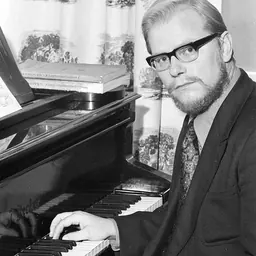
Same field, nearest in time


Contemporaries
People whose lives overlapped Harrison Birtwistle's


Frequently asked questions
Who was Harrison Birtwistle?
English composer (1934–2022)
When was Harrison Birtwistle born?
Harrison Birtwistle was born on 15 July 1934 in Accrington.
When did Harrison Birtwistle die?
Harrison Birtwistle died on 18 April 2022 in Mere.
What was Harrison Birtwistle's occupation?
Harrison Birtwistle was a composer, music educator, film score composer and musician.
What nationality was Harrison Birtwistle?
Harrison Birtwistle was British.
Sources & further reading
· Wikipedia: Harrison Birtwistle
· DBpedia: Harrison Birtwistle
Cite this page
APA: Biography.guide. (2026). Harrison Birtwistle. https://biography.guide/harrison-birtwistle/
MLA: "Harrison Birtwistle." Biography.guide, https://biography.guide/harrison-birtwistle/.
Chicago: "Harrison Birtwistle." Biography.guide. https://biography.guide/harrison-birtwistle/.
Data last updated: 2026-09-20 · Spot an error? Report a correction.
Page generated 2026-09-27 05:31 UTC